
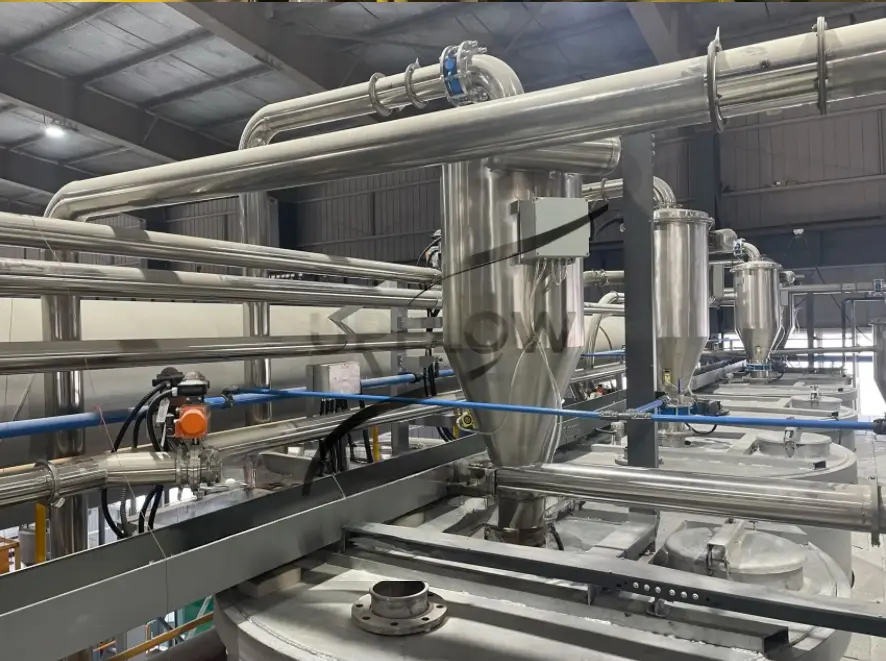
A pneumatic conveying system is an industrial material handling solution that uses airflow as the driving force to transport powdered or granular materials through enclosed pipelines. It is also commonly referred to as pneumatic transport.
Based on principles of fluid mechanics and gas-solid two-phase flow theory, the system mixes bulk materials with air to form a controlled gas-solid flow, enabling continuous, automated, and efficient material conveying over short or long distances.
Compared with traditional mechanical conveying methods, pneumatic conveying systems offer higher flexibility, cleaner operation, and better integration with automated production lines.
Basic Working Principle of Pneumatic Conveying Systems
The core working principle of a pneumatic conveying system is to utilize the kinetic energy or pressure difference of airflow to keep materials in a suspended, fluidized, or semi-fluidized state inside the pipeline.
Once the material enters the conveying line, it is transported from the feeding point to the discharge point along the direction of airflow, without direct mechanical contact between moving parts and the material.
Depending on the system design and application requirements, pneumatic conveying systems can be classified according to pressure mode and material flow characteristics.
Classification by Pressure Mode
Positive Pressure Pneumatic Conveying System
A positive pressure pneumatic conveying system uses a Roots blower or air compressor to generate compressed air at a pressure higher than atmospheric pressure. The airflow “pushes” the material through the pipeline to the destination.
Key features:
Suitable for long-distance and large-capacity conveying
Commonly applied in cement plants, power plants, and fly ash handling systems
Capable of conveying material from one source to multiple discharge points
A typical application is transporting fly ash from a power plant boiler to an ash storage silo.
Vacuum Pneumatic Conveying System
A vacuum pneumatic conveying system creates negative pressure inside the pipeline using a vacuum pump installed at the discharge end. The material is “sucked” into the pipeline from one or multiple feeding points.
Key features:
Ideal for short-distance, small-batch, or multi-point feeding applications
Excellent dust containment, suitable for food, pharmaceutical, and chemical industries
Safer operation when handling hazardous or dusty materials
This system is commonly used for centralized material collection and clean production environments.
Combined Pressure Pneumatic Conveying System
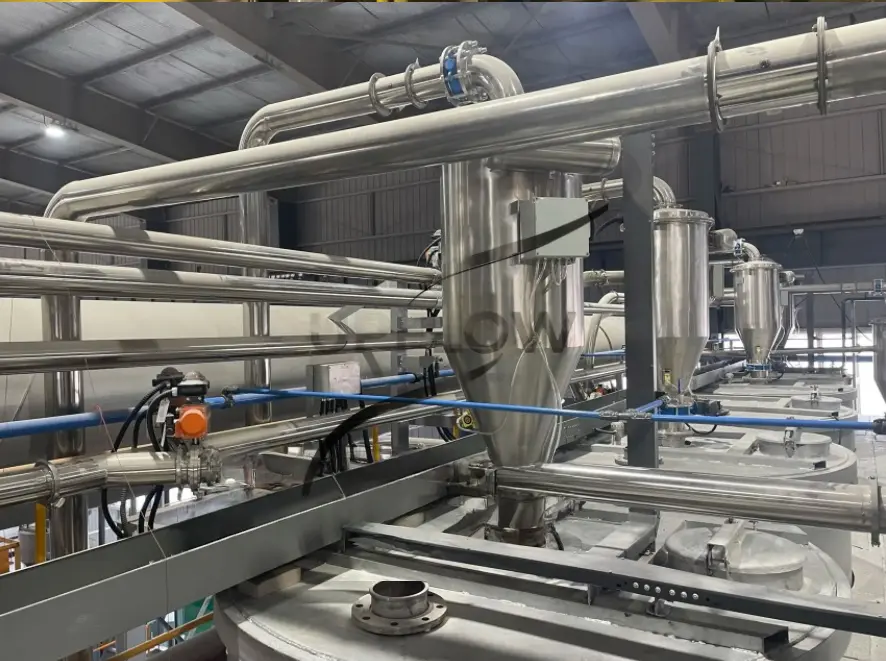
A combined pneumatic conveying system integrates both positive and negative pressure conveying modes. Different pressure states are applied in different pipeline sections to improve efficiency and adapt to specific material characteristics.
This configuration is often used in complex conveying layouts or customized industrial applications.
Classification by Material Flow Characteristics
Dilute Phase Pneumatic Conveying
In a dilute phase pneumatic conveying system, the material concentration is relatively low (typically below 1–10 kg/m³), while the air velocity is high (approximately 15–30 m/s). Materials are fully suspended and conveyed continuously.
Advantages:
Simple system design
Stable conveying process
Limitations:
Higher energy consumption
Increased pipeline wear and material degradation
Dense Phase Pneumatic Conveying
A dense phase pneumatic conveying system operates with a higher material concentration (typically 10–30 kg/m³, or a solid-to-gas ratio greater than 25) and a much lower air velocity (2–8 m/s).
Materials move in a slug, plug, or dune-like flow pattern, offering significant benefits:
Reduced pipeline wear
Lower material breakage
Improved energy efficiency
Better protection of material quality
Dense phase conveying is widely used for abrasive, fragile, or high-value powders.
Typical Process of a Positive Pressure Pneumatic Conveying System
A standard positive pressure pneumatic conveying process for fly ash handling includes the following steps:
Fly ash enters the sending tank
The feed valve closes and the tank is sealed
Compressed air enters the tank to build pressure
The gas-solid mixture is pushed into the conveying pipeline
At the discharge end, a cyclone separator and bag filter separate powder from air
Powder is discharged into the storage silo, while clean air is released.
This process ensures continuous, enclosed, and dust-free material transport.
Applications of Pneumatic Conveying Systems
Pneumatic conveying systems are widely used for handling dry, non-sticky, and non-caking materials, including:
Cement and fly ash
Flour and food powders
Plastic pellets and resin
Chemical and pharmaceutical powders
They are commonly applied in industries such as building materials, power generation, plastics, food processing, chemicals, and pharmaceuticals.
Pneumatic conveying systems are widely used across multiple industries. You can explore real-world use cases in our article Typical Applications of Pneumatic Conveying Systems in Industry.
Advantages and Limitations
Advantages
Long conveying distance and flexible layout
Enclosed system with reduced dust pollution
Easy integration with automated batching, dosing, and mixing systems
Low maintenance for moving mechanical parts
Limitations
Higher energy consumption compared with mechanical conveyors
Pipeline and component wear if improperly designed
Requires professional system design and parameter selection
Proper engineering design and regular maintenance are essential to ensure stable and efficient operation.
Conclusion
A pneumatic conveying system is a highly efficient and flexible solution for modern powder and bulk material handling. By selecting the appropriate conveying mode—positive pressure, vacuum, or dense phase—and optimizing system design, manufacturers can achieve reliable, clean, and automated material transport.
If you are planning a customized pneumatic conveying system for your application, professional system design is the key to long-term performance and cost efficiency.
For companies planning to implement an efficient bulk material handling solution, it is important to select a properly engineered system. Learn more about our Pneumatic Conveying System Solutions designed for various industrial powder and granular material applications.
Looking for a reliable pneumatic conveying system manufacturer? Contact us today for a free consultation and quotation.