
Description
Email: in**@************ry.com
Product Description
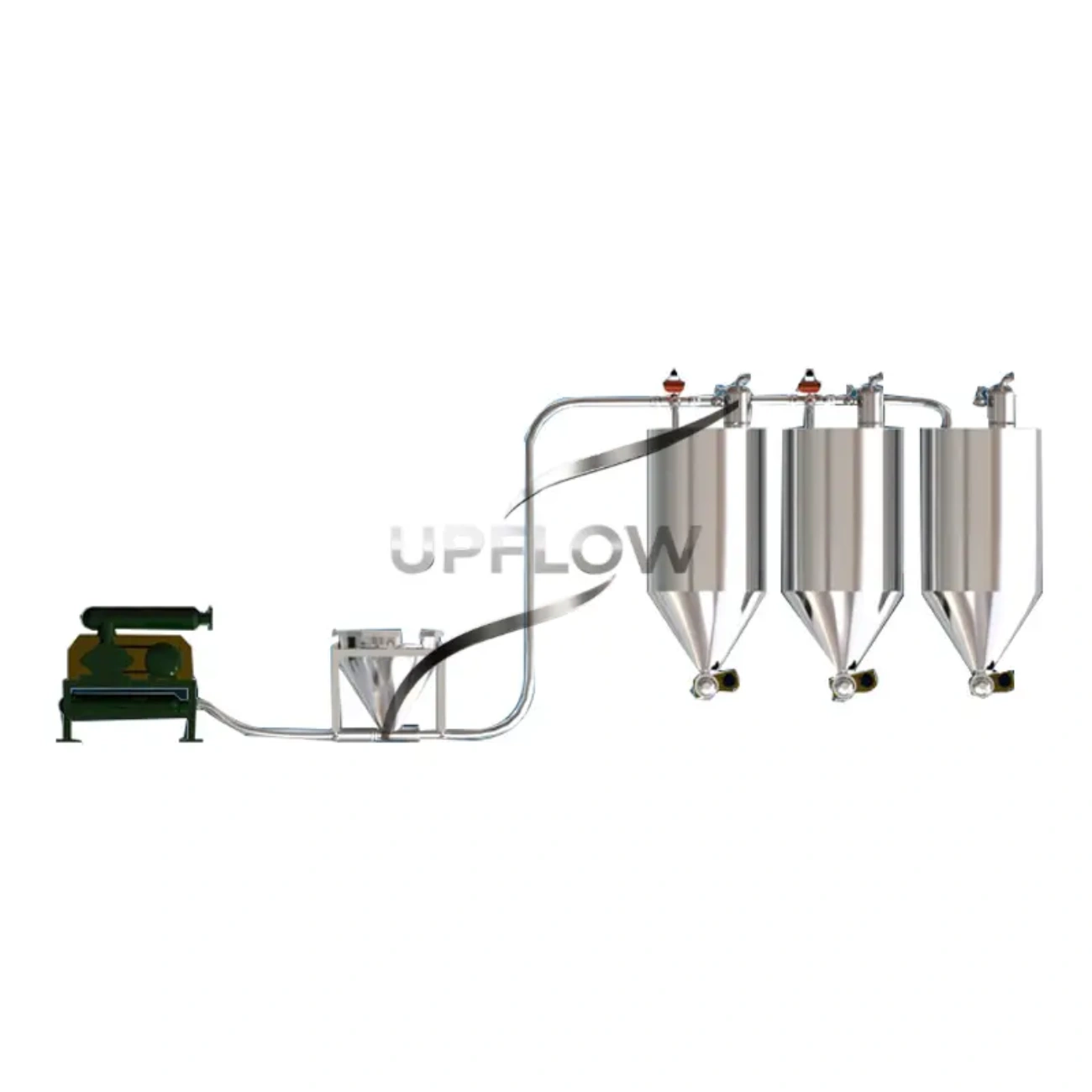
Positive pressure dilute phase, also known as positive pressure airflow conveying system or pneumatic conveying system, is an air-powered material handling solution designed for the continuous conveying of bulk powders and granular materials. The system uses compressed airflow generated by a Roots blower or air blower as the conveying medium, transporting materials through enclosed pipelines to designated downstream equipment.
Materials are introduced into the conveying pipeline via rotary feeders or screw feeders, forming a gas-solid mixture that is conveyed under positive pressure. Depending on material characteristics and operating conditions, the conveying pressure can be adjusted from several kilopascals to several hundred kilopascals to ensure stable and efficient operation.
In dilute phase conveying mode, the system operates at a positive pressure typically below 0.15 MPa, with a gas-to-solid ratio ranging from 5 to 20. Material is conveyed primarily by airflow kinetic energy, making this system suitable for short- to medium-distance pneumatic conveying applications.
System Features
1.Material is conveyed at relatively high velocity (8–25 m/s) using gas dynamic pressure, with conveying pressure gradually decreasing along the pipeline
2.Continuous and stable conveying process with consistent airflow, pressure, velocity, and gas-solid ratio, ensuring high operational reliability
3.Supports multi-point feeding and multi-point discharge, enabling flexible system layouts
4.When used in a closed-loop configuration, no additional air buffering equipment is required, making system control simple and efficient
5.Well-suited for short-distance and medium-distance pneumatic conveying of powders and granular materials
Application Characteristics and Precautions
Positive pressure dilute phase pneumatic conveying is particularly suitable for distributed conveying from one source to multiple discharge points. Since the system operates under positive pressure, even if minor gaps exist at pipeline connections, external air or rainwater will not enter the system, effectively preventing material moisture absorption, contamination, or impurity mixing.
Additionally, the positive pressure design ensures smooth and reliable material discharge at outlet points. However, when a Roots blower is used as the air source, the system pressure has inherent limitations. As a result, conveying capacity and conveying distance cannot be maximized simultaneously, and system parameters must be properly balanced during design.
For special applications—such as petrochemical or explosion-sensitive environments—the system can use nitrogen or carbon dioxide as the conveying gas to enhance safety.
This system is mainly suitable for conveying granular, powdery, and flake materials.
Related Solution: Pneumatic Conveying System
Positive pressure conveying is one of the important technologies within a complete pneumatic conveying system. By using compressed air to transport powders and bulk materials through pipelines, positive pressure conveying systems are suitable for applications requiring long-distance transportation, high conveying capacity, and stable material transfer.
UPFLOW provides customized complete pneumatic conveying system solutions based on material characteristics, conveying distance, production capacity, and process requirements, including positive pressure conveying, vacuum conveying, and integrated powder handling solutions for different industrial applications.
Key Factors Affecting Conveying Efficiency
1.Airflow Velocity
Higher airflow velocity increases conveying efficiency but also significantly raises energy consumption and pipeline pressure loss. Therefore, airflow velocity must be carefully optimized to balance efficiency and energy use.
2.Material-to-Air Ratio
A higher material-to-air ratio generally results in lower energy consumption and more stable conveying. Increasing material concentration reduces the required conveying air volume, improving system efficiency and operational stability.
3.Feeding Rate
Excessive feeding rates require higher conveying pressure. As material feed rate and conveying height increase, the blower must supply greater pressure, highlighting the importance of accurate feeding control and system pressure design.
System Capacity and Performance
UPFLOW’s positive pressure dilute phase pneumatic conveying system features continuous and uniform feeding, an optimized gas-solid ratio for energy saving and consumption reduction, and reliable, safe operation.
Maximum conveying capacity: up to 60 tons/hour (single conveying line)
Maximum conveying distance: up to 400 meters
Optional diverter valves allow one-point feeding with multi-point distribution
Custom Design and Services
UPFLOW provides complete design solutions for positive pressure dilute phase pneumatic conveying systems based on customer material properties, capacity requirements, and site conditions. We also supply complete equipment packages, including electrical control systems, as well as on-site installation and commissioning services.
Product Cases
For detailed project case information:
Calcium Carbonate and Barium Carbonate Positive Pressure Pneumatic Conveying System Project for European Customer
FAQ
1. What is a positive pressure conveying system and how does it work?
A positive pressure conveying system is a pneumatic conveying solution that uses compressed air generated by a blower or compressor to push powders and bulk materials through pipelines from the feeding point to the destination. The system typically includes a feeding device, air source, conveying pipeline, rotary valve, filter system, receiver, and control unit. By controlling air pressure, airflow velocity, and material feeding rate, the system can achieve stable and efficient material transfer. UPFLOW designs customized positive pressure pneumatic conveying systems for industrial applications requiring reliable powder transportation over different distances and capacities.
2. What is the difference between positive pressure conveying and vacuum conveying?
The main difference between positive pressure conveying and vacuum conveying is the airflow direction and operating principle. A positive pressure conveying system pushes materials through pipelines using compressed air, making it suitable for longer conveying distances, higher capacities, and multiple discharge points. A vacuum conveying system draws materials through pipelines using negative pressure and is commonly used for hygienic applications or handling sensitive powders. The selection depends on factors such as material characteristics, conveying distance, capacity requirements, and production conditions. UPFLOW evaluates these factors to provide the most suitable pneumatic conveying solution.
3. When should I choose a positive pressure conveying system?
A positive pressure conveying system is often selected for applications requiring long-distance transportation, high throughput, or continuous material transfer. It is widely used for chemical powders, mineral materials, plastic powders, battery materials, and other bulk materials that need efficient transportation between multiple process points. Positive pressure conveying can also be designed for dense phase conveying, which helps reduce material degradation and is suitable for fragile or abrasive materials. UPFLOW engineers select the appropriate conveying mode based on material properties, production capacity, pipeline layout, and customer process requirements.
4. What materials are suitable for positive pressure pneumatic conveying systems?
Positive pressure pneumatic conveying systems can handle various powders and granular materials, including chemical powders, minerals, food ingredients, plastic materials, and battery-related powders. They are especially suitable for applications requiring stable transportation over longer distances or higher conveying capacity. Material characteristics such as bulk density, particle size, moisture content, flowability, and abrasiveness are important factors when designing the system. UPFLOW analyzes these parameters to determine suitable conveying pressure, airflow conditions, pipeline configuration, and feeding equipment for each customized powder conveying application.
5. Does UPFLOW provide customized positive pressure conveying system design?
Yes, UPFLOW provides customized positive pressure conveying system design based on specific material handling requirements and production conditions. Our engineering team evaluates material characteristics, conveying capacity, pipeline distance, installation layout, and process integration requirements before developing a suitable solution. The system can be customized with different feeding devices, rotary valves, dust collection systems, control systems, and automated material handling equipment. UPFLOW focuses on delivering reliable positive pressure pneumatic conveying solutions for industries including chemical, food, pharmaceutical, and battery material manufacturing.