
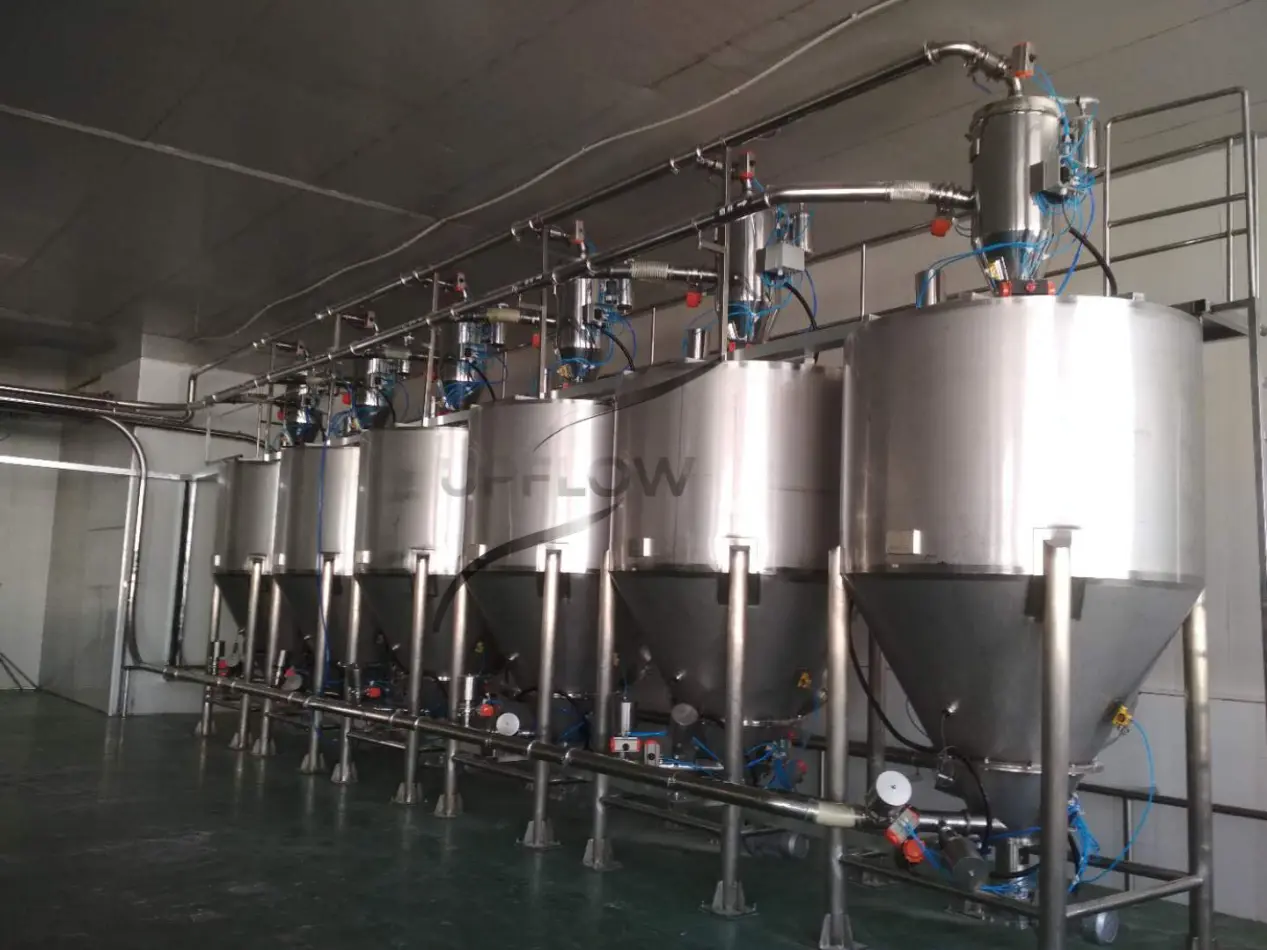
Description
Email: in**@************ry.com
Product Description
UPFLOW’s Vacuum Feeding System(also known as Vacuum Conveying & Pneumatic Conveying System), is a closed-loop material handling solution designed for the clean, efficient, and contamination-free transport of powders and granular materials. By using negative pressure airflow, the system conveys materials through sealed pipelines, effectively preventing moisture absorption, material degradation, and cross-contamination.
This vacuum feeding and pneumatic conveying system supports multiple process operations during conveying, including metering, batching, screening, mixing, magnetic separation, and impurity removal, allowing seamless integration into automated production lines.
With its fully enclosed structure, high-efficiency dust collection, and automated feeding design, the system significantly improves workshop cleanliness while ensuring stable and reliable material transport. Thanks to its flexible pipeline layout, it also helps optimize plant design and overall production efficiency.
The system is widely used in pharmaceutical, food, chemical, battery materials, plastics, and building materials industries, especially in applications requiring high hygiene standards and precise material control.
Vacuum conveying is one of the main technologies used in pneumatic conveying systems. Learn more about our complete Pneumatic Conveying System solutions.
Product Features
Clean and Contamination-Free Conveying
The sealed pipeline design ensures dust-free feeding and leak-free conveying, protecting materials from moisture, damage, and external impurities while maintaining consistent product quality.
Multi-Process Integration
During conveying, the system can simultaneously perform metering, batching, screening, mixing, iron removal, and impurity separation, meeting complex production requirements within a single integrated system.
Improved Workshop Hygiene
Automatic feeding combined with high-precision dust collection units ensures a clean working environment and compliance with strict environmental and hygiene standards.
High Efficiency and Flexible Layout
The system enables efficient bulk material conveying with flexible pipeline routing, supporting rational equipment layout and optimized production processes.
Performance Advantages
Up to 20% Increase in Production Efficiency
A high degree of automation reduces manual intervention, saves time and labor, and significantly improves overall production efficiency.
Up to 20% Reduction in Labor Costs
Each production line typically requires only 1–2 operators, effectively lowering labor demand and operating costs.
Environmentally Friendly and Safe Operation
Fully enclosed conveying, automatic feeding, and efficient dust removal ensure a clean, healthy, and environmentally compliant production environment.
Stable Operation and Easy Maintenance
Designed for reliable performance, the system operates with no clogging, no leakage, a simple structure, and minimal maintenance requirements.
High-Precision Metering and Batching
Metering and batching accuracy can reach up to 2‰, improving product consistency and reducing material waste and defect rates.
Simple and User-Friendly Operation
The automated control system enables easy operation, quick parameter setting, and stable long-term performance.
Project cases
For more project cases information:
PVC Powder Feeding and Vacuum Conveying System Project for a New Materials Manufacturer
Vacuum Conveying System Project for Korea Customer | Automatic Powder Feeding Solution
FAQ
1. What is a vacuum conveying system and how does it work?
A vacuum conveying system is a pneumatic conveying solution that uses negative pressure generated by a vacuum source to transport powders, granules, and bulk materials through pipelines. During operation, material is drawn from the feeding point into the conveying line and transferred to a receiving hopper or processing equipment through controlled airflow. A typical vacuum conveyor consists of a vacuum pump, filter system, conveying pipeline, material receiver, discharge valve, and control unit. Compared with open material handling methods, vacuum conveying provides an enclosed and clean conveying process, helping reduce dust emissions and improve product protection.
2. What materials are suitable for a vacuum conveying system?
A vacuum conveying system is suitable for a wide range of powder and granular materials, especially materials that require clean, enclosed, and gentle transportation. Common applications include pharmaceutical powders, food ingredients, chemical powders, fine minerals, battery materials, and other sensitive bulk materials. Materials such as lactose, starch, calcium carbonate, silica, pigments, and various fine powders can often be handled through vacuum conveying. However, the final system design depends on material properties including particle size, bulk density, moisture content, flowability, and sensitivity to degradation. UPFLOW evaluates these characteristics to provide a suitable powder conveying solution.
3. What are the advantages of using a vacuum conveying system for powder handling?
A vacuum conveying system offers several advantages for powder handling applications, including enclosed transportation, reduced dust generation, improved hygiene, and better protection of sensitive materials. Because the system operates under negative pressure, it can help prevent powder leakage into the surrounding environment and is widely used in industries with strict cleanliness requirements, such as pharmaceutical and food production. Vacuum conveyors also provide flexible installation options and can be integrated with other equipment, including bag dump stations, storage tanks, and automatic batching systems. UPFLOW designs customized vacuum conveying solutions according to specific production requirements.
4. How do I select the right vacuum conveying system for my application?
Selecting the right vacuum conveying system requires evaluating multiple factors, including material characteristics, conveying capacity, distance, feeding method, and production process requirements. Important material information includes bulk density, particle size, moisture content, flowability, and whether the material is fragile or abrasive. The required conveying distance, transfer height, and receiving equipment also affect system design. UPFLOW engineers analyze these parameters to determine suitable vacuum conveying equipment, pipeline configuration, filtration method, and control system, ensuring the final solution meets the customer’s operational requirements.
5. Does UPFLOW provide customized vacuum conveying system design and integration?
Yes, UPFLOW provides customized vacuum conveying system design and integration services for different industrial applications. Our engineering team develops solutions based on customer requirements, including material characteristics, production capacity, factory layout, and process connections. The system can be integrated with feeding equipment, bag unloading stations, storage systems, automatic batching systems, and other powder handling equipment to create a complete automated conveying solution. With experience in pharmaceutical, food, chemical, and battery material applications, UPFLOW focuses on providing reliable and efficient vacuum conveying systems for global customers.
Email: in**@************ry.com