
Introduction
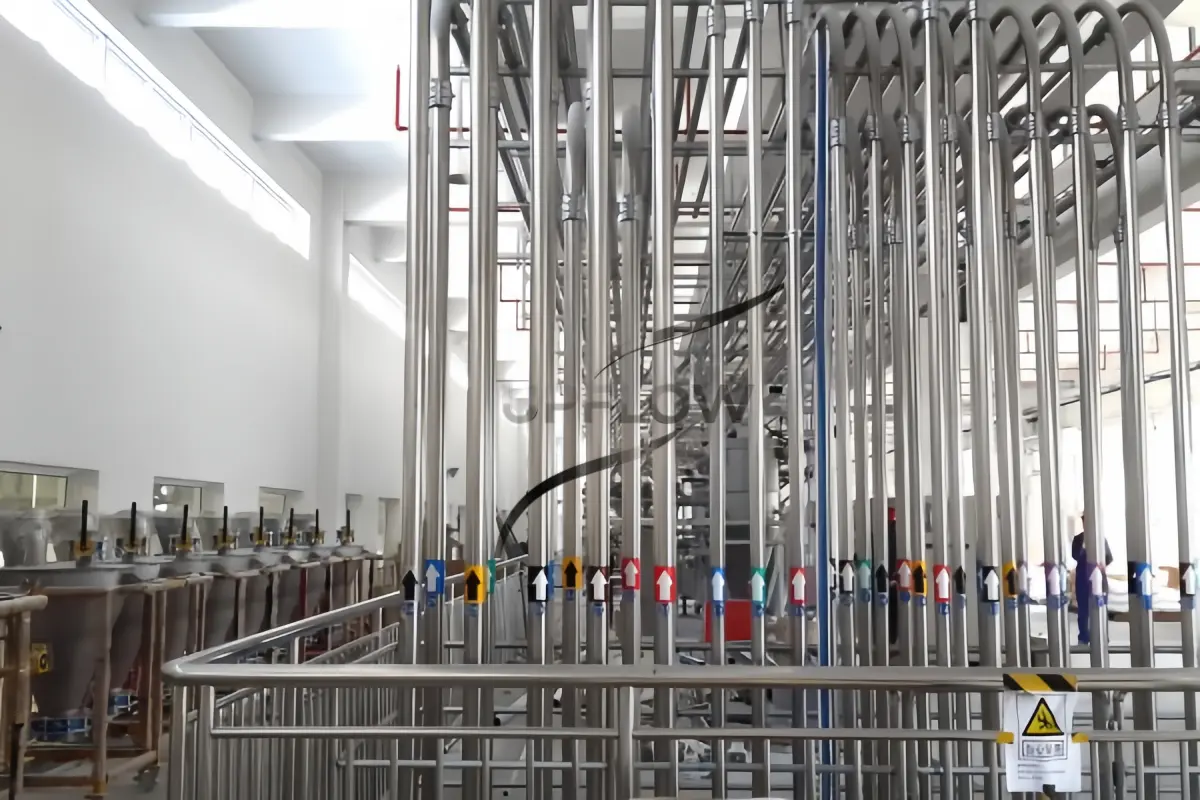
Titanium dioxide pneumatic conveying systems play an essential role in modern industrial production by enabling efficient and reliable powder handling. Titanium dioxide, commonly used as a white pigment, requires a controlled and clean conveying process from storage to production lines.
A well-designed titanium dioxide pneumatic conveying system provides high efficiency, environmental protection, and stable performance, making it a preferred solution across multiple industries.
Material Characteristics of Titanium Dioxide
Titanium dioxide (TiO₂), also known as titania, is a fine white powder widely used in coatings, plastics, paper, and rubber industries due to its excellent opacity, brightness, and weather resistance.
It typically has a bulk density of approximately 0.5–0.9 t/m³, depending on its grade and particle size. Due to its fine particle structure, titanium dioxide is prone to dust generation and requires careful handling. Therefore, using a titanium dioxide powder conveying system with enclosed design is critical to maintaining product quality and reducing environmental impact.
In many automated production environments, a titanium dioxide material automation system is used to ensure continuous and controlled material transfer.
High-Efficiency Conveying
The titanium dioxide pneumatic conveying system uses airflow as the conveying medium. By generating airflow within pipelines, powder materials are transported from one location to another efficiently.
This method enables titanium dioxide high-speed airflow conveying, allowing large volumes of material to be transferred in a short time. It is particularly important for production processes that require high throughput and consistent material supply.
Reduced Dust and Contamination
Traditional mechanical conveying systems may generate dust during operation, which can negatively affect both the working environment and product quality.
In contrast, a pneumatic conveying system operates within a closed pipeline, significantly reducing dust emission. This ensures safer working conditions and improves overall production cleanliness.
A fully enclosed titanium dioxide positive pressure conveying system is especially effective in minimizing contamination risks.
Strong Adaptability
Titanium dioxide pneumatic conveying systems are highly adaptable and can be customized to meet various production requirements.
Pipeline length, diameter, bends, and branching structures can be designed according to specific process layouts. This flexibility allows the system to be applied in both large-scale and small-scale production environments.
Space-Saving Design
Compared to traditional mechanical conveying systems, pneumatic conveying solutions occupy less space.
This is particularly beneficial for factories with limited installation space, enabling more efficient use of available production areas.
Low Maintenance Cost
Pneumatic conveying systems generally require less maintenance because they have fewer mechanical components such as belts, rollers, and gears, which are prone to wear and failure.
This reduces maintenance costs and downtime, improving the stability and reliability of production operations.
Energy Efficiency and Environmental Benefits
Pneumatic conveying systems are typically more energy-efficient than mechanical systems because they do not rely heavily on mechanical drive components.
By optimizing airflow and material transport, energy consumption can be reduced, making the system more environmentally friendly. This contributes to sustainable production practices.
Conclusion
Titanium dioxide pneumatic conveying systems offer significant advantages, including high efficiency, reduced dust, strong adaptability, space-saving design, low maintenance cost, and energy efficiency.
These features make them a preferred solution in industries such as coatings, plastics, paper, and rubber. By adopting a modern titanium dioxide pneumatic conveying system, manufacturers can improve production efficiency, enhance workplace safety, and support sustainable industrial development.