
Introduction
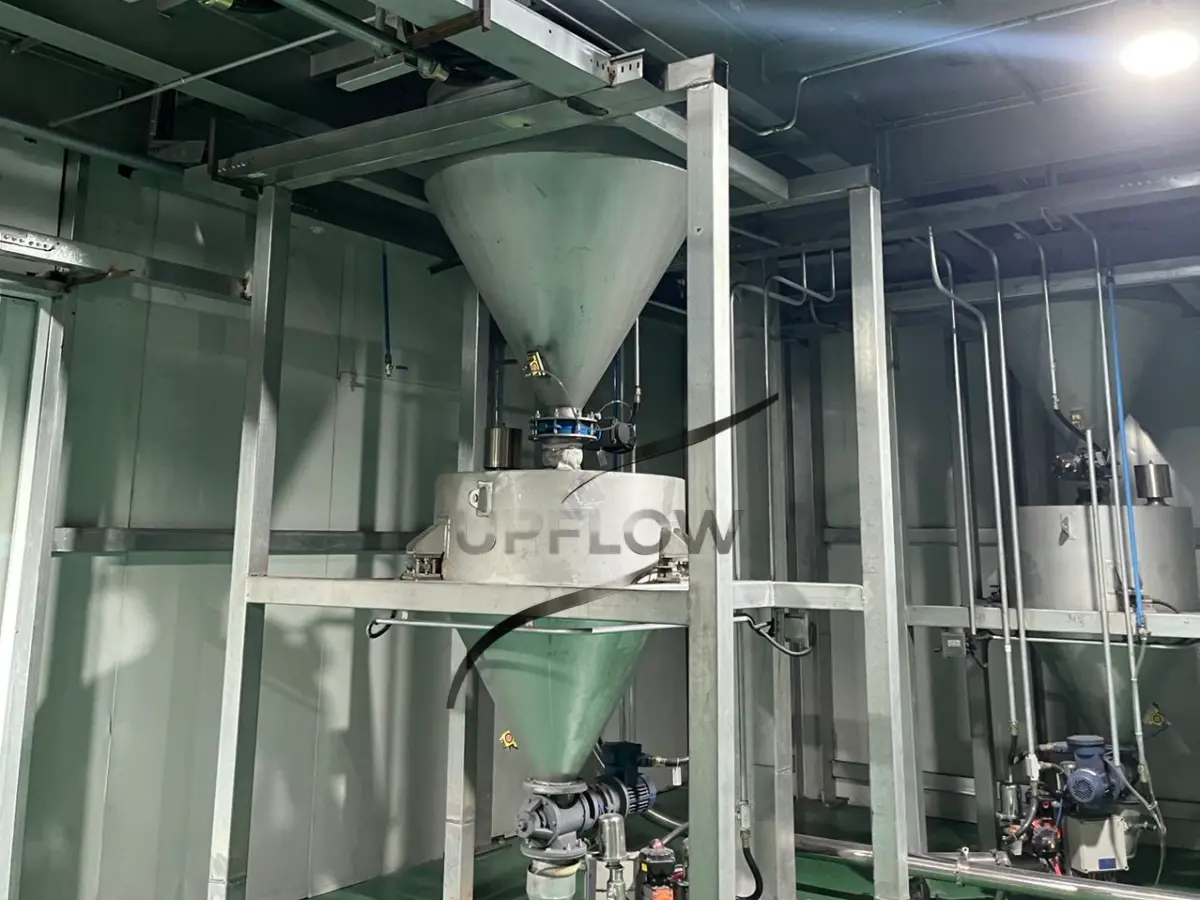
An ammonium sulfate pneumatic conveying system is a reliable and efficient solution for transporting powder materials using airflow as the conveying medium, enabling continuous and enclosed transfer in industries such as fertilizers, chemicals, and environmental processing, where stable material handling and dust control are essential. Compared with traditional mechanical systems, this type of powder conveying system significantly reduces manual handling, improves efficiency, and ensures cleaner production conditions.
Ammonium Sulfate Material Characteristics
Ammonium sulfate (chemical formula: (NH₄)₂SO₄), also known as sulfate of ammonia, is a widely used nitrogen fertilizer and industrial chemical that typically appears as white crystalline particles or fine powder. It generally has a bulk density of approximately 0.8–1.1 t/m³, depending on particle size and moisture content.
Although ammonium sulfate has relatively good flowability under dry conditions, it is mildly hygroscopic and can absorb moisture from the environment, which may lead to agglomeration or caking during storage and conveying. Therefore, using a properly designed ammonium sulfate pneumatic conveying system is important to ensure stable flow, minimize dust emission, and maintain material quality during transport.
Working Principle
The ammonium sulfate pneumatic conveying system operates based on aerodynamic principles, where compressed air or gas generates a controlled airflow within pipelines to carry and move material particles either in suspension or as a moving mass. By adjusting airflow velocity and pressure, the system can achieve continuous and stable conveying, while supporting accurate dosing and automated control.
Depending on process requirements, the system can function as a pressure conveying system or a vacuum conveying system, providing flexibility for different production environments and layouts.
Product Advantages
1.Simple Structural Design: The system consists of basic components such as conveying pipelines, gas supply equipment, and control units. Maintenance and upkeep are relatively simple, and the user interface is user-friendly and easy to learn. The system can be flexibly adjusted according to needs, supporting horizontal, vertical, or oblique conveying to adapt to various production scenarios.
2.Versatile Conveying Paths: The conveying pipeline layout is highly flexible, supporting vertical, horizontal, and curved installations, effectively adapting to complex production layouts and space constraints, optimizing production processes, and improving labor productivity.
3.Superior Conveying Efficiency: The ammonium sulfate conveying system directly conveys bulk materials, eliminating packaging and loading/unloading processes, significantly improving conveying efficiency and reducing related costs. The system operates continuously and stably, with rapid conveying speed, significantly improving production efficiency and conveying capacity.
4.Advanced Automated Control: The system has a high degree of automation and can be remotely operated and monitored through a central control console, reducing labor costs and improving production efficiency and management convenience.
5.Convenient Maintenance: The equipment has few moving parts, facilitating daily maintenance and upkeep. At the same time, the system’s simple structure makes it easy to achieve automated control, further improving production efficiency and management convenience.
6. Excellent Conveying Quality: During the conveying process, the system effectively prevents materials from getting damp, contaminated, or mixed with impurities, ensuring the quality of the conveyed materials.
7.Multifunctional Integration: While conveying materials, the system can perform physical or chemical operations such as heating, cooling, drying, and airflow classification, enhancing its versatility.
Product Features
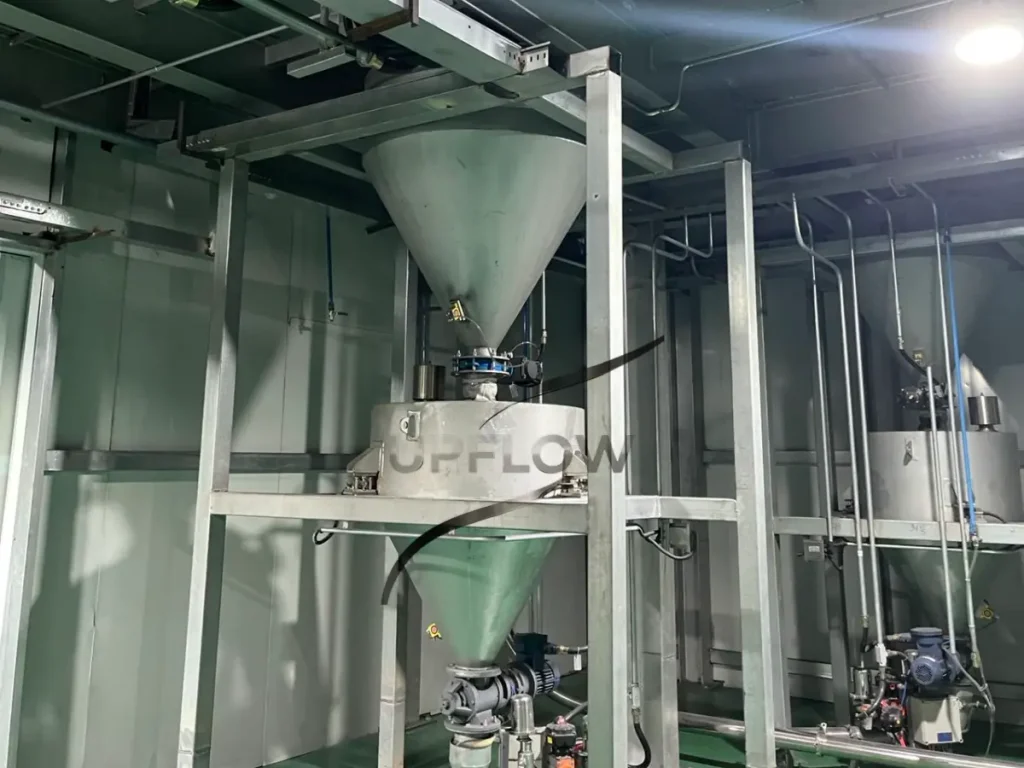
The ammonium sulfate conveying system boasts multiple advantages, including versatility, high-speed conveying capacity, reduced labor intensity, easy maintenance, and good adaptability. The system primarily relies on aerodynamic principles, using compressed air or other gases to generate airflow, causing material particles to suspend or clump together in the airflow and be conveyed along the pipeline. In pressure conveying mode, high-pressure gas propels the material through the pipeline; while in vacuum conveying mode, the negative pressure environment within the pipeline draws in the material and transports it to the designated location. The system consists of a silo system, a feeding system, a conveying pipeline system, an air source system, and a control system.
Product Functions
The ammonium sulfate conveying system, with its explosion-proof construction, features both material conveying and enclosed conveying characteristics, and integrates heating, cooling, and drying functions. This system is suitable for bulk material conveying, enabling long-distance and multi-point transport while emphasizing environmental protection and clean production principles. It utilizes airflow as the conveying medium to achieve a continuous transport process of bulk materials from multiple sources to multiple destinations.
Conclusion
The ammonium sulfate conveying system employs compressed air or pneumatic force to transfer materials from one point to another. It features dust removal and purification, long-distance conveying, process assistance, material handling, and energy saving functions, ensuring zero dust leakage and achieving environmentally friendly and pollution-free operation. Its fully sealed design ensures pollution-free material transport.