
Introduction
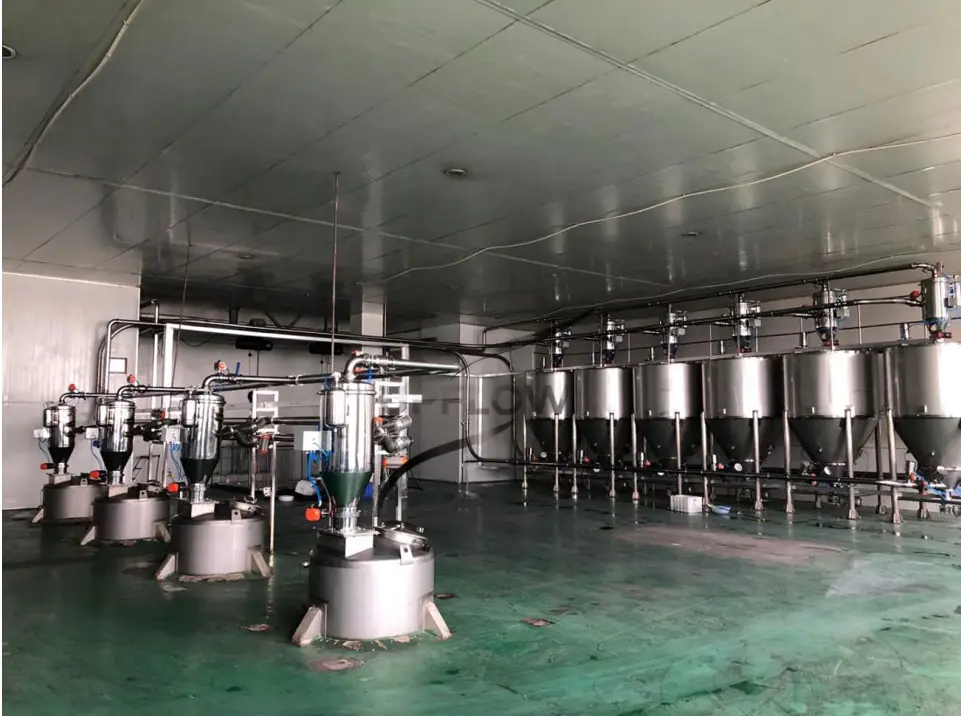
A magnesium stearate pneumatic conveying system is widely applied in industries that demand high levels of cleanliness and precision, particularly in pharmaceutical, food, and fine chemical production, where maintaining powder purity, preventing contamination, and achieving stable and controlled material transfer are essential for consistent product quality.
Magnesium Stearate Material Characteristics
Magnesium stearate (chemical formula: Mg(C₁₈H₃₅O₂)₂) is a fine, light, and highly hydrophobic powder commonly used as a lubricant, anti-caking agent, and flow enhancer in tablet manufacturing and powder processing, with a bulk density typically ranging from 0.2 to 0.3 t/m³.
Due to its extremely fine particle size and low density, magnesium stearate tends to disperse easily into the air, creating dust during handling, while its strong hydrophobicity and soft texture can result in poor flow behavior, making it difficult to achieve consistent feeding without proper system design. In addition, the material may adhere to equipment surfaces, which can affect long-term system stability if airflow conditions are not properly optimized.
These characteristics make a well-designed magnesium stearate pneumatic conveying system critical for ensuring precise, clean, and reliable powder handling.
Working Principle
The magnesium stearate pneumatic conveying system operates by using controlled airflow to transport powder particles through pipelines, where material movement is carefully regulated to maintain a balance between conveying efficiency and product integrity.
For applications requiring strict cleanliness, an aspiration conveying system (vacuum conveying system) is often used, as it ensures that any potential leakage is drawn inward rather than released into the environment, thereby maintaining a hygienic processing condition.
In contrast, a pressure conveying system can be applied in larger production setups where higher throughput or longer conveying distances are required, especially within integrated pneumatic conveying production lines.
Advantages of Magnesium Stearate Pneumatic Conveying System
One of the primary advantages of a magnesium stearate pneumatic conveying system is its ability to support hygienic and contamination-free conveying, which is essential in pharmaceutical and food-grade applications where even minor contamination can affect product quality.
The system also enables precise material handling, allowing accurate dosing and controlled feeding into downstream equipment, which is particularly beneficial for processes such as tablet formulation or powder blending.
Another key benefit is its adaptability to different conveying configurations, including both aspiration conveying systems and pressure conveying systems, enabling flexible design depending on plant layout and process requirements.
In addition, the system supports long-distance pipeline conveying systems, allowing centralized material supply to multiple processing units without manual handling, which improves efficiency and reduces the risk of contamination.
The enclosed design also significantly minimizes dust generation, improving workplace safety and reducing product loss during transfer.
Key Design Considerations
When designing a magnesium stearate pneumatic conveying system, it is important to carefully control airflow velocity, as excessive air speed may cause powder dispersion or segregation, while insufficient airflow may result in unstable conveying or material accumulation.
Feeding consistency is another critical factor, as uneven material input can lead to fluctuations in system pressure and affect downstream processing accuracy. Special attention should also be given to system cleanliness, especially in pharmaceutical applications, where easy cleaning and maintenance are required.
In addition, pipeline layout and conveying distance must be optimized to ensure efficient operation while minimizing energy consumption.
Industrial Applications
The magnesium stearate pneumatic conveying system is widely used in pharmaceutical manufacturing, food processing, and fine chemical production, where it supports the safe and accurate transfer of sensitive powder materials.
Within a complete pneumatic conveying production line, the system can be integrated with mixing, batching, and packaging equipment to ensure continuous and controlled material flow.
Conclusion
In conclusion, a properly engineered magnesium stearate pneumatic conveying system provides a clean, efficient, and highly controlled solution for handling ultra-fine powders, combining the advantages of an aspiration conveying system, pressure conveying system, pneumatic conveying production line, and long-distance pipeline conveying system to meet the strict requirements of modern high-end manufacturing industries.