
Introduction
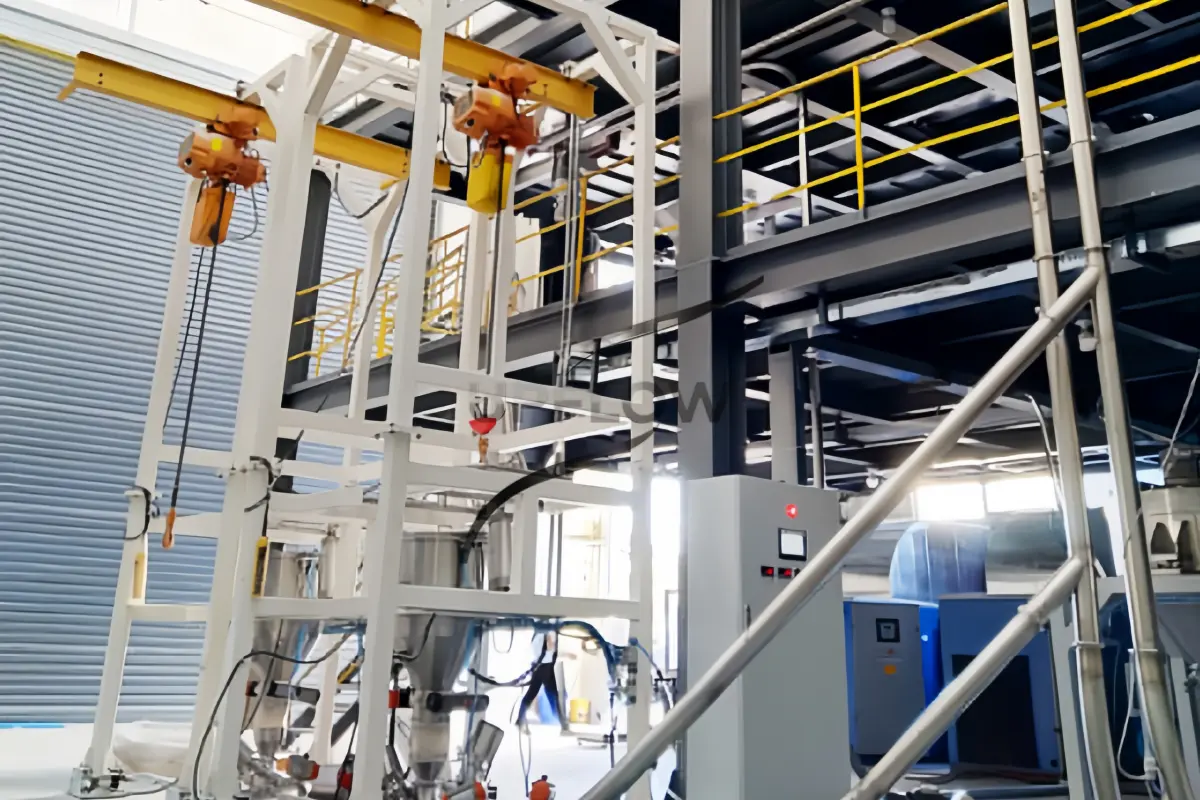
A calcium stearate pneumatic conveying system is widely used in powder handling industries where stable feeding, low dust emission, and continuous conveying are essential, especially in plastics, PVC processing, coatings, and rubber manufacturing, where calcium stearate is commonly used as a lubricant, stabilizer, or anti-caking agent.
Calcium Stearate Material Characteristics
Calcium stearate (chemical formula: Ca(C₁₈H₃₅O₂)₂) is a typical metallic stearate that appears as a white, fine, and lightweight powder, with a bulk density generally around 0.2–0.4 t/m³, depending on particle size and processing method.
Compared with many inorganic powders, calcium stearate is more hydrophobic and has a relatively fluffy structure, which makes it easy to disperse into the air during handling, while also causing challenges such as poor flowability, bridging inside hoppers, and inconsistent feeding. In addition, its tendency to adhere to surfaces may lead to gradual buildup inside pipelines or equipment if airflow and conveying conditions are not properly controlled.
Because of these characteristics, a well-designed calcium stearate pneumatic conveying system must ensure stable airflow, controlled velocity, and reliable feeding to maintain continuous and clean operation.
Working Principle
The calcium stearate pneumatic conveying system relies on airflow generated to move powder materials through pipelines, where particles are transported under controlled velocity conditions, ensuring a balance between conveying efficiency and material stability.
In many industrial applications, a positive pressure conveying system or positive pressure blowing system is preferred, as it allows material to be pushed over long distances with stable performance, making it suitable for centralized material supply and continuous production lines.
Advantages of Calcium Stearate Pneumatic Conveying System
One of the key benefits of a calcium stearate pneumatic conveying system is its ability to maintain stable conveying performance for low-density powders, reducing fluctuations in feeding and ensuring consistent material supply to downstream processes.
The system also supports integration into a mixed conveying system, where calcium stearate can be transported alongside or coordinated with other additives, enabling more efficient batching and blending operations in complex production lines.
Another advantage lies in its clean conveying capability, as the enclosed pipeline prevents dust leakage and reduces contamination risks, which is particularly important for industries requiring strict quality control.
In addition, the use of a positive pressure conveying system allows for flexible plant layout, enabling long-distance transfer and centralized feeding from one source to multiple processing points, improving overall plant efficiency.
The system also contributes to reduced manual handling, minimizing labor costs while enhancing safety, especially when dealing with fine powders that can easily become airborne.
Key Design Considerations
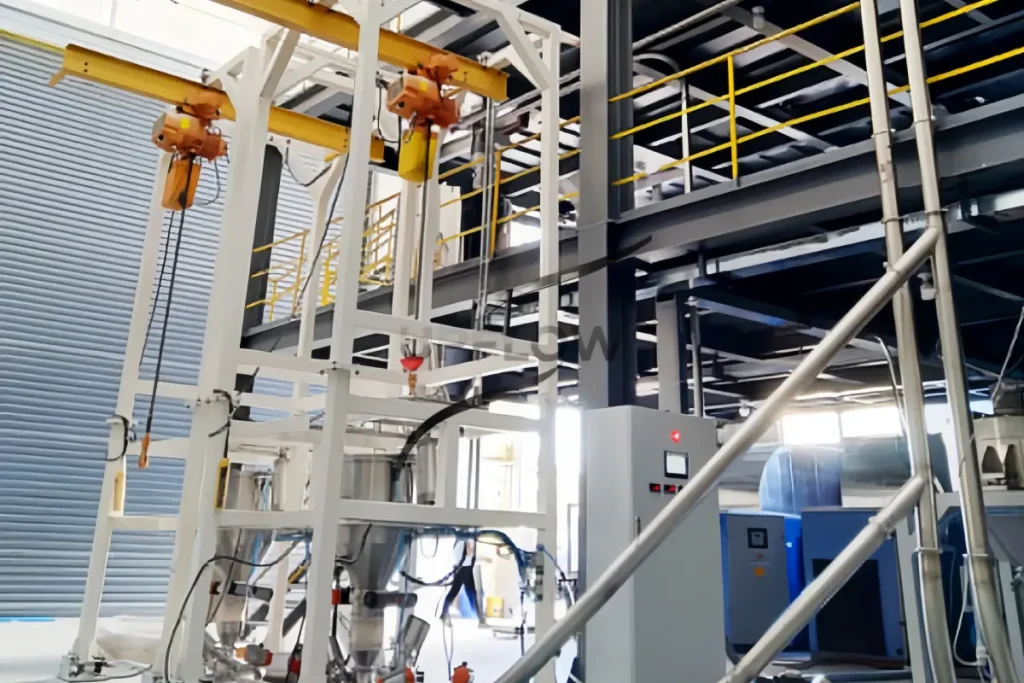
Designing a calcium stearate pneumatic conveying system requires special attention to material flow behavior, as its low density and poor flowability can lead to unstable feeding if not properly managed.
Airflow velocity must be carefully optimized, since excessive speed may increase dust generation and material dispersion, while insufficient airflow may result in settling or blockage within the pipeline.
Feeding devices should be selected to ensure uniform material introduction, and anti-adhesion design considerations may be necessary to reduce material buildup inside equipment.
At the same time, system pressure and conveying distance should be balanced to achieve efficient operation without unnecessary energy consumption.
Industrial Applications
The calcium stearate pneumatic conveying system is widely used in PVC compounding, plastics processing, coatings production, and chemical manufacturing, where it plays a key role in delivering additives accurately and consistently.
By integrating with dosing and mixing systems, it helps ensure precise formulation control while maintaining a clean and efficient production environment.
Conclusion
In conclusion, a properly designed calcium stearate pneumatic conveying system provides a reliable solution for handling lightweight and difficult-flowing powders, combining the benefits of a positive pressure conveying system, positive pressure blowing system, and mixed conveying system to achieve stable, efficient, and dust-free material transfer in modern industrial processes.