
Material Profile: What Is Conductive Carbon Black?
Conductive carbon black is a specialized form of carbon black designed to provide electrical conductivity in various industrial applications, and it is commonly referred to as conductive carbon black powder, conductive carbon additive, or battery conductive agent, especially in lithium battery manufacturing.
Unlike general carbon black, which is mainly used for reinforcement and pigmentation, conductive carbon black features a high structure, large specific surface area, and low electrical resistivity, enabling it to form conductive networks within materials. In terms of physical properties, conductive carbon black typically has a true density of around 1.8–2.1 g/cm³, but due to its fluffy nature, the bulk density is much lower (often 0.1–0.3 g/cm³), making it extremely light and prone to airborne dispersion.
It can be classified into several types, including acetylene black, furnace conductive carbon black, and specialty high-conductivity carbon blacks, each used in applications such as lithium batteries, anti-static plastics, cables, and electronic materials.
Difference Between Conductive Carbon Black and Standard Carbon Black
Although conductive carbon black belongs to the broader carbon black family, there are significant differences between the two.
Standard carbon black is primarily used for reinforcement, coloring, and UV protection, while conductive carbon black is engineered specifically for electrical conductivity and functional performance. As a result, conductive carbon black has a more complex structure, higher cost, and stricter handling requirements.
From a conveying perspective, conductive carbon black is much more challenging due to its low bulk density, strong cohesion, and high dusting tendency, which makes a fully enclosed conductive carbon black pneumatic conveying system essential for stable and safe operation.
What Is a Conductive Carbon Black Pneumatic Conveying System?
A conductive carbon black pneumatic conveying system is an advanced material handling solution that uses airflow to transport conductive carbon black powder through sealed pipelines, ensuring clean, efficient, and automated transfer.
In industrial applications, it is also known as a dust-free conveying system for conductive carbon black powder, an automatic feeding system for conductive carbon additives, a powder transfer system for carbon black materials, or a pneumatic material conveying system for battery conductive agents, depending on system configuration.
By forming a controlled gas-solid flow, this material conveying system for conductive carbon black powder ensures continuous transport while minimizing dust emission and material loss.
Conveying Challenges and System Design Considerations
Handling conductive carbon black presents unique challenges due to its physical characteristics.
As a lightweight and highly cohesive powder, it tends to agglomerate and form bridges, which can cause feeding instability or pipeline blockage. In addition, its fine particle size leads to severe dust generation, requiring a dust-free conveying system for conductive carbon black materials with high-efficiency filtration.
Another critical factor is static electricity, as conductive carbon black can accumulate charges during conveying, increasing the risk of dust explosions. Therefore, a powder transfer system for conductive carbon black powder must include anti-static grounding, explosion protection, and optional inert gas conveying (such as nitrogen systems) for high-end applications.
Working Principle of Conductive Carbon Black Pneumatic Conveying
The conductive carbon black pneumatic conveying system operates based on gas-solid two-phase flow, where compressed air or controlled gas flow transports powder particles through pipelines.
In a low-pressure or dilute phase conveying system for conductive carbon black powder, the material is suspended in airflow and conveyed at controlled velocity, ensuring stable transport. In more demanding applications, a dense phase conveying system for conductive carbon black materials may be used to reduce dusting and improve energy efficiency.
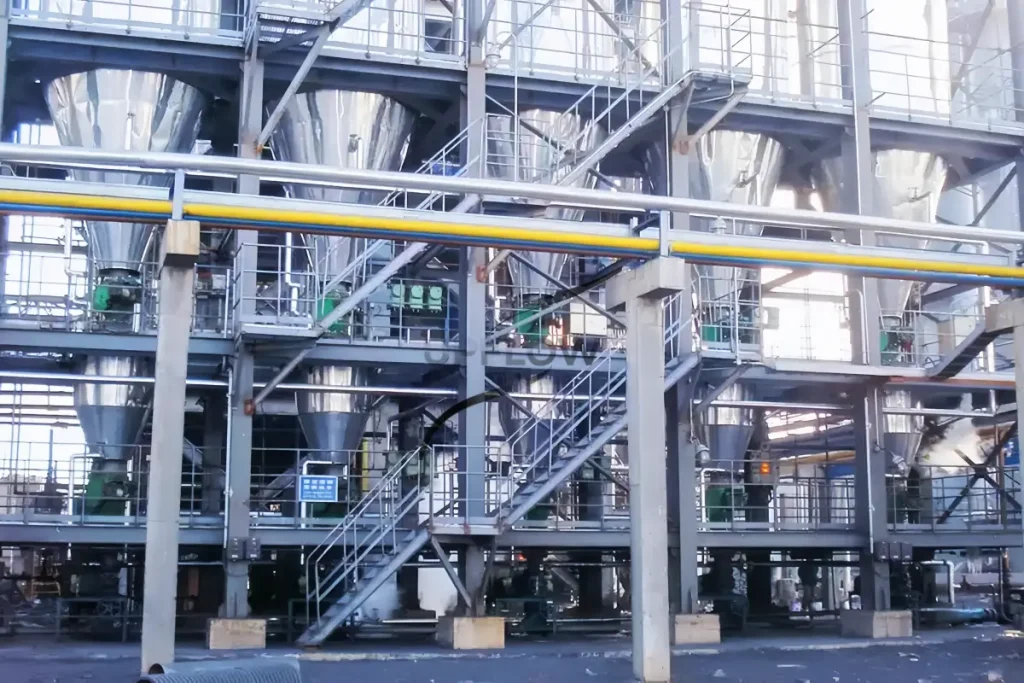
As a fully enclosed material conveying system for conductive carbon black powder, the system ensures that the entire process is isolated from the external environment, maintaining cleanliness and product integrity.
Key Advantages of Conductive Carbon Black Conveying Systems
The conductive carbon black pneumatic conveying system provides several advantages for industrial production.
First, as a dust-free conveying system for conductive carbon black materials, it significantly reduces dust emission, improving workplace safety and environmental compliance. Second, it enables fully automated operation, functioning as an automatic feeding system for conductive carbon black powder, which reduces manual handling and improves efficiency.
In addition, the system supports flexible pipeline layouts and long-distance conveying, making it suitable for complex production lines. Compared with traditional mechanical systems, this powder transfer system for conductive carbon black materials offers lower maintenance requirements and more stable performance.
Industrial Applications
The conductive carbon black pneumatic conveying system is widely used in lithium battery production, where it serves as a material conveying system for battery conductive agents, ensuring precise and consistent feeding into mixing and coating processes.
It is also applied in anti-static plastic production, cable manufacturing, and electronic material processing, where clean and controlled powder handling is essential.
Conclusion
The conductive carbon black pneumatic conveying system is a highly specialized solution designed for handling lightweight, fine, and functional powders. By integrating dust-free conveying systems, automatic feeding systems, powder transfer systems, and advanced pneumatic material conveying technologies for conductive carbon black, manufacturers can achieve improved efficiency, enhanced safety, and consistent product quality in modern industrial environments.