
Material Profile: Lithium Manganese Oxide Properties and Types
Lithium manganese oxide, commonly referred to as LMO (LiMn₂O₄ or Li₂MnO₃ depending on structure), is an important cathode material widely used in lithium-ion batteries for electric vehicles, portable electronics, and energy storage systems, and it is also known as lithium manganese cathode powder, manganese-based lithium battery material, or LMO active material in industrial applications.
In production environments, LMO is typically handled as a fine powder or micro-particle material, with a bulk density generally ranging from approximately 1.2 to 2.5 g/cm³, depending on synthesis method and particle morphology. It is characterized by moderate density, strong abrasiveness, brittleness, and sensitivity to contamination, which requires precise and enclosed conveying systems to maintain product quality.
LMO materials can be classified into spinel lithium manganese oxide (LiMn₂O₄) and layered lithium manganese compounds, as well as battery-grade LMO (high purity for energy applications) and industrial-grade LMO, all of which demand stable and contamination-free powder handling solutions.
Working Principle of Lithium Manganese Oxide Pneumatic Conveying System
The lithium manganese oxide pneumatic conveying system is based on gas-solid two-phase flow, where airflow generated by a compressor or blower is used to transport LMO powder through pipelines.
In a typical positive pressure blowing system for lithium manganese oxide powder, compressed air is introduced into the feeding unit, where the powder becomes suspended in the airflow and is conveyed along the pipeline to the target location, such as a mixing tank, reactor, or storage silo. As a powder conveying system for lithium manganese oxide materials, it allows continuous and stable transport while ensuring uniform particle dispersion.
In some configurations, a dense phase conveying system for LMO powder may be used to reduce wear and energy consumption, especially when handling high-density or abrasive materials.
System Structure and Key Components
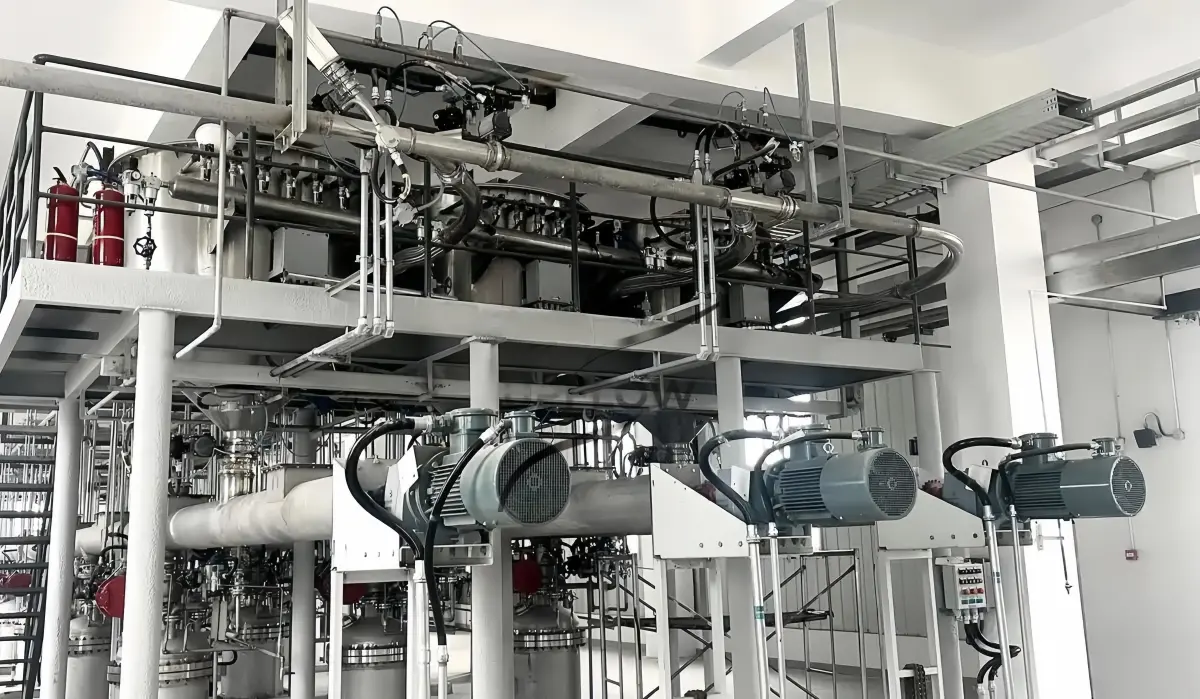
A complete lithium manganese oxide pneumatic conveying system consists of several essential components that work together to ensure efficient operation.
The feeding system introduces LMO powder into the pipeline in a controlled manner, using devices such as rotary valves or screw feeders. The air supply system, typically a compressor or blower, generates the airflow required for conveying. The pipeline system, constructed from wear-resistant and corrosion-resistant materials, ensures safe and reliable transport.
In addition, the dust collection system captures fine particles during conveying, ensuring environmental compliance and clean operation. The control system enables real-time monitoring and adjustment of airflow velocity, pressure, and feeding rate, functioning as a centralized feeding system for lithium manganese oxide materials.
Advantages of LMO Pneumatic Conveying Systems
The lithium manganese oxide pneumatic conveying system offers several advantages that make it highly suitable for battery material production.
First, as a fully enclosed powder conveying system for LMO materials, it eliminates direct contact between material and environment, preventing contamination and preserving product purity. This is particularly important for lithium battery materials, where even small impurities can affect performance.
Second, the system ensures fast, uniform, and precise material transfer, improving process consistency and production efficiency. Compared with traditional mechanical systems, this powder conveying system for lithium manganese oxide powder has fewer moving parts, resulting in lower maintenance costs and reduced wear.
Additionally, as a centralized feeding system for LMO powder handling, it offers high flexibility and scalability, allowing easy adjustment of conveying capacity and integration with other processing equipment.
Industrial Applications and Process Integration
The lithium manganese oxide pneumatic conveying system is widely used in lithium battery cathode production lines, where it supports the transfer of LMO powder from storage to mixing, dosing, and reaction systems.
As a material conveying system for lithium manganese oxide powder, it can also be integrated with processes such as mixing, dispersion, and classification, enabling multifunctional operation within a single system.
With the rapid growth of battery manufacturing, this positive pressure blowing system for LMO materials plays a key role in improving automation, reducing labor requirements, and ensuring consistent product quality.
Conclusion
The lithium manganese oxide pneumatic conveying system provides an efficient, reliable, and flexible solution for handling fine battery powders. By combining powder conveying systems, dense phase conveying systems, positive pressure blowing systems, and centralized feeding systems for lithium manganese oxide materials, manufacturers can achieve higher efficiency, lower operational costs, and improved material quality in modern lithium battery production.