
Material Overview: Types and Properties of Membrane Powders
Membrane material powders, widely used in filtration, water treatment, and energy storage industries, include materials such as PVDF membrane powder, PTFE powder, PES (polyethersulfone) powder, and polypropylene (PP) powder, and they are also referred to as membrane-grade polymer powders or filtration material powders.
These materials are typically handled as fine powders with bulk densities ranging from approximately 0.3 to 0.9 g/cm³, depending on polymer type and particle size, and they are characterized by lightweight structure, high purity requirements, sensitivity to contamination, and in some cases static electricity and cohesion, which require stable and enclosed conveying systems. Membrane powders can be classified into microfiltration membrane materials, ultrafiltration materials, and battery separator materials, each demanding precise and clean handling conditions.
What Is a Membrane Material Powder Pneumatic Conveying System?
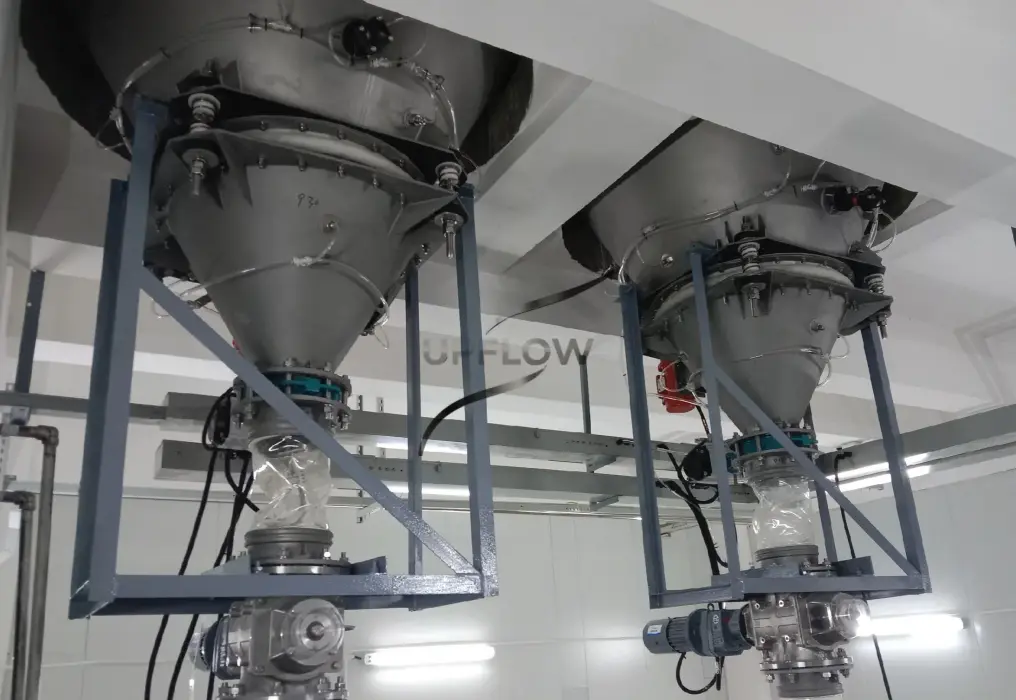
A membrane material powder pneumatic conveying system is an advanced material handling solution that transports fine polymer powders through enclosed pipelines using airflow or vacuum, ensuring dust-free, automated, and contamination-free transfer.
In industrial applications, it is also known as a feeding system for membrane powder materials, a low-pressure pneumatic conveying system for membrane polymers, a vacuum conveying system for PVDF or PTFE membrane powder, or a pneumatic material conveying system for filtration powders.
This material pneumatic conveying system for membrane powders enables continuous and stable transfer across production processes such as mixing, extrusion, and membrane forming.
Conveying Methods for Membrane Powder Materials
Due to the lightweight and sensitive nature of membrane powders, selecting the appropriate conveying method is critical.
For fine and cohesive powders such as PVDF or PTFE membrane materials, a low-velocity low-pressure pneumatic conveying system for membrane powder is preferred, as it minimizes dust generation and material degradation. In cleanroom or high-purity environments, a vacuum conveying system for membrane material powders is widely used to ensure dust-free feeding and prevent contamination.
For applications requiring stable long-distance transport, a pneumatic conveying system for membrane polymer powders with controlled airflow provides reliable and efficient material movement.
System Operation and Integration
In a typical membrane material powder pneumatic conveying system, powders are fed from storage bins into pipelines through controlled feeding devices, and then transported by airflow or vacuum to downstream equipment such as mixers or extrusion units.
As a feeding system for membrane powder processing lines, it integrates sensors and control systems to monitor pressure, flow rate, and feeding accuracy, ensuring consistent and stable operation while maintaining material quality.
Advantages of Membrane Powder Pneumatic Conveying Systems
The membrane material powder pneumatic conveying system offers significant advantages in modern production environments.
As a fully enclosed powder conveying system for membrane materials, it ensures dust-free operation and protects product purity, which is essential for filtration and battery applications. In addition, it supports automated feeding and precise control, functioning as an efficient pneumatic conveying system for membrane powders, reducing labor costs and improving productivity.
Furthermore, the system provides flexible layout, low maintenance requirements, and stable conveying performance, making it suitable for advanced manufacturing processes.
Conclusion
The membrane material powder pneumatic conveying system is a reliable solution for handling sensitive polymer powders. By integrating feeding systems, low-pressure conveying systems, pneumatic conveying equipment, and vacuum conveying systems for membrane powders, manufacturers can achieve clean production, stable material transfer, and high-efficiency operation in modern industrial applications.