
Material Profile: Properties and Types of Magnesium Powder
Magnesium powder, also known as Mg powder, magnesium metal powder, or magnesium dust, is widely used in industries such as metallurgy, aerospace, pyrotechnics, pharmaceuticals, and chemical processing due to its light weight, high reactivity, and excellent energy properties.
In practical applications, magnesium powder is typically handled as a fine or ultra-fine powder, with a bulk density ranging from approximately 0.6 to 1.2 g/cm³, depending on particle size and morphology. It is characterized by high flammability, strong oxidation tendency, and dust explosion risk when dispersed in air, making safe conveying essential. Magnesium powders can be classified into atomized magnesium powder, spherical magnesium powder, flake magnesium powder, and ultra-fine magnesium dust, each requiring different conveying strategies and safety measures.
What Is a Magnesium Powder Pneumatic Conveying System?
A magnesium powder pneumatic conveying system is a specialized material handling solution that uses airflow energy to transport magnesium powder through enclosed pipelines, ensuring efficient, controlled, and safe transfer.
In industrial applications, it is also known as a positive pressure conveying system for magnesium powder, a central conveying system for magnesium materials, or a long-distance pneumatic conveying system for magnesium powder, depending on system design. This material pneumatic conveying system for magnesium powder allows flexible conveying from multiple feeding points to single or multiple discharge locations.
Working Principle and Conveying Process
The magnesium powder pneumatic conveying system operates based on gas-solid two-phase flow, where compressed air or inert gas generates a controlled airflow inside pipelines.
Under this airflow, magnesium powder particles are either suspended or transported in clusters, forming a stable conveying state that ensures smooth and continuous transfer. As a positive pressure conveying system for magnesium powder materials, it can handle long distances efficiently, while maintaining system stability and performance.
System Structure and Functional Integration
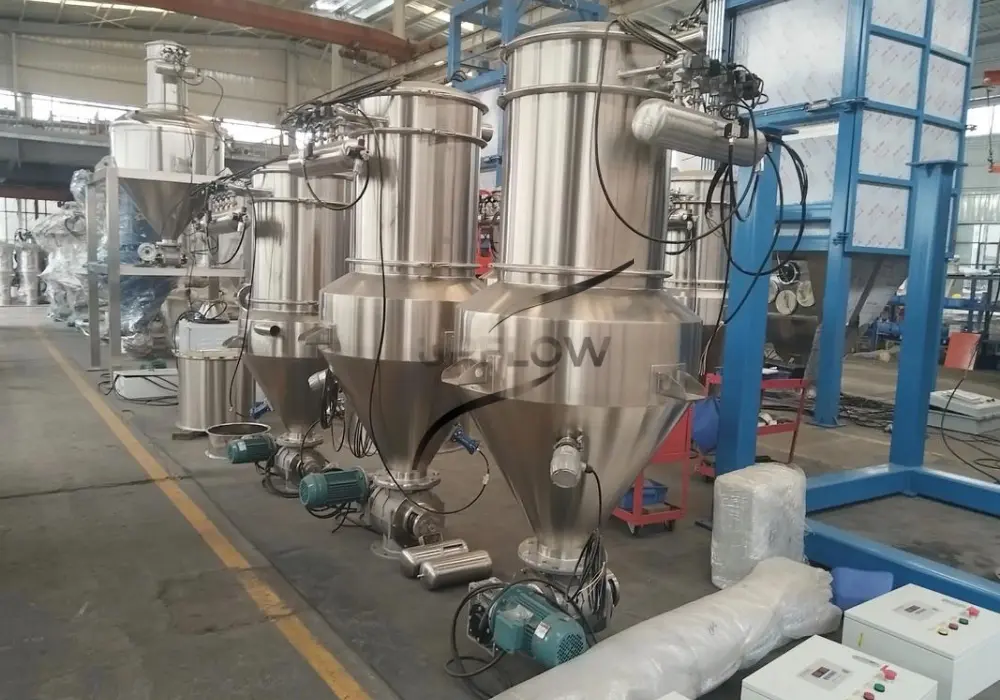
A typical magnesium powder pneumatic conveying system consists of feeding devices, conveying pipelines, dust collection units, air supply systems, storage silos, and control systems, forming a complete and integrated solution.
As a central conveying system for magnesium powder, it supports automated operation, multi-point feeding, and flexible routing, while maintaining enclosed conveying conditions to reduce environmental impact and improve operational efficiency.
Safety and Performance Advantages
Due to the reactive nature of magnesium powder, safety is the most critical factor. The magnesium powder pneumatic conveying system is designed with explosion protection, anti-static grounding, and fully enclosed pipelines, ensuring safe operation in industrial environments.
In addition, as a long-distance pneumatic conveying system for magnesium powder, it provides stable performance, low material loss, and efficient energy usage, while supporting automated control and reducing manual intervention.
Application and Industrial Value
The magnesium powder pneumatic conveying system is widely applied in industries requiring safe and efficient handling of reactive powders, functioning as a reliable pneumatic conveying system manufacturer solution for magnesium powder processing.
It enables clean production, flexible conveying paths, and integrated processing functions such as mixing and classification, improving overall production efficiency and safety.
Conclusion
The magnesium powder pneumatic conveying system offers a safe, efficient, and modern solution for handling highly reactive metal powders. By integrating positive pressure conveying systems, central conveying systems, and advanced long-distance conveying technologies for magnesium powder, manufacturers can achieve stable operation, enhanced safety, and high-efficiency material transfer in demanding industrial environments.