
Material Profile: Properties and Types of Copper Powder
Copper powder, also known as Cu powder, metal copper powder, or conductive copper powder, is widely used in electronic pastes, 3D printing, powder metallurgy, and electromagnetic shielding materials due to its excellent electrical and thermal conductivity.
In practical handling, copper powder is typically a fine or ultra-fine powder, with a bulk density ranging from approximately 2.0 to 4.5 g/cm³, depending on particle morphology. It is characterized by high chemical activity, easy oxidation, strong dusting tendency, and variable flowability, which creates challenges during conveying. Copper powders can be classified into spherical copper powder, dendritic copper powder, flake copper powder, and nano copper powder, each requiring different conveying conditions and protection levels.
Why Copper Powder Requires Specialized Conveying Solutions
A copper powder pneumatic conveying system must address multiple challenges simultaneously, including oxidation control, dust containment, and stable flowability.
Fine copper powders, especially nano or dendritic types, are highly sensitive to oxygen and moisture, while irregular shapes may cause bridging or blockage in pipelines, making conventional open feeding or high-speed airflow conveying unsuitable. Therefore, a closed and controlled powder conveying system for copper powder materials becomes essential for maintaining product quality and process stability.
Vacuum Conveying for Copper Powder Handling
A vacuum-based copper powder pneumatic conveying system is widely used due to its enclosed and low-disturbance conveying characteristics.
As a material automatic conveying system for copper powder, it transports powder through pipelines under negative pressure, effectively isolating the material from air and humidity. Compared with high-speed airflow systems, this low-velocity powder conveying system for copper materials reduces particle damage and oxidation risk while ensuring stable transfer.
For highly sensitive materials, the system can be integrated with inert gas protection (such as nitrogen or argon), forming a controlled atmosphere conveying environment.
Dust-Free Feeding Station for Safe Material Loading
In a complete powder conveying system for copper powder, the feeding stage is a critical point for dust emission and contamination.
A dust-free feeding station for copper powder materials works in coordination with the conveying system by capturing dust during bag opening and material loading through a negative pressure filtration unit, ensuring a clean and safe working environment. As part of a copper powder pneumatic conveying system, it allows seamless transfer from manual feeding to automated conveying without exposure.
Integrated System for Clean and Automated Transfer
The most effective solution is an integrated system combining vacuum conveying equipment and dust-free feeding stations, forming a continuous and enclosed process.
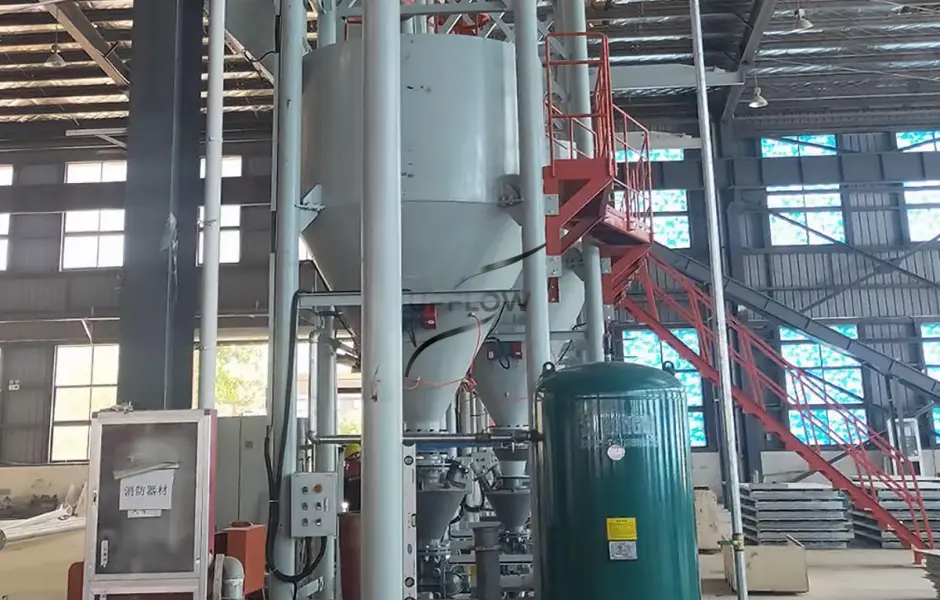
As a high-efficiency powder conveying system for copper powder, it enables automated transfer from raw material feeding to downstream equipment such as mixers or 3D printing machines, eliminating manual handling, reducing contamination risk, and improving production efficiency.
Conclusion
The copper powder pneumatic conveying system provides a reliable solution for handling sensitive and reactive metal powders. By integrating material automatic conveying systems, controlled airflow conveying systems, and advanced powder conveying systems for copper powder, manufacturers can achieve clean, stable, and high-quality material transfer in modern high-end manufacturing industries.