
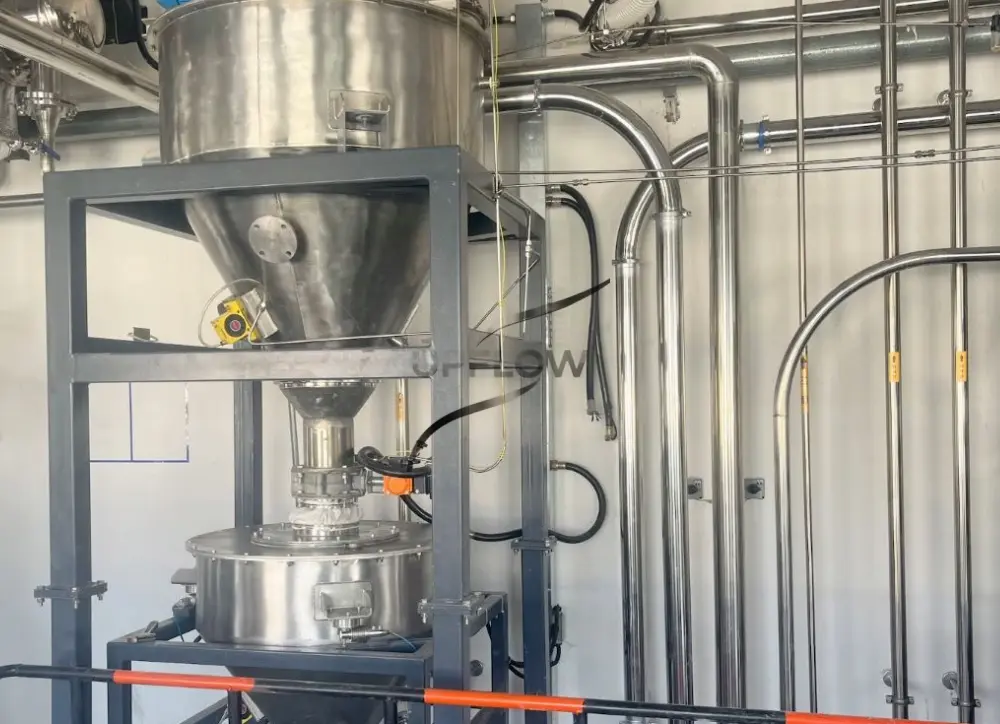
As industrial automation continues to improve in the chemical and powder processing industries, more manufacturers are adopting enclosed conveying technologies to reduce dust pollution, improve conveying efficiency, and achieve continuous material transfer. Among these technologies, the Magnesium Chloride Pneumatic Conveying System has become an important solution for handling hygroscopic and fine powder materials in modern production plants.
Because magnesium chloride powder easily absorbs moisture from the surrounding air and tends to agglomerate during storage and transportation, selecting a stable powder conveying solution is extremely important for maintaining production efficiency and reducing pipeline blockage risks.
Material Characteristics of Magnesium Chloride Powder
Magnesium chloride, also known as MgCl₂, is an inorganic salt that is widely used in chemical manufacturing, wastewater treatment, pharmaceutical processing, dust suppression, food additives, and environmental protection industries. The material is commonly available in powder, flake, or granular form, while magnesium chloride powder is the most challenging form for conveying and storage applications.
The bulk density of magnesium chloride powder generally ranges from 0.65 to 0.95 t/m³ depending on particle size and moisture content, while its true density is approximately 2.3 g/cm³. Since the material has strong hygroscopic properties, it can rapidly absorb water vapor from the environment, resulting in caking, bridging, and poor flowability inside storage silos and conveying pipelines.
In many industrial plants, a magnesium chloride powder feeding system must be specially designed with moisture-proof structures, airtight conveying pipelines, and stable airflow control in order to maintain continuous operation under humid working conditions.
Why Pneumatic Conveying Is Suitable for Magnesium Chloride Powder
Compared with traditional mechanical conveying equipment, a Magnesium Chloride Pneumatic Conveying System offers several advantages for handling fine chemical powders, especially when the production environment requires dust-free and fully enclosed material transfer.
Because the entire conveying process is completed inside sealed pipelines, the system can effectively reduce dust leakage, minimize material contamination, and improve workshop cleanliness. At the same time, the conveying distance can be flexibly adjusted according to plant layout, which makes pneumatic conveying suitable for long-distance powder transfer between storage silos, unloading stations, mixers, and production lines.
For hygroscopic materials such as magnesium chloride powder, many factories prefer to use a closed powder conveying system combined with dehumidified compressed air, because this design can significantly reduce moisture absorption during conveying and storage.
Application of Vacuum Conveying Systems in Magnesium Chloride Handling
In some applications where conveying capacity is relatively small but environmental requirements are high, manufacturers often choose a vacuum conveying system for magnesium chloride powder transfer. Compared with positive pressure conveying, vacuum conveying can provide cleaner feeding conditions while reducing powder escape at feeding points.
A magnesium chloride vacuum conveying system is commonly used in pharmaceutical plants, food additive processing facilities, and fine chemical production workshops where dust control and contamination prevention are critical. Since the material remains under negative pressure during operation, the risk of powder leakage into the surrounding environment can be greatly reduced.
Additionally, vacuum powder conveying systems can simplify equipment layout in compact workshops while improving operator safety and reducing cleaning frequency.
Key Design Considerations for a Magnesium Chloride Powder Conveying System
When designing a Magnesium Chloride Pneumatic Conveying System, engineers must carefully evaluate several important factors including conveying distance, material moisture content, particle size distribution, airflow velocity, and pipeline resistance. Since magnesium chloride powder can easily adhere to the inner wall of pipelines under humid conditions, improper airflow design may result in pipeline buildup or conveying instability.
To improve system reliability, many powder conveying systems are equipped with stainless steel pipelines, automatic filter cleaning devices, air drying units, and fluidization systems inside silos or hoppers. These auxiliary components can effectively improve powder flowability while reducing maintenance frequency during continuous operation.
For long-distance conveying applications, dense phase conveying technology is sometimes selected because it can reduce pipeline wear, lower material degradation, and decrease energy consumption compared with dilute phase conveying systems.
Advantages of Fully Enclosed Powder Conveying Solutions
A fully enclosed magnesium chloride powder feeding system not only improves conveying efficiency but also helps manufacturers comply with increasingly strict environmental protection standards. Since the conveying process is isolated from the external environment, operators can avoid direct contact with chemical powder while maintaining cleaner factory conditions.
In addition, an enclosed powder conveying system can reduce material waste caused by dust leakage and improve raw material utilization rates during production. For industries handling corrosive or moisture-sensitive powders, this type of conveying solution provides significant long-term operational advantages.
As automation technology continues to develop, more chemical processing companies are investing in intelligent magnesium chloride pneumatic conveying systems equipped with automatic pressure control, remote monitoring, and PLC-based operation management, allowing factories to achieve more stable and energy-efficient powder handling processes.
Conclusion
With the increasing demand for efficient bulk powder handling technologies, the Magnesium Chloride Pneumatic Conveying System is becoming an essential solution for modern chemical and industrial production lines. By combining airtight conveying pipelines, stable airflow control, and advanced powder feeding technology, manufacturers can effectively solve the challenges associated with hygroscopic magnesium chloride powder conveying.
Whether using a vacuum conveying system, dense phase conveying equipment, or a fully enclosed powder conveying system, selecting the right conveying configuration can significantly improve production efficiency, reduce maintenance costs, and ensure long-term operational stability.