
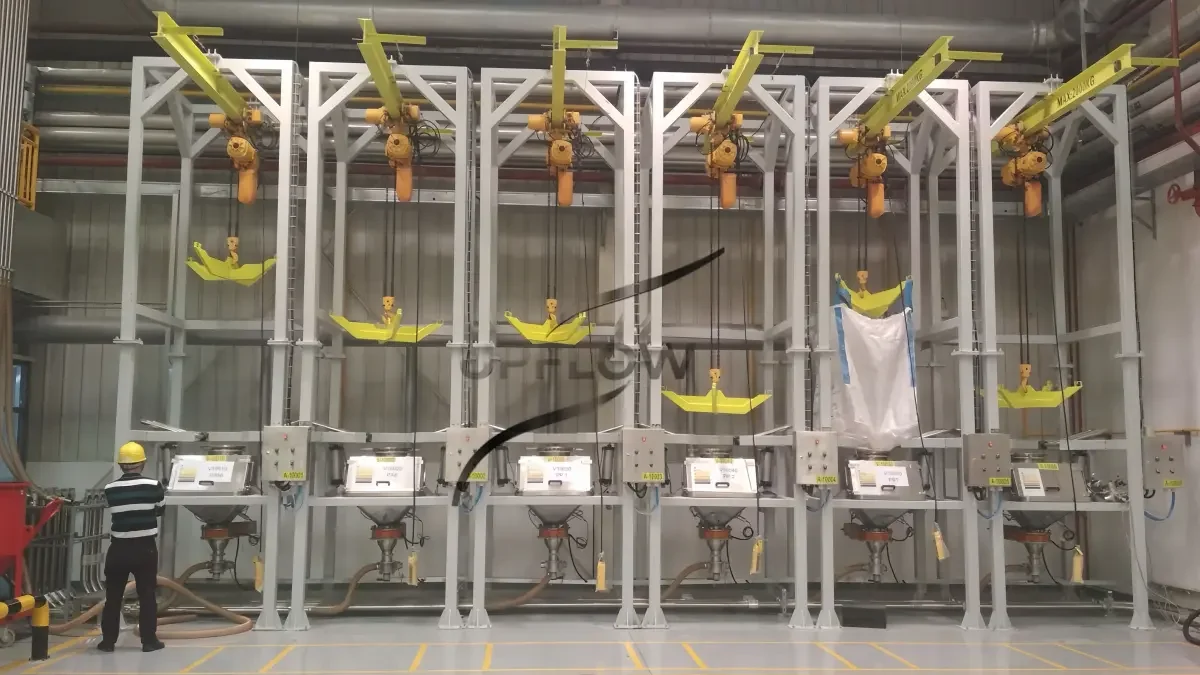
Bulk Bag Unloader FAT Checklist: What Should Buyers Test Before Shipment?
A bulk bag unloader FAT should verify the actual bag interface, material discharge, complete operating cycle, dust-control arrangement, downstream interlocks and recovery from a stopped process. Agree the acceptance method before the test. A machine running empty, or unloading an easy substitute powder, does not establish performance with the production material.
This bulk bag unloader FAT checklist is for buyers preparing a factory acceptance test before shipment. It separates checks that can be completed at the manufacturer’s workshop from those requiring the installed plant. The aim is a signed record of what was tested, under which conditions, and what remains open.
Define the test boundary before arranging the FAT
Start with the purchase specification, approved drawing and equipment list. Mark the boundary from the suspended FIBC to the receiving connection. Identify whether the supply includes a hoist, bag support, spout enclosure, flow aids, buffer hopper, screw feeder, dust collector, weighing equipment and controls. A component outside this boundary needs an agreed simulation or a later site test.
UPFLOW’s ton bag unpacking machine description identifies the hoist, pneumatic bag connection and squeezing assistance as configurable elements, with downstream integration options. These are configuration descriptions, not evidence that a particular purchased assembly has passed its FAT. Check the signed project specification against the equipment actually presented.
For wider procurement scope, read the bulk bag unloading and conveying system guide. This checklist addresses acceptance evidence rather than general system selection or pricing.
Prepare representative bags and material
Record the material grade, batch reference, moisture condition, measured bulk density and storage history. Document bag dimensions, filled mass, lifting-loop arrangement, outlet diameter and length, liner construction and closure method. Two powders with the same chemical name can unload differently after transport or prolonged storage.
Use production-representative bags where practicable, including the liner and outlet ties. Agree who supplies them and how unused material will be handled. If hazardous or combustible material cannot be tested at the factory, approve the substitute and list the limitations explicitly. Do not translate a substitute-material result into an unqualified production guarantee.
Photograph the test arrangement and label the equipment. A useful FIBC discharge test record includes the bag reference, machine configuration, flow-aid settings, receiving arrangement, extraction condition, operator actions and measurement instruments. Record deviations before starting rather than reconstructing them from memory.
Use a practical acceptance matrix
| Check | Evidence to record | Acceptance basis |
|---|---|---|
| Bag fit and access | Bag drawing, connection photographs, operator reach | Approved bag range and access arrangement |
| Discharge performance | Delivered mass, start and finish times, interruptions | Agreed material and complete-cycle duty |
| Residual material | Weighed residue and collection method | Project-specific limit and measurement method |
| Containment | Connection inspection, extraction conditions, agreed sampling | Specified containment test; visual checks alone are limited |
| Controls | Alarm, stop, reset and restart records | Approved cause-and-effect sequence |
| Downstream interface | Ready/full/fault signal response | Defined responsibilities at each connection |
Give each row a result, responsible person and supporting file reference. A blank acceptance criterion should be resolved before the demonstration. Otherwise, buyer and supplier may observe the same event and reach different conclusions about whether the machine passed.
Inspect bag loading and the discharge connection
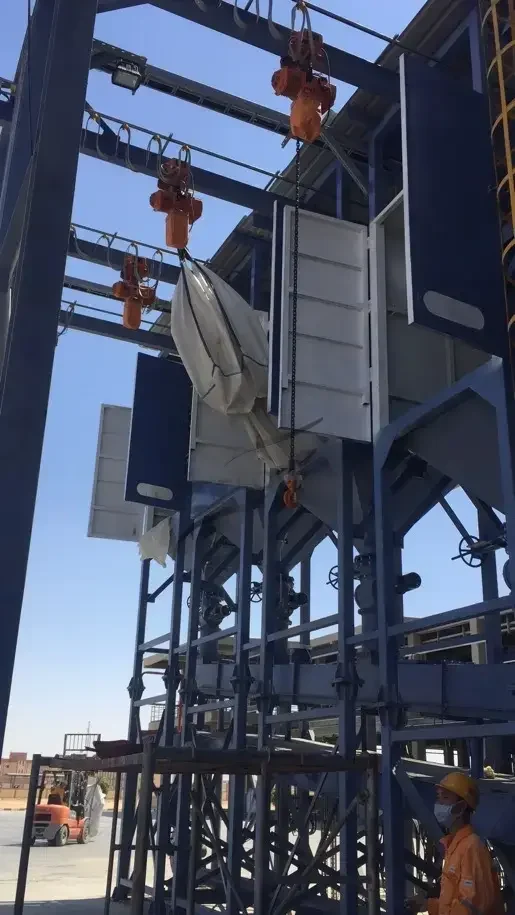
Check the installed lifting equipment against its documentation, approved load and handling procedure. Confirm clearance for the filled bag, lifting attachment and expected travel path. Keep personnel clear of suspended loads. The FAT should not introduce improvised overload tests or unsafe access beneath a bag.
Demonstrate connection, opening, discharge, closure and removal using the agreed bag. Inspect seal seating, liner management and access to the ties. Verify that the operator can follow the intended sequence without reaching into moving equipment or opening an enclosure that should remain closed during discharge.
If partially emptied bags form part of normal production, demonstrate the approved stop-and-reclose procedure. Confirm how remaining material is supported and contained. A successful full-bag emptying cycle does not automatically demonstrate safe removal of a partly filled bag.
Measure throughput over the complete cycle
Define whether the requirement is active discharge rate or sustained production rate. Time bag loading, connection, opening, discharge, residue handling, closure and removal. Include interruptions that belong to routine operation. Record whether the downstream conveyor is continuously available or runs intermittently.
Illustrative calculation with assumed conditions: a bag delivers 1,000 kg during 8 minutes of active discharge; connection and changeover take another 4 minutes. Active discharge rate is 7.5 t/h, while the complete-cycle average is 5 t/h: 1,000 × 60 ÷ 12 = 5,000 kg/h. These figures are hypothetical and are not UPFLOW test results.
For repeated cycles, divide total delivered mass by total elapsed time. Do not average individual rates when bag masses or cycle durations differ. Report the observed variation, manual interventions and any bridging. Agree the number of cycles and representative conditions in advance; one favourable run provides limited evidence of repeatability.
Weigh residue using a defined method that separates powder from packaging. State whether residue remains in the liner, spout, hopper or feeder. This distinction helps identify the cause of a shortfall and avoids treating downstream retained material as a bag-emptying problem.
Check dust control and material flow together
Observe the spout connection, inspection openings and bag removal stage under the intended extraction condition. Record available extraction measurements and filter condition. A visible dust plume is a reason to investigate; the absence of visible dust does not establish an occupational exposure level or a numerical containment performance.
Where a numerical dust criterion is specified, use the agreed sampling method, locations, duration and competent test personnel. Separate an equipment leakage check from workplace exposure assessment. The installed room, local air currents and connected extraction system may require further verification at site.
Test flow aids with the approved settings and material. Note bridging, intermittent feed, liner movement and interventions. Excessive vibration or squeezing can create other problems, so increased actuation should not substitute for investigating the bag, material or outlet geometry.
Verify controls and downstream handshakes
Check emergency-stop response, guards and access devices against the approved risk assessment and electrical documentation. Demonstrate alarms for the conditions actually included in the supply. Record the expected safe response, the observed result and whether an operator reset is required before restart.
Simulate a receiving hopper full condition, downstream equipment not ready and a conveyor fault using the approved test method. Confirm how material feed stops and how trapped material is managed. After power restoration, verify the agreed recovery sequence rather than assuming the process should resume automatically.
For a line with conveying and weighing, check who owns each permissive and where measurement takes place. Our guide to integrating conveying and batching provides process context. The FAT record should identify which interfaces were tested physically and which were simulated.
Close the FAT with a traceable punch list
Collect approved drawings, instrument references, operating instructions, maintenance information, spare-parts lists and test records. List each unresolved item with its owner, required evidence and closure date. Distinguish items requiring correction before shipment from checks reserved for site acceptance.
Send UPFLOW your material specification, bag drawing, required throughput, conveying distance and operating conditions to discuss an acceptance plan for the complete line. Review the unpacking and feeding equipment range when defining the equipment boundary.
Watch the equipment demonstration
The equipment demonstration illustrates a bulk bag unloading arrangement. It is not a substitute for the project-specific FAT records described above.
Watch this UPFLOW equipment video on YouTube.
Frequently asked questions
Can water or free-flowing granules replace the production powder?
Only for explicitly agreed checks. A substitute may demonstrate basic movement or controls while failing to represent cohesion, dustiness or liner behaviour. Record the remaining production-material tests.
Does factory acceptance replace site acceptance?
No. Installed utilities, room conditions, foundations and connected process equipment can change operation. Define site acceptance tests for the conditions that the factory cannot reproduce.
What should a buyer send before requesting a FAT?
Provide the purchase specification, bag details, material data, required production duty and downstream interfaces. Ask UPFLOW to review your material, throughput, transfer distance and site conditions before agreeing the witness-test scope.