
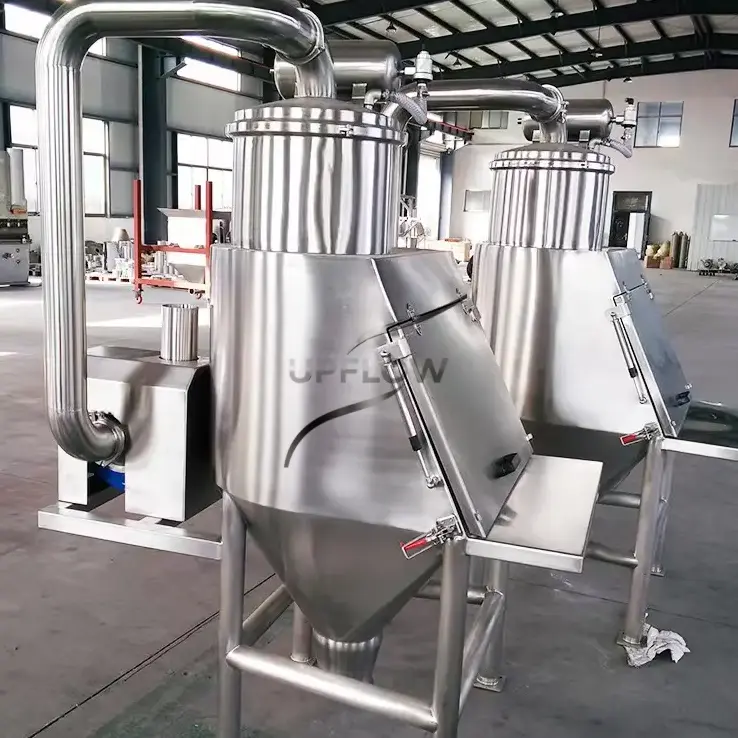
Handling sticky and cohesive powders through a manual bag dumping station can be more challenging than processing free-flowing materials, because certain powders tend to adhere to hopper walls, form stable bridges above discharge openings or accumulate around feeding outlets during material transfer.
These problems can interrupt the feeding process, increase manual cleaning requirements and reduce the consistency of material supply to downstream production equipment, particularly when the bag emptying station is connected to a screw feeder, pneumatic conveying system, mixer or automated batching line.
For manufacturers processing fine chemical powders, mineral materials, food ingredients and other cohesive bulk solids, the hopper and discharge arrangement should therefore be designed according to the actual material flow characteristics rather than relying on a standard hopper geometry for every application.
This article explains how to evaluate sticky powder handling problems, select an appropriate hopper structure, determine suitable discharge arrangements and choose mechanical flow assistance devices for industrial bag emptying and powder feeding applications.
1. Why Do Sticky Powders Cause Problems in Bag Dumping Stations?
Sticky powders do not necessarily behave like conventional free-flowing granular materials, because their particles may adhere to one another or to equipment surfaces under the influence of moisture, particle size, electrostatic forces and material composition.
When these materials are introduced into a receiving hopper through a bag emptying or sack tipping station, several flow problems may develop.
1.1 Powder Bridging
Powder bridging occurs when material forms a stable structure above the hopper outlet, preventing the material above it from discharging normally.
The problem may become more significant when the hopper outlet is relatively small, the material has high cohesion or the hopper wall geometry does not provide sufficient conditions for reliable flow.
1.2 Ratholing
Ratholing occurs when material discharges through a relatively narrow central channel while the surrounding powder remains stationary along the hopper walls.
This condition can result in incomplete hopper emptying, material accumulation and inconsistent feeding rates, especially when the powder has strong cohesive characteristics.
1.3 Wall Adhesion and Material Build-Up
Some fine powders adhere to stainless steel or other contact surfaces, gradually forming layers around the hopper walls, discharge transitions and feeding equipment.
Material build-up may reduce the effective hopper volume, interfere with discharge mechanisms and increase the frequency of manual cleaning.
1.4 Irregular Discharge
Even when powder does not completely block the hopper outlet, unstable material movement may cause fluctuations in the feeding rate.
This can create problems for downstream weighing systems, screw feeders, vacuum conveying equipment and batch production processes that require a more consistent material supply.
Understanding which of these problems occurs with the actual material is the first step toward selecting a suitable cohesive powder handling solution.
2. How to Design a Hopper for Sticky and Cohesive Powders
Hopper design is one of the most important factors affecting the discharge behavior of cohesive materials, because the hopper geometry determines how powder moves toward the outlet and whether stagnant material regions develop along the walls.
2.1 Hopper Wall Angle
The hopper wall angle should be evaluated according to the material’s flow properties and the friction characteristics between the powder and the contact surface.
A steeper hopper may help improve material movement in certain applications, but simply increasing the wall angle does not guarantee reliable discharge.
The appropriate geometry depends on factors such as:
Powder cohesion and internal friction.
Wall friction against the selected contact material.
Particle size distribution.
Moisture content and storage conditions.
Required discharge rate.
Hopper outlet dimensions.
For difficult cohesive powders, engineering assessment of the material’s flow properties may be necessary to determine whether a mass-flow or other suitable hopper configuration is appropriate.
2.2 Hopper Outlet Dimensions
The discharge opening should be designed according to the material’s tendency to form stable arches or bridges, rather than selecting the outlet size solely according to the required nominal feeding capacity.
A relatively small outlet may restrict material movement and increase the risk of blockage, while an excessively large outlet may introduce additional challenges involving downstream flow control and equipment sizing.
For applications involving highly cohesive powders, representative material testing and appropriate hopper flow calculations can help determine a more suitable outlet arrangement.
2.3 Smooth Internal Surfaces
The internal surface finish can influence wall adhesion and material retention, particularly when handling fine powders that tend to accumulate around welded connections and surface irregularities.
Stainless steel contact surfaces such as SUS304 or SUS316L may be considered according to the chemical compatibility and cleaning requirements of the material.
The internal construction should also minimize unnecessary ledges, sharp transitions and inaccessible areas where powder can accumulate.
However, a smoother surface alone cannot eliminate bridging when the underlying material has strong cohesive properties or the hopper geometry is unsuitable.
2.4 Hopper Transition and Outlet Design
The transition between the hopper body and discharge outlet should provide an appropriate flow path without introducing unnecessary restrictions.
For example, sudden changes in cross-sectional area or unsuitable outlet positioning may create stagnant regions where cohesive powder accumulates.
The discharge arrangement should therefore be coordinated with the selected screw feeder, rotary valve or other downstream equipment to maintain a suitable material flow path.
3. Which Discharge Devices Are Suitable for Sticky Powders?
Different cohesive powders require different discharge assistance methods, and the most appropriate solution depends on the material’s flow characteristics, hopper geometry and required feeding rate.
3.1 Hopper Vibrators
External pneumatic or electric vibrators may be considered when material adhesion or poor discharge causes powder accumulation around hopper walls.
The vibration introduces mechanical energy into the hopper structure, which may help loosen material and improve discharge under suitable operating conditions.
However, vibrator selection and installation position are important, because excessive or incorrectly applied vibration can compact certain cohesive materials, create additional structural loads or transfer unwanted vibration to weighing equipment.
For this reason, the vibration force, operating duration and mounting arrangement should be evaluated according to the actual hopper design.
3.2 Bin Activators
A bin activator is a specialized device designed to promote material movement near a storage hopper or silo outlet.
It can be considered for applications where cohesive powders require assistance in moving toward the discharge point, particularly when a conventional hopper arrangement does not provide sufficiently reliable flow.
The selection should consider the vessel dimensions, material characteristics, required discharge capacity and compatibility with the downstream feeding equipment.
3.3 Mechanical Agitators
Mechanical agitation may be considered when sticky material requires more direct assistance to prevent accumulation or promote movement toward the discharge outlet.
Depending on the equipment configuration, suitable internal devices may include rotating agitators or other mechanical flow assistance mechanisms.
However, mechanical agitation is not suitable for every powder, because excessive mechanical action may cause material degradation, increased dust generation or undesirable changes in bulk density.
3.4 Hopper Massage Pads
Flexible pneumatic massage pads can be installed at selected hopper wall locations to provide localized movement assistance for certain cohesive powders.
By periodically applying pressure to the hopper wall, these devices can help disturb material accumulation and improve discharge in applications where conventional vibration alone is insufficient.
Their suitability depends on the hopper construction, material characteristics, operating pressure and required maintenance arrangements.
3.5 Flexible Screw or Controlled Feeding Devices
In some applications, the solution may involve modifying the discharge equipment rather than adding more vibration to the hopper.
A suitably configured screw feeder can provide controlled material withdrawal from the hopper, provided that the outlet geometry and material supply arrangement allow consistent feeding.
For cohesive materials, the screw design, inlet arrangement and hopper interface should be evaluated together to avoid creating a feeding restriction at the outlet.
The final selection should be based on representative material behavior rather than assuming that one anti-bridging device can solve every sticky powder discharge problem.
4. How to Select the Right Discharge Assistance Method
The following comparison provides a preliminary reference for evaluating different material flow assistance options.
| Equipment | Main function | Applications to evaluate |
| Hopper vibrator | Introduces vibration into hopper structure | Certain powders with wall adhesion or poor flow |
| Bin activator | Promotes material movement near outlet | Storage hoppers and cohesive bulk solids |
| Mechanical agitator | Provides direct mechanical material movement | Selected sticky and difficult-flowing powders |
| Pneumatic massage pads | Applies localized movement to hopper walls | Certain cohesive powders with wall accumulation |
| Screw feeder | Controls material discharge and transfer | Applications requiring controlled powder feeding |
| Vibrating sieve | Separates selected particles and agglomerates | Processes requiring preliminary screening |
It is important to distinguish between flow assistance and screening, because a vibrating sieve is designed to separate material according to its particle size, whereas a hopper vibrator or massage pad is intended to influence material discharge.
For some applications, a combination of hopper geometry optimization, mechanical flow assistance and controlled screw feeding may provide a more suitable arrangement than relying on a single device.
5. How to Integrate Sticky Powder Feeding with Dust Collection
Sticky powders can create additional dust collection challenges when operators open bags and discharge material into the receiving hopper, particularly when the material contains fine particles that become airborne during handling.
A suitable bag emptying station should therefore consider the relationship between the feeding opening, hopper enclosure and dust extraction system.
5.1 Dust Extraction at the Bag Dumping Opening
The bag dumping area should provide an appropriately enclosed working space with a suitable extraction connection to capture airborne particles during bag opening and tipping.
The required airflow should be determined according to the opening dimensions, operator working position, powder characteristics, duct arrangement and filter resistance.
5.2 Preventing Filter and Duct Accumulation
Certain sticky powders may adhere to filter surfaces or accumulate inside dust collection ductwork, making filtration and cleaning requirements particularly important.
The filter media, dust collector configuration and maintenance access should be selected according to the actual material properties rather than using a standard filtration arrangement without evaluating powder behavior.
5.3 Coordination with Downstream Equipment
When the bag emptying station feeds a screw conveyor or pneumatic conveying system, the dust collection arrangement should be coordinated with the material transfer process.
The objective is to capture airborne powder without interfering with the intended material flow or creating unsuitable pressure conditions around the feeding equipment.
For further guidance, read Bag Dump Station Dust Collector Sizing: Airflow and Filter Selection.
6. Industry Applications for Sticky Powder Handling
Different industries process powders with different moisture levels, particle sizes and cohesive characteristics, meaning that hopper and discharge designs should be evaluated according to the actual material rather than relying only on the industry category.
6.1 Chemical Manufacturing
Chemical production facilities may handle fine additives, pigments, mineral fillers and other powders that can accumulate around hopper walls or discharge outlets.
A suitable feeding station may incorporate a customized hopper, selected flow assistance devices and a controlled screw feeder to support the required material supply process.
6.2 Food Ingredient Processing
Certain food ingredients, including fine starches, powdered additives and other moisture-sensitive materials, may present flow and cleaning challenges during bag emptying.
For these applications, the hopper construction should consider product-contact material compatibility, cleaning accessibility and the requirements of the customer’s food production process.
6.3 Pharmaceutical Powder Handling
Pharmaceutical powders may require more controlled material containment, cleaning procedures and contact-surface specifications.
The feeding equipment should be selected according to the actual formulation, contamination control requirements and applicable production standards, rather than assuming that all pharmaceutical powders have identical flow properties.
6.4 Mineral and Battery Materials
Some fine mineral powders and battery material ingredients may exhibit cohesive behavior or material accumulation under specific storage and environmental conditions.
The hopper and discharge arrangement should be evaluated using actual bulk density, particle size, moisture content and material flow characteristics before selecting a mechanical assistance method.
7. What Information Is Required to Design a Sticky Powder Hopper?
Before preparing an equipment proposal, the supplier should understand the material properties and actual operating conditions, because the same hopper geometry may perform differently when processing powders with different cohesion and wall friction characteristics.
| Parameter | Information required | Engineering purpose |
| Material name | Actual powder name | Initial material assessment |
| Particle size | Particle size distribution | Flow and discharge evaluation |
| Bulk density | Loose and settled density | Hopper capacity calculation |
| Moisture content | Actual operating moisture | Cohesion and adhesion assessment |
| Flowability | Free-flowing or cohesive | Discharge arrangement |
| Bag weight | 20 kg, 25 kg, 50 kg or other | Bag dumping configuration |
| Hopper volume | Required working volume | Equipment sizing |
| Required capacity | kg/h or batches per hour | Discharge device selection |
| Material contact surface | SUS304, SUS316L or other | Compatibility and cleaning |
| Downstream equipment | Screw feeder, rotary valve or pneumatic conveying | Outlet integration |
| Cleaning requirements | Manual or other validated procedure | Structural and access design |
Where the material has strong cohesive characteristics, representative flow-property testing may be necessary to evaluate wall friction, cohesive strength and the potential for arching or ratholing.
Providing material samples, technical data sheets and photographs of existing feeding problems can help the equipment supplier evaluate a more appropriate hopper and discharge arrangement.
8. UPFLOW Powder Feeding and Conveying Project References
8.1 Magnesium Silicate Pneumatic Conveying and Batching Project
UPFLOW supplied a customized magnesium silicate powder conveying and batching system for an overseas industrial customer, integrating manual bag dumping, pneumatic conveying, weighing hoppers, screw feeding equipment, storage and centralized control.
The project demonstrates how the bag feeding stage can be integrated with downstream conveying and batching equipment according to the material characteristics and production requirements.
For manufacturers evaluating a customized powder feeding arrangement, this project provides a practical reference for connecting material introduction, conveying, weighing and controlled discharge within one integrated process.
Read more about the Magnesium Silicate Pneumatic Conveying and Batching System Project.
8.2 PVC Powder Feeding and Vacuum Conveying Project
For a new materials manufacturer, UPFLOW supplied a customized PVC powder feeding and vacuum conveying system incorporating bag unloading equipment, vacuum conveying units, stainless steel pipelines, receiving hopper modifications, dust collection connections and centralized electrical control.
The system connected the bag unloading area with multiple downstream receiving points, demonstrating how customized hopper arrangements and enclosed conveying equipment can be integrated according to an existing factory layout.
The project provides a relevant reference for industrial powder feeding and conveying integration, although it should not be interpreted as a specific sticky-powder hopper performance test.
Read more about the PVC Powder Feeding and Vacuum Conveying System Project.
9. Frequently Asked Questions
Q1. Why do sticky powders block bag dumping station hoppers?
Sticky powders may develop strong cohesion or adhere to hopper walls, allowing stable bridges to form above the discharge opening or creating material accumulation around the hopper outlet. Moisture, particle size, wall friction and hopper geometry can all influence the severity of the problem.
Q2. What is the best hopper design for cohesive powders?
There is no single hopper geometry suitable for every cohesive powder. The appropriate design should be determined according to material flow properties, wall friction, outlet dimensions and required discharge capacity, with representative material testing considered where necessary.
Q3. Can a hopper vibrator prevent powder bridging?
A hopper vibrator may help improve discharge under suitable conditions, particularly when material accumulates along hopper walls. However, it cannot guarantee the elimination of bridging, and its installation should be evaluated according to hopper geometry and material behavior.
Q4. Are pneumatic massage pads better than hopper vibrators?
Neither solution is universally better. Pneumatic massage pads provide localized movement of selected hopper wall sections, while vibrators introduce mechanical vibration into the structure. The appropriate option depends on the powder characteristics, hopper construction and discharge problem.
Q5. Can sticky powders be discharged using a screw feeder?
Yes, a suitable screw feeder can be used for controlled powder discharge, provided that the hopper outlet, screw geometry and material supply conditions are properly designed. The screw feeder should not be expected to compensate automatically for an unsuitable hopper design.
Q6. Which stainless steel grade is suitable for sticky powder handling equipment?
SUS304 and SUS316L may be considered depending on the chemical composition, moisture conditions, cleaning agents and contamination requirements. The final contact material should be confirmed through material compatibility assessment.
Q7. Can a bag dump station be customized for different cohesive powders?
Yes. The hopper geometry, outlet dimensions, grille, discharge device, dust collection arrangement and downstream connections can be customized according to the actual powder characteristics and production requirements.
Conclusion: Design the Hopper Around the Actual Powder Flow Behavior
A reliable bag dumping system for sticky powders requires coordinated consideration of hopper geometry, discharge opening dimensions, internal surface characteristics and suitable material flow assistance devices, because these factors determine whether cohesive materials can move toward the outlet without excessive accumulation, bridging or irregular discharge.
For chemical, food, pharmaceutical, mineral and other powder processing applications, the equipment configuration should be developed according to the actual material properties rather than relying on a standard hopper design or assuming that a single vibrator or mechanical device can resolve every discharge problem.
UPFLOW provides customized bag dumping stations, powder feeding equipment, hopper discharge arrangements, dust collection systems and pneumatic conveying connections according to customer material specifications and factory layouts.
Experiencing powder bridging, hopper blockage or material build-up during bag emptying? Send UPFLOW your powder specifications, bulk density, moisture content, required feeding capacity and hopper drawings so that our engineering team can evaluate a suitable hopper and discharge configuration.
Explore the UPFLOW Manual Bag Dump Station and Pneumatic Conveying System, or contact our engineering team to discuss your project requirements.