
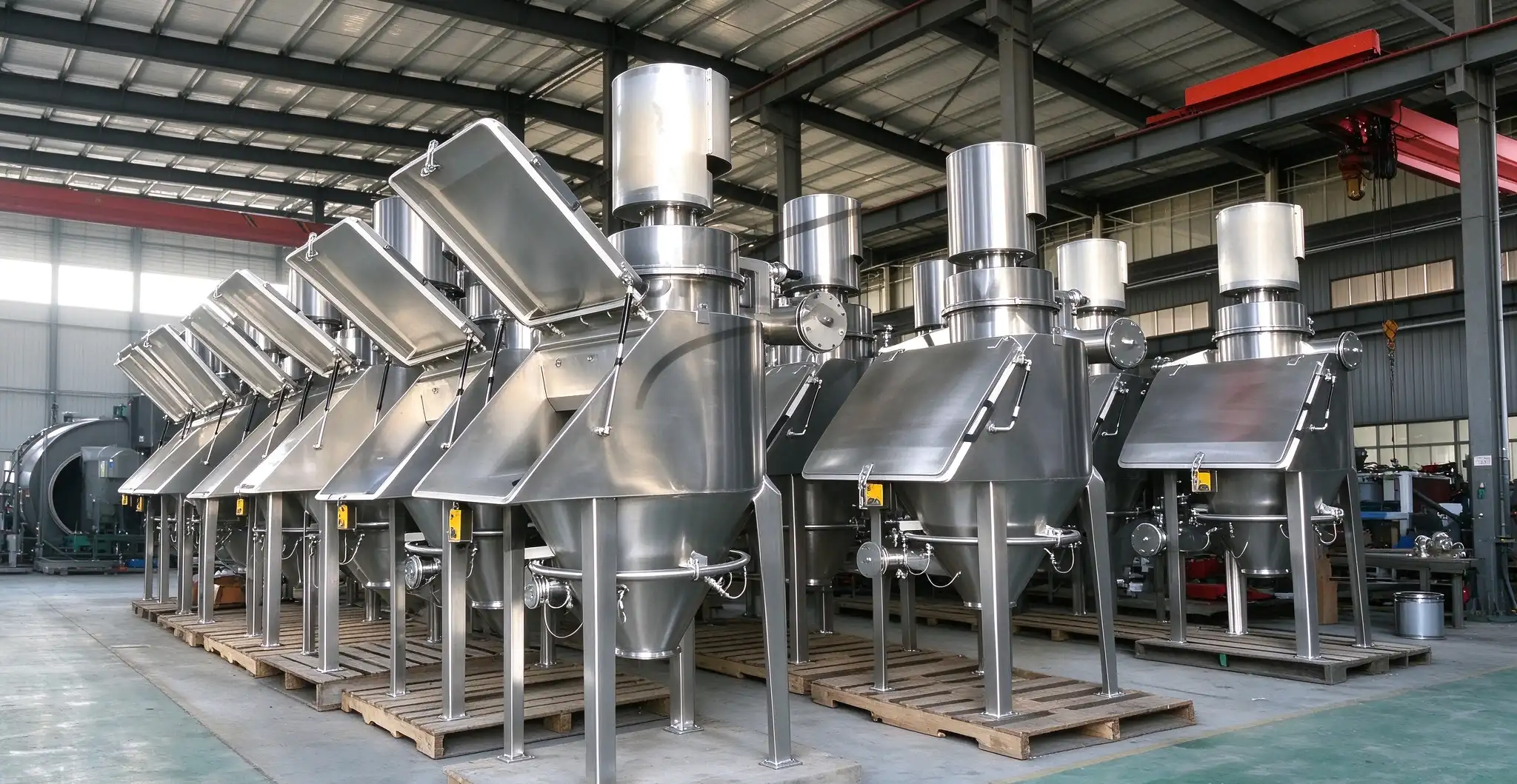
Dust collector filter cleaning is an important part of maintaining the performance of a manual bag dump station, particularly when operators regularly open and discharge fine powders from paper bags, woven sacks or other industrial packaging.
During manual bag emptying, airborne particles are generated as powder falls into the receiving hopper, empty packaging is handled and material accumulates inside the feeding enclosure. A dust extraction system captures these airborne particles and passes the air through filter elements before the cleaned air is discharged.
Over time, collected dust accumulates on the filter surface, increasing airflow resistance and potentially reducing the extraction performance of the dust collector if the filter cleaning system is not operating properly.
For manufacturers handling chemical powders, food ingredients, mineral materials, plastic additives and other fine bulk solids, understanding how to clean dust collector filters and identify maintenance problems is essential for keeping the bag dumping process operating reliably.
This article explains common industrial filter cleaning methods, pulse jet cleaning principles, differential pressure monitoring, filter inspection and replacement considerations for dust collection systems installed on manual bag dump stations.
1. Why Does a Manual Bag Dump Station Need Regular Filter Cleaning?
A manual bag dumping station normally generates airborne dust during several operating stages, including bag cutting, material tipping, empty packaging removal and cleaning around the feeding opening.
The dust collection system draws contaminated air from the enclosed feeding area and directs it through a filter element that captures suspended powder particles.
As dust accumulates on the filter surface, a filter cake gradually develops. Under suitable operating conditions, this dust layer can contribute to filtration, but excessive accumulation increases resistance to airflow.
If the filter is not cleaned effectively, several problems may occur:
Reduced extraction airflow around the bag opening.
Increased pressure drop across the filter element.
Poor dust capture during manual bag emptying.
Increased loading on the fan and cleaning system.
More frequent filter maintenance requirements.
Potential powder accumulation inside the dust collector.
Therefore, filter cleaning is not simply a routine housekeeping activity. It is part of maintaining the intended airflow and dust collection performance of the complete bag dumping station.
2. How Does a Pulse Jet Dust Collector Clean Filter Elements?
Pulse jet cleaning is a commonly used method for cleaning industrial dust collector filter cartridges or filter bags without removing them from the equipment during normal operation.
The system uses short bursts of compressed air to dislodge accumulated dust from the filter surface, allowing the released powder to fall into the dust collection hopper.
A typical pulse jet cleaning arrangement includes:
Filter cartridges or filter bags.
Compressed air storage tank.
Pulse valves.
Blow pipes and nozzles.
Differential pressure monitoring.
Cleaning control system.
Dust collection hopper.
2.1 Normal Filtration Operation
During normal operation, dust-laden air enters the dust collector and passes through the filter media.
The filter elements capture suspended powder particles, while filtered air passes through the media and continues toward the exhaust outlet.
The accumulated dust gradually forms a layer on the filter surface, increasing the resistance to airflow as the filter operates.
2.2 Compressed Air Pulse Cleaning
When the cleaning system activates, a pulse valve releases a short burst of compressed air through the blow pipe toward the filter element.
The rapid air pulse produces a pressure disturbance that helps detach accumulated dust from the filter surface.
The released powder then falls into the collection hopper under gravity and can be removed through an appropriate discharge arrangement.
2.3 Return to Normal Filtration
After the cleaning pulse, the filter element returns to its normal filtration condition.
Depending on the dust collector design, the cleaning sequence may operate automatically at predetermined intervals or according to differential pressure readings.
The pulse duration, compressed air pressure, cleaning interval and valve sequence should follow the dust collector manufacturer’s design requirements rather than being adjusted arbitrarily.
3. What Are the Different Dust Collector Filter Cleaning Methods?
Not every dust collection system uses the same filter cleaning arrangement. The appropriate method depends on the collector structure, filter media, dust characteristics and operating conditions.
3.1 Pulse Jet Cleaning
Pulse jet cleaning is suitable for many industrial cartridge and bag filter dust collectors that require periodic cleaning while maintaining normal operation.
Its main advantages include:
Automatic cleaning operation.
Reduced need for frequent manual filter removal.
Adjustable cleaning sequences according to equipment design.
Suitability for many continuous industrial dust collection applications.
However, compressed air quality, pulse valve condition and cleaning parameters need to be maintained within the manufacturer’s specifications.
3.2 Reverse Air Cleaning
Reverse air cleaning uses airflow in the opposite direction to normal filtration to help remove accumulated dust from filter media.
This method is used in certain larger industrial baghouse configurations, where the collector is designed to support reverse airflow cleaning.
The equipment structure and cleaning sequence differ from pulse jet systems, so the two methods should not be treated as interchangeable.
3.3 Mechanical Shaking
Mechanical shaking uses a mechanical mechanism to move filter bags or other suitable filter elements, allowing accumulated dust to separate from the filter surface.
This method is generally associated with specific baghouse designs and may require filtration to be interrupted in the compartment being cleaned.
The suitability of mechanical shaking depends on filter construction, dust properties and the required operating sequence.
3.4 Manual Filter Cleaning
Some small dust collection units use removable filter elements that require periodic manual cleaning or replacement according to the manufacturer’s maintenance instructions.
Manual cleaning should only be carried out after the equipment has been safely isolated and the appropriate procedures have been followed.
Operators should not use uncontrolled compressed air or aggressive mechanical brushing on filter media unless the manufacturer explicitly permits the method, because improper cleaning can damage the filter material or release concentrated dust into the workplace.
4. How to Monitor Filter Condition Using Differential Pressure
Differential pressure is one of the most useful indicators for evaluating the operating condition of a dust collector filter.
It represents the pressure difference between the dirty-air side and the clean-air side of the filter element.
As dust accumulates on the filter surface, airflow resistance generally increases, which can result in a higher differential pressure.
Monitoring this value helps operators identify changes in filter loading and determine whether the cleaning system is functioning as intended.
4.1 Increasing Differential Pressure
If the differential pressure gradually increases during normal operation, possible causes include:
Excessive dust accumulation on the filter.
Insufficient pulse jet cleaning.
Blocked or restricted filter media.
Incorrect compressed air supply.
Damaged or malfunctioning pulse valves.
High dust loading beyond the original design conditions.
The appropriate response is to inspect the filter cleaning system and compare the measured pressure difference with the manufacturer’s operating limits.
4.2 Unusually Low Differential Pressure
A lower-than-expected differential pressure does not always indicate that the filter is clean.
It may also indicate:
A damaged or torn filter element.
Incorrectly installed filter cartridges.
Air leakage around filter seals.
A disconnected or malfunctioning pressure measurement line.
If dust is detected on the clean-air side or at the exhaust outlet, the filter elements and sealing arrangements should be inspected.
4.3 Establishing a Maintenance Reference
The dust collector manufacturer should provide the recommended operating differential pressure range and maintenance limits for the selected filter media.
Operators can record the pressure difference during commissioning and compare subsequent readings under similar operating conditions.
The following information can be included in a routine inspection record:
| Monitoring item | What to check |
| Initial differential pressure | Record the clean or commissioning reference |
| Operating differential pressure | Observe changes during normal filtration |
| Pulse cleaning pressure | Check against equipment specifications |
| Pulse valve operation | Confirm the cleaning sequence |
| Extraction airflow | Check whether dust capture remains effective |
| Filter condition | Inspect for damage and abnormal accumulation |
| Dust hopper | Check for excessive powder accumulation |
A fixed differential pressure value should not be applied to every dust collector, because filter media, airflow, dust loading and collector design vary between applications.
5. How Often Should Dust Collector Filters Be Cleaned?
There is no universal filter cleaning interval suitable for every manual bag dump station.
The required cleaning frequency depends on the quantity of dust generated, powder particle characteristics, filter surface area, airflow, operating hours and the performance of the cleaning system.
For a pulse jet dust collector, automatic cleaning may take place during operation according to a programmed interval or differential pressure control strategy.
For smaller systems using removable filters, inspection and cleaning schedules should follow the equipment manufacturer’s recommendations and the actual operating conditions.
A practical maintenance arrangement can include the following checks:
Daily Operating Checks
Observe whether dust extraction is operating normally during bag emptying.
Check for unusual dust leakage around the feeding enclosure.
Observe abnormal alarms or differential pressure readings.
Confirm that the dust discharge arrangement is functioning.
Weekly or Routine Maintenance Checks
Inspect compressed air connections and visible pulse valve conditions.
Check the dust hopper for excessive powder accumulation.
Inspect accessible filter and sealing components according to the maintenance procedure.
Review changes in airflow and differential pressure records.
Periodic Detailed Inspection
Inspect filter elements for wear, tears and deformation.
Check pulse pipes, valves and compressed air supply.
Examine filter installation and sealing arrangements.
Replace filter elements when cleaning no longer restores acceptable performance or when damage is identified.
These are suggested inspection categories, not a universal cleaning timetable. The actual maintenance schedule should be established according to the manufacturer’s instructions, dust characteristics and operating history.
6. What Causes Dust Collector Filters to Become Blocked?
Filter blockage can result from several operating conditions, and cleaning the filter repeatedly without identifying the underlying cause may not solve the problem.
6.1 Excessive Dust Loading
If the dust collector receives more dust than its original design capacity, filter loading may increase rapidly.
This can occur when the material throughput changes, additional feeding openings are introduced or the actual powder characteristics differ from the original design assumptions.
6.2 Fine Powder Characteristics
Very fine powders can penetrate or accumulate within filter media depending on the filter construction and particle characteristics.
The appropriate filter media and surface treatment should therefore be selected according to the actual material and operating requirements.
6.3 Moisture and Condensation
Moisture can cause some powders to become sticky, increasing the possibility of material accumulation on filter surfaces.
Condensation inside the dust collector may also affect filtration performance, particularly when air temperature, humidity and operating conditions are not properly considered.
6.4 Insufficient Pulse Jet Cleaning
Insufficient compressed air pressure, blocked pulse valves, damaged diaphragms or incorrect cleaning sequences may reduce the effectiveness of pulse jet cleaning.
The entire cleaning arrangement should be inspected rather than assuming that the filter itself is the only source of the problem.
6.5 Incorrect Filter Media Selection
Filter media must be compatible with the material, operating temperature, moisture conditions and filtration requirements.
Selecting filter media solely according to a nominal filtration efficiency may overlook other important factors such as dust release characteristics, surface treatment and cleaning compatibility.
7. When Should a Dust Collector Filter Be Replaced?
Cleaning can restore some filter performance when the accumulated dust is removable and the filter media remains in good condition.
However, cleaning cannot repair physical damage or restore every type of degraded filter element.
Filter replacement should be considered when:
Filter media is torn, punctured or visibly damaged.
Seals or connecting arrangements cannot maintain proper isolation.
Persistent high differential pressure remains after the approved cleaning process.
Dust appears on the clean-air side of the collector.
The filter has reached the manufacturer’s recommended service life.
Filtration performance cannot be restored through the prescribed maintenance procedure.
Before replacing a filter, operators should also inspect the pulse jet cleaning system, dust discharge arrangement and operating conditions to determine whether an underlying equipment problem is causing repeated filter failure.
Replacement filters should match the original equipment specifications, including dimensions, filter media, sealing design and operating requirements.
8. How to Maintain Dust Collection Performance During Bag Emptying
Filter maintenance is only one part of dust control at a manual bag dumping station.
The feeding enclosure, extraction opening, dust collector, filter media and downstream powder handling arrangement should be evaluated as one integrated system.
8.1 Maintain Suitable Negative Pressure
The bag dumping enclosure should maintain the intended airflow direction during bag opening and material discharge.
If the extraction airflow is insufficient or the enclosure has excessive air leakage, dust may escape into the operator’s working area.
8.2 Inspect the Extraction Ductwork
Dust accumulation, damaged flexible connections and leaking duct joints may affect extraction performance.
The duct arrangement should be inspected according to the operating conditions and the characteristics of the handled powder.
8.3 Coordinate Dust Collection with Material Feeding
The dust collector should be designed around the actual feeding opening, operating sequence and downstream equipment.
For applications where powder enters a screw feeder or vacuum conveying system, the extraction arrangement should not create unintended airflow interference with the material transfer process.
8.4 Select Filter Media According to the Material
Different powders may require different filter media and surface treatments.
Chemical compatibility, operating temperature, humidity, dust loading and any combustible-dust characteristics should be evaluated before selecting a filter element.
Where combustible dust may be present, the dust collection system must also undergo an appropriate process hazard assessment and be designed with suitable protection measures in accordance with applicable requirements.
For a broader discussion of airflow and filter selection, read Bag Dump Station Dust Collector Sizing: Airflow and Filter Selection.
9. UPFLOW Manual Bag Dump Station and Dust Collection Integration
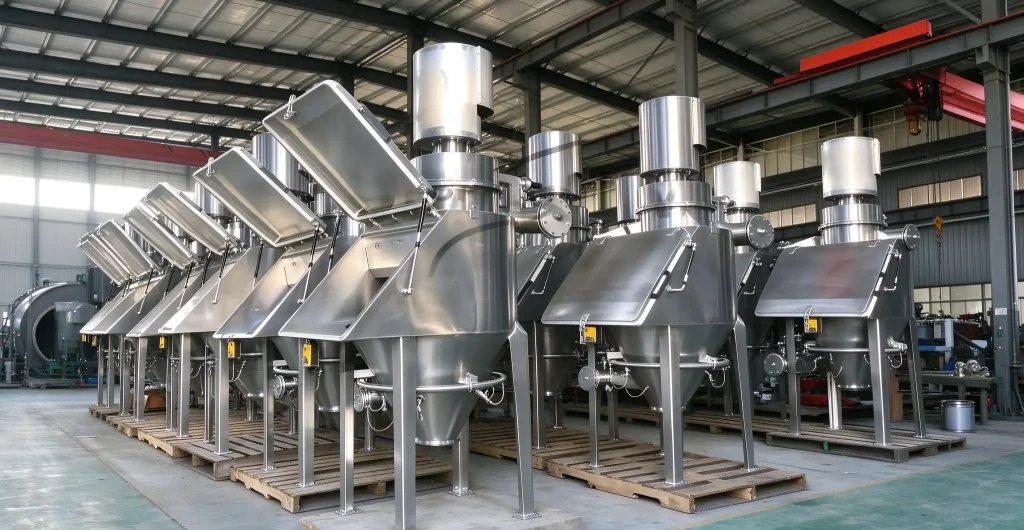
UPFLOW’s Manual Bag Dump Station is designed for controlled emptying of powders and granules from small bags, with an integrated dust collection arrangement that helps capture airborne particles generated during manual feeding.
The operating process can include automatic activation of the dust extraction fan when the feeding door is opened, followed by manual bag emptying and filter back-blowing after the feeding operation is completed.
The equipment can be configured with suitable filter elements, dust collection connections and optional components according to the customer’s material characteristics and production requirements.
For applications requiring further material transfer, the station can also be connected to screw feeding equipment or a vacuum conveying system.
9.1 Magnesium Silicate Pneumatic Conveying and Batching Project
UPFLOW supplied a customized magnesium silicate pneumatic conveying and batching system for a Kenyan industrial customer, integrating manual bag dumping, vacuum conveying, weighing hoppers, screw conveying equipment, filtration, controls and storage equipment.
The project demonstrates how manual feeding, dust collection and enclosed material transfer can be coordinated as part of a larger powder handling process.
Read more about the Magnesium Silicate Pneumatic Conveying and Batching System Project.
9.2 PVC Powder Feeding and Vacuum Conveying Project
For a new materials manufacturer, UPFLOW supplied a customized PVC powder feeding and vacuum conveying system incorporating bag unloading equipment, dust collection and filtration connections, stainless steel conveying pipelines, receiving hopper modifications and centralized electrical control.
The project illustrates how bag unloading and filtration arrangements can be integrated with enclosed powder transportation to multiple downstream receiving points.
Read more about the PVC Powder Feeding and Vacuum Conveying System Project.
These are project-specific examples of UPFLOW’s powder feeding and conveying integration experience; they should not be interpreted as published filter cleaning performance tests or universal filter replacement intervals.
10. Frequently Asked Questions
Q1. How often should dust collector filters be cleaned?
The cleaning frequency depends on dust loading, filter media, airflow, operating hours and the dust collector’s cleaning design. Pulse jet systems may clean filters automatically during operation, while smaller removable filter units require inspection according to the manufacturer’s maintenance instructions.
Q2. What is pulse jet filter cleaning?
Pulse jet cleaning uses short bursts of compressed air to dislodge accumulated dust from filter bags or cartridges, allowing the released powder to fall into the dust collector hopper.
Q3. What does high differential pressure mean in a dust collector?
High differential pressure generally indicates increased airflow resistance across the filter elements. Possible causes include dust accumulation, insufficient cleaning, blocked filter media or problems with the compressed air cleaning system.
Q4. Can I clean a dust collector filter using compressed air manually?
Only when the filter manufacturer explicitly permits the procedure and the equipment has been safely isolated. Uncontrolled compressed air can damage filter media or disperse hazardous dust into the workplace.
Q5. How do I know when a filter cartridge needs replacement?
Replacement may be necessary when the filter is physically damaged, dust appears on the clean-air side, seals fail or differential pressure remains outside the acceptable operating range after the approved cleaning process.
Q6. Which filter material is suitable for fine powder collection?
The appropriate filter media depends on particle characteristics, operating temperature, moisture, chemical compatibility and the required filtration performance. Polyester-based media and other specialized materials may be considered, but the final selection should follow an application-specific assessment.
Q7. Can a manual bag dump station use an automatic filter cleaning system?
Yes. A manual bag dump station can incorporate an automatic pulse jet cleaning arrangement, depending on the dust collector design, filter configuration and control requirements.
Conclusion: Maintain Filter Performance to Support Reliable Powder Feeding
Regular dust collector filter inspection and cleaning help maintain airflow resistance within the intended operating range and support effective dust capture during manual bag emptying.
For industrial applications handling fine powders, a reliable maintenance strategy should combine differential pressure monitoring, appropriate pulse jet cleaning, inspection of filter elements, compressed air system maintenance and timely filter replacement when required.
UPFLOW provides customized manual bag dump stations with integrated dust collection arrangements and connections to downstream powder feeding and pneumatic conveying equipment according to customer material characteristics and production requirements.
Looking for a manual bag dumping station with an integrated dust collection system? Send UPFLOW your material specifications, bag weight, required feeding capacity, dust control requirements and operating conditions so that our engineering team can evaluate a suitable configuration.
Explore the UPFLOW Manual Bag Dump Station and Vacuum Feeding System, or contact our engineering team to discuss your project requirements.