
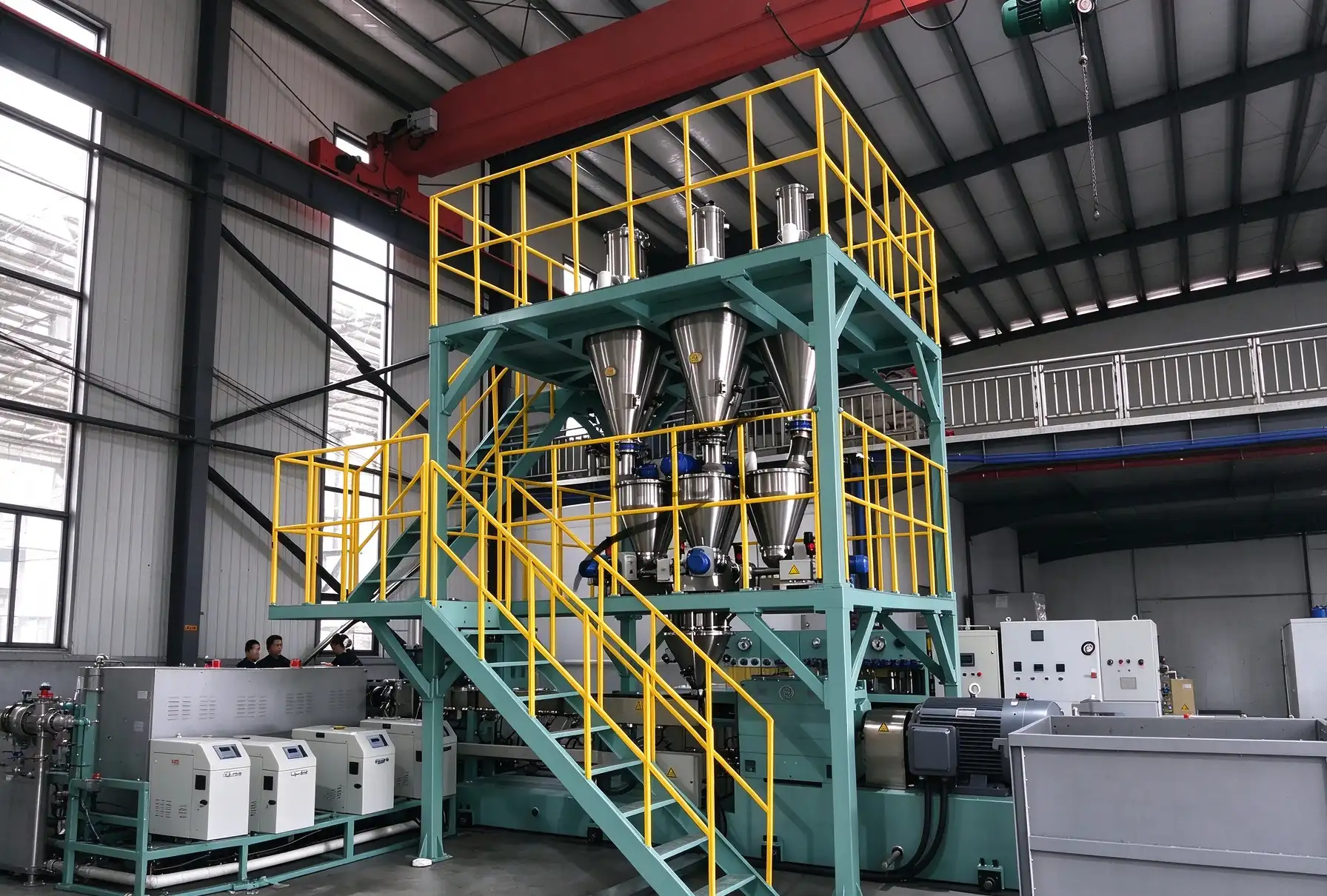
Powder batching accuracy is one of the most important performance requirements when selecting an automated weighing and dosing system, particularly for manufacturers handling multiple raw materials that must be delivered into a mixer, reactor, storage vessel or production line according to a predefined recipe.
In applications involving chemical additives, battery materials, pharmaceutical ingredients, food powders and other industrial bulk solids, even relatively small deviations in individual ingredient quantities can affect formulation consistency, product quality and the stability of subsequent production processes.
However, when a supplier specifies a powder batching accuracy of ±0.2%, buyers should first establish what this percentage represents, because the accuracy of a load cell, the weighing resolution of an instrument and the actual deviation of a completed batch are different performance indicators that cannot be treated as interchangeable specifications.
A complete powder batching system must consider the weighing hopper, load cells, feeding devices, material flow characteristics, mechanical connections, control logic and operating conditions together, since the final dosing result depends on the performance of the entire weighing and feeding process rather than the sensor specification alone.
This article explains how to define a ±0.2% batching tolerance, calculate the acceptable weight deviation, select an appropriate weighing principle and verify actual dosing performance through calibration, repeated batch testing and documented acceptance procedures.
1. What Does ±0.2% Powder Batching Accuracy Actually Mean?
The first step in defining batching accuracy is identifying the reference value used to calculate the percentage deviation.
For most batch weighing applications, a relative batching tolerance can be defined by comparing the actual discharged or collected material weight against the target batch weight.
The basic formula is:
Batch Weight Deviation (%) = [(Actual Weight − Target Weight) ÷ Target Weight] × 100%
For a target batch weight of 1,000 kg, a tolerance of ±0.2% means that the acceptable deviation is:
1,000 × 0.2% = ±2 kg.
Therefore, the acceptable actual batch weight would be between 998 kg and 1,002 kg, provided that the agreed acceptance criterion is based on the total batch weight.
The following examples illustrate how the same percentage tolerance translates into different absolute weight deviations.
| Target batch weight | ±0.2% allowable deviation | Acceptable weight range |
| 100 kg | ±0.2 kg | 99.8–100.2 kg |
| 250 kg | ±0.5 kg | 249.5–250.5 kg |
| 500 kg | ±1 kg | 499–501 kg |
| 1,000 kg | ±2 kg | 998–1,002 kg |
| 2,000 kg | ±4 kg | 1,996–2,004 kg |
| 5,000 kg | ±10 kg | 4,990–5,010 kg |
This calculation provides a useful starting point for equipment selection, but the buyer and supplier must also agree whether the tolerance applies to the total batch, each individual ingredient, the weighing instrument or the complete material discharge process.
1.1 Total Batch Accuracy vs. Individual Ingredient Accuracy
In a multi-component batching system, the total batch may meet its target weight even when individual ingredients have different weighing deviations.
For example, a recipe containing four ingredients may achieve the specified total batch weight while one ingredient is over-dosed and another is under-dosed.
For applications where recipe composition is critical, the acceptance criteria should therefore define the allowable deviation for each ingredient rather than relying exclusively on the final combined batch weight.
1.2 Accuracy vs. Repeatability
Accuracy describes how close a measured result is to the target or reference value, whereas repeatability describes how consistently the system produces similar results when the same operation is repeated under comparable conditions.
A system may repeatedly deliver nearly identical weights while maintaining a systematic deviation from the target, which means good repeatability does not automatically demonstrate good accuracy.
Both parameters should be evaluated when establishing the performance requirements of a precision powder batching system.
2. Which Weighing System Is Suitable for ±0.2% Powder Batching?
The weighing principle has a significant influence on the achievable dosing performance, particularly when material bulk density changes or the production process requires accurate measurement of multiple ingredients.
2.1 Gain-in-Weight Batching System
A gain-in-weight system measures the increase in weight of a receiving vessel, weighing hopper or mixer as material is introduced.
The feeding equipment delivers material into the weighing container until the measured weight reaches the programmed target, after which the feeding operation stops.
This arrangement is commonly considered for batch production where several ingredients are weighed sequentially into a common vessel or individual weighing hoppers.
Its main advantages include:
Direct measurement of material weight entering the receiving vessel.
Suitability for recipe-based batch production.
Integration with screw feeders and other controlled feeding devices.
Flexibility for sequential dosing of multiple ingredients.
Ability to coordinate weighing and material transfer through PLC control.
However, achieving a tight tolerance requires careful consideration of material flow after the feeder stops, mechanical disturbances, weighing vessel tare conditions and the control system’s ability to compensate for residual material discharge.
2.2 Loss-in-Weight Feeding System
A loss-in-weight system measures the reduction in weight of a supply hopper as material is discharged through a controlled feeder.
The control system calculates the actual material flow based on the measured weight reduction and adjusts the feeder speed to maintain the required dosing rate.
This principle is commonly used in continuous gravimetric feeding applications where a stable mass flow is required rather than a fixed batch weight.
For applications involving fluctuating bulk density, gravimetric feeding can provide an advantage over purely volumetric feeding because the system measures mass rather than assuming that a fixed feeder volume always represents the same material weight.
2.3 Gravimetric vs. Volumetric Dosing
A volumetric feeder controls material delivery according to volume or feeder displacement, while a gravimetric system uses weight measurement to monitor and control the actual material quantity.
Because powder bulk density can change with material source, moisture, aeration and storage conditions, volumetric dosing may experience greater variation when consistent material mass is required.
The appropriate weighing principle should therefore be selected according to the batch size, ingredient characteristics, required production rate and agreed accuracy target.
For a more detailed overview of the equipment configuration, see UPFLOW’s Automatic Batching System.
3. What Factors Affect ±0.2% Batching Accuracy?
Achieving a specified batching tolerance requires more than installing a high-quality load cell, because mechanical, electrical, material-related and operational factors can all influence the final weighing result.
3.1 Load Cell Selection and Installation
Load cells convert mechanical force into an electrical signal that the weighing controller interprets as weight.
Their capacity, sensitivity, resolution, calibration characteristics and installation arrangement should be selected according to the actual weighing vessel and operating load.
Important considerations include:
Appropriate load cell capacity for the weighing range.
Correct mechanical support and load distribution.
Suitable installation alignment.
Protection against side loads and mechanical interference.
Stable electrical connections and signal transmission.
Proper calibration and verification procedures.
Selecting a load cell with a high nominal accuracy does not automatically guarantee the same accuracy for the complete batching system, because the surrounding mechanical structure and operating conditions also affect the measurement.
3.2 Material Flow and Residual Discharge
One of the most important sources of error in powder dosing is the material that continues falling after the control system sends a stop signal.
When the screw feeder or discharge valve stops, a certain quantity of material may already be moving through the outlet or falling toward the weighing vessel.
This is commonly described as material in flight, and it can cause the actual batch weight to exceed the programmed target if the control system does not account for the remaining material.
A suitable control strategy may use coarse and fine feeding stages, where the system first delivers material at a higher rate and then reduces the feeding rate as the target weight approaches.
The controller can also use a cutoff compensation value based on previous weighing results to improve the stopping point.
3.3 Mechanical Connections and External Forces
The weighing vessel should be mechanically arranged so that external forces do not interfere with the load cell measurements.
Rigid connections to pipelines, conveyors, support structures or other equipment may introduce additional forces that affect the weight signal.
Flexible connections should be selected and installed appropriately, while cables, hoses and surrounding structures should not create unintended mechanical contact with the weighing assembly.
3.4 Vibration and Environmental Conditions
Nearby motors, screw feeders, mixers and other rotating equipment may introduce vibration that affects the stability of weighing signals.
Temperature fluctuations, air currents, dust accumulation and moisture may also influence the measuring system or its supporting components.
For precision batching applications, the weighing structure should be isolated from unnecessary mechanical disturbances, and the control system should use suitable filtering and stable measurement conditions.
3.5 Powder Characteristics
Different powders behave differently during discharge, which means the same dosing equipment may produce different results when processing materials with different flow properties.
Relevant material characteristics include:
Bulk density and its variation.
Particle size distribution.
Moisture content.
Cohesion and flowability.
Aeration and compressibility.
Electrostatic characteristics.
Tendency to bridge or adhere to hopper walls.
For example, a free-flowing mineral powder may discharge consistently through a suitable screw feeder, while a cohesive fine powder may require additional hopper flow assistance and a different feeding strategy.
4. How to Improve Batching Accuracy Through Feeding Control
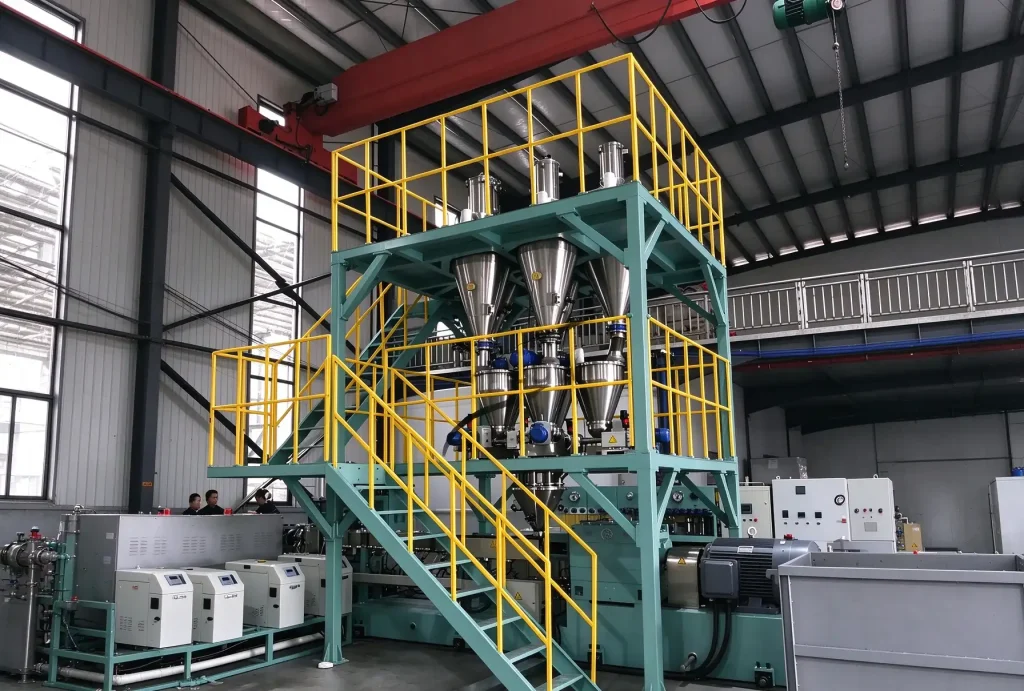
The feeding control strategy is an important part of achieving a tight batch tolerance, particularly when the required material quantity is relatively small compared with the maximum capacity of the weighing vessel.
4.1 Coarse and Fine Dosing
A two-stage dosing strategy is commonly used to balance production speed and final weighing accuracy.
During coarse dosing, the feeder operates at a relatively high speed to deliver most of the target quantity efficiently.
As the measured weight approaches the target, the control system switches to fine dosing at a lower feeding rate, reducing the amount of material that continues to enter the weighing vessel after the stop command.
The switching point should be determined according to the material flow characteristics, feeder response and actual residual discharge quantity.
4.2 Material-in-Flight Compensation
Material-in-flight compensation estimates the amount of powder that continues moving toward the weighing vessel after the feeder stops.
By subtracting an appropriate compensation value from the target weight, the controller can initiate the stopping sequence earlier and reduce the possibility of over-dosing.
The compensation value should be established through actual operating tests because different powders and feeder configurations may produce different residual discharge behavior.
4.3 Suitable Feeding Equipment
The feeding device should provide sufficient control over the material flow rate throughout the dosing cycle.
Depending on the powder characteristics and required capacity, possible arrangements include:
Single or twin screw feeders.
Rotary discharge valves.
Vibratory feeders.
Pneumatic feeding arrangements with controlled discharge interfaces.
Customized feeding devices for difficult-flowing powders.
The feeder selection should be coordinated with the weighing vessel and downstream process rather than treating the feeder as an independent component.
4.4 Stable Weighing Hopper Design
The weighing hopper should provide sufficient capacity for the target batch while maintaining suitable load distribution and material discharge characteristics.
The hopper structure should also allow cleaning and inspection without creating unnecessary material accumulation or mechanical interference with the weighing assembly.
Where several ingredients are dosed separately, the system may use dedicated weighing hoppers or a shared weighing arrangement according to recipe requirements and production cycle time.
5. How to Verify ±0.2% Powder Batching Accuracy
A supplier’s stated accuracy should be supported by an agreed verification method, because a load cell calibration certificate alone does not demonstrate that the complete system can consistently meet the required batch tolerance.
A practical acceptance procedure should include the following stages.
5.1 Confirm the Test Conditions
Before testing begins, the buyer and supplier should define:
Target batch weight.
Required tolerance and its reference basis.
Individual ingredient or total batch acceptance criteria.
Material name and relevant physical properties.
Operating temperature and environmental conditions.
Feeding rate and batch cycle requirements.
Number of repeated test batches.
Independent weighing method and reference equipment.
The test should use representative operating conditions, because results obtained with an easy-flowing test material may not accurately represent the performance of the actual production powder.
5.2 Verify the Weighing Instrument
The weighing system should be checked using suitable calibrated test weights or another agreed verification method.
Where practical, test weights should cover the normal operating range rather than testing only at zero or at one convenient measurement point.
The verification should include:
Zero and tare stability.
Response to known reference weights.
Reading consistency at different load points.
Return-to-zero behavior.
Mechanical interference and load distribution.
Signal stability during normal operation.
For larger weighing vessels where certified test weights cannot cover the full operating range, an appropriate substitution method or another validated procedure may be considered.
5.3 Conduct Repeated Batch Tests
After the weighing system has been verified, the complete feeding and dosing process should be tested through repeated batches.
Each test should use the same agreed recipe, target quantity and operating conditions, with the actual discharged or independently collected material weight recorded for comparison.
The batch deviation can then be calculated using:
Batch Deviation (%) = [(Actual Batch Weight − Target Batch Weight) ÷ Target Batch Weight] × 100%
The test results should be evaluated against the agreed acceptance limits, with both the individual batch deviations and the overall variation reviewed.
5.4 Record and Evaluate the Results
A suitable test record may include the following information:
| Test No. | Target weight | Actual weight | Deviation |
| 1 | 1,000 kg | 1,001 kg | +0.10% |
| 2 | 1,000 kg | 999 kg | -0.10% |
| 3 | 1,000 kg | 1,002 kg | +0.20% |
| 4 | 1,000 kg | 998 kg | -0.20% |
| 5 | 1,000 kg | 1,000 kg | 0.00% |
These figures are illustrative acceptance examples, not measured UPFLOW project results.
If the agreed criterion is ±0.2% of the target batch weight, each batch must fall within the corresponding acceptance range. An average result within tolerance does not compensate for an individual batch that exceeds the permitted deviation.
The acceptance document should also define the number of test batches, the weighing reference, instrument uncertainty and the treatment of invalid or interrupted tests.
5.5 Reverify After Equipment Changes
Changes to load cells, weighing controllers, feeder components, hopper connections or mechanical supports may affect the original calibration and system performance.
The weighing system should therefore be checked again after relevant maintenance or component replacement, following the applicable quality procedure and equipment manufacturer’s recommendations.
For more guidance on weighing verification and preventive maintenance, see Powder Batching System Cost and Configuration Considerations.
6. How to Define a Practical Accuracy Requirement in an RFQ
When preparing an equipment inquiry, buyers should avoid specifying only that the system must achieve ±0.2% accuracy, because this statement does not explain the reference weight, operating range or verification method.
A more useful RFQ should define the following requirements.
| RFQ parameter | Information to specify |
| Batch capacity | Minimum and maximum batch weight |
| Number of ingredients | Number of individual dosing points |
| Target tolerance | ±0.2% or another agreed value |
| Tolerance reference | Individual ingredient or total batch weight |
| Weighing principle | Gain-in-weight or loss-in-weight |
| Load cell specification | Capacity, accuracy class and configuration |
| Feeding method | Screw feeder, rotary valve or other |
| Control method | Coarse/fine dosing and cutoff compensation |
| Material characteristics | Bulk density, particle size and flowability |
| Test procedure | Calibration and repeated batch verification |
| Acceptance criteria | Maximum permitted deviation and test conditions |
| Documentation | Calibration and commissioning records |
For example, an RFQ could specify that a 1,000 kg target batch must be delivered within ±2 kg under defined material and operating conditions, with repeated batch tests performed using an agreed independent weighing reference.
This is much more useful for comparing suppliers than simply requesting a load cell with a nominal accuracy specification.
For a more detailed discussion of supplier quotation requirements, see Pneumatic Conveying and Batching System Supplier: Quotation Scope.
7. Integrating Accurate Batching with Powder Conveying Systems
In many industrial facilities, batching accuracy is closely connected to the upstream feeding arrangement and downstream material transfer process, because the weighing system must receive and discharge the correct quantity of material without introducing additional measurement disturbances.
An integrated system may include:
Raw material storage or bulk bag unloading.
Manual or automatic feeding equipment.
Screw feeders or controlled discharge devices.
Weighing hoppers and load cells.
PLC-based batching and recipe control.
Mixing or processing equipment.
Pneumatic conveying and downstream material transfer.
The configuration should be developed according to the production process, particularly when several powders must be introduced sequentially or transferred between different production areas.
For example, a system may use a dedicated weighing hopper to measure each ingredient before transferring the material into a mixer, while another arrangement may use a weighing vessel that receives several ingredients according to a programmed sequence.
Explore UPFLOW’s Automatic Batching System and Pneumatic Conveying System for integrated powder feeding, weighing and transfer applications.
8. UPFLOW Project References for Powder Batching and Material Handling
8.1 European Artificial Graphite Airflow Mixing Project
UPFLOW has supplied multiple airflow mixing machines for a European battery material manufacturer, with four contracts covering a total of 12 units.
The project involves artificial graphite powder with a particle size below 20 μm, a bulk density of approximately 0.85 t/m³ and a mixing vessel design volume of 60 m³.
The technical requirements include a maximum loading weight of 30 tonnes per batch, a mixing cycle of no more than 30 minutes, a mixing uniformity requirement of CV ≤5% and weighing equipment using load cells with a C3 accuracy class or better.
The system integrates pneumatic material feeding, weighing, mixing, dust collection and controlled discharge, providing a practical example of how weighing requirements can be incorporated into a large-capacity powder processing arrangement.
It is important to distinguish the specified C3 load cell accuracy class from the overall batch dosing accuracy, because the latter must be established through the complete weighing system and actual operating verification.
Read more about the European Artificial Graphite Airflow Mixing Project.
8.2 Magnesium Silicate Pneumatic Conveying and Batching Project
UPFLOW supplied a customized magnesium silicate conveying and batching system for an overseas industrial customer, integrating manual bag dumping, pneumatic conveying, weighing hoppers, screw feeding equipment, storage and centralized control.
The project demonstrates how raw material introduction, weighing, feeding and conveying can be coordinated within an integrated powder handling process according to the customer’s production requirements.
Read more about the Magnesium Silicate Pneumatic Conveying and Batching System Project.
These projects illustrate UPFLOW’s experience in integrated powder processing and batching equipment, but their individual technical specifications should not be interpreted as proof that every system achieves ±0.2% dosing accuracy.
9. Frequently Asked Questions
Q1. What does ±0.2% powder batching accuracy mean?
It means that the measured batch weight is permitted to deviate by 0.2% above or below the agreed reference weight. For a 1,000 kg target batch, this corresponds to an allowable deviation of ±2 kg if the tolerance is defined relative to the target batch weight.
Q2. Can a powder batching system achieve ±0.2% accuracy?
A tolerance of ±0.2% may be achievable in suitably designed and tested applications, but the result depends on batch size, material flowability, weighing equipment, feeder response, mechanical installation and operating conditions. It should be demonstrated through an agreed verification procedure rather than assumed from the load cell specification alone.
Q3. Is load cell accuracy the same as batching accuracy?
No. Load cell accuracy relates to the performance of the weighing sensor under specified conditions, whereas complete batching accuracy includes the weighing structure, feeding equipment, control system, material discharge and actual operating conditions.
Q4. What is the difference between gain-in-weight and loss-in-weight dosing?
Gain-in-weight measures the increase in weight of a receiving vessel as material enters it, whereas loss-in-weight measures the decrease in weight of a supply hopper as material is discharged. Gain-in-weight is commonly used for batch weighing, while loss-in-weight is frequently applied to continuous gravimetric feeding.
Q5. Why does powder dosing exceed the target weight?
Overshooting may occur because material continues falling after the feeder receives a stop signal, a condition commonly described as material in flight. Coarse/fine dosing and suitable cutoff compensation can help reduce this effect.
Q6. How many batches should be tested to verify batching accuracy?
The number of test batches should be agreed between the equipment supplier and buyer according to the process requirements and acceptance procedure. The test should include sufficient repeated operations to evaluate individual batch deviations and repeatability under representative operating conditions.
Q7. Does a C3 load cell guarantee ±0.2% batching accuracy?
No. C3 is a load cell accuracy class under its applicable classification and test conditions, not a guarantee of the complete batching system’s accuracy. System performance also depends on the weighing assembly, installation, control and material feeding process.
Q8. What documents should a supplier provide for a precision batching system?
Depending on the contractual scope, relevant documents may include load cell specifications, calibration records, weighing system drawings, PLC control descriptions, commissioning records, batch test results and an agreed acceptance report.
Conclusion: Define the Tolerance Before Selecting the Batching Equipment
A reliable powder batching accuracy requirement begins with a clear definition of the reference weight, the allowable deviation and the operating conditions under which the system must perform, because a specification such as ±0.2% has limited engineering value unless the buyer and supplier agree on how it will be measured and verified.
For industrial manufacturers requiring accurate recipe control, the weighing hopper, load cells, feeding devices, control algorithms, material flow and downstream process should be designed as one integrated system, with repeated batch testing used to confirm the actual performance against the agreed acceptance criteria.
UPFLOW provides customized automatic batching systems, weighing hoppers, powder feeding equipment and pneumatic conveying solutions according to material characteristics, batch capacity and production requirements.
Planning a precision powder batching system with a ±0.2% tolerance requirement? Send UPFLOW your target batch weight, ingredient list, material specifications, required dosing rate and acceptance criteria so that our engineering team can evaluate a suitable weighing and feeding configuration.
Explore the UPFLOW Automatic Batching System and Pneumatic Conveying System, or contact our engineering team to discuss your project requirements.