
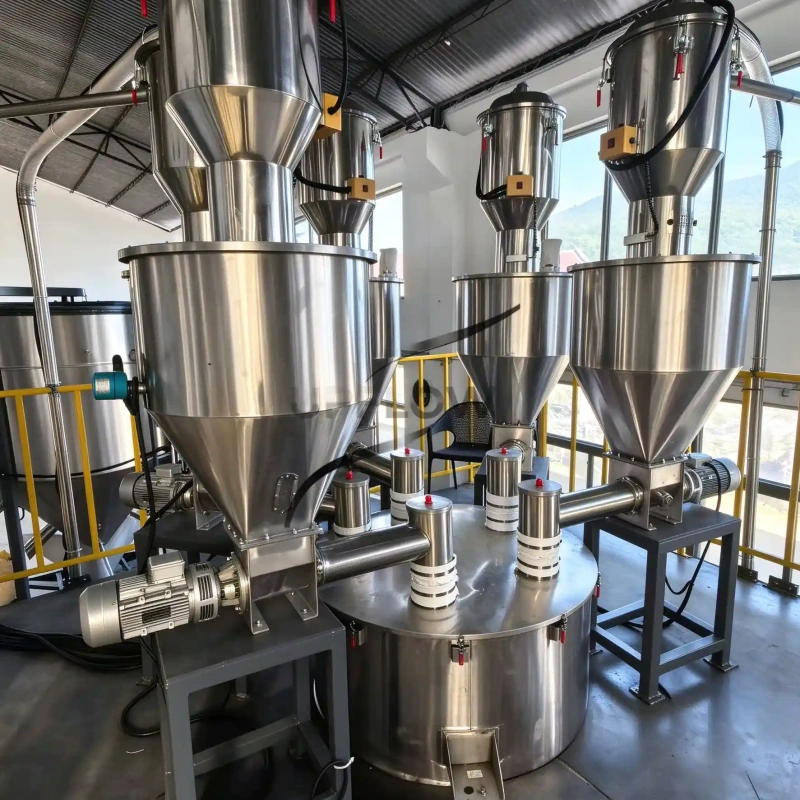
Multi-ingredient powder batching is widely used in industrial production processes where several raw materials must be weighed, proportioned and transferred according to a predefined formulation. In industries such as chemicals, food processing, pharmaceuticals, battery materials and building materials, selecting the right weighing arrangement is essential for maintaining recipe consistency, controlling production cycle time and coordinating material feeding with downstream mixing or processing equipment.
When designing an automatic powder batching system, one of the most important decisions is whether to weigh ingredients sequentially using a shared weighing arrangement or simultaneously through multiple independent weighing units.
A sequential batching system measures different ingredients one after another, generally using a shared weighing hopper or weighing vessel, whereas a parallel batching system uses multiple weighing units to measure different ingredients at the same time before transferring them into a common mixer or receiving vessel.
Both arrangements can support automated recipe-based production, but their equipment configuration, control logic, weighing capacity, material handling requirements and production efficiency can differ considerably.
This article compares sequential and parallel powder batching systems, explains their respective advantages and limitations, and provides practical guidance for selecting a suitable multi-ingredient weighing arrangement according to production requirements.
1. What Is Sequential Powder Batching?
Sequential powder batching is a weighing method in which multiple ingredients are measured one after another according to a predefined production recipe.
In a typical configuration, several raw material feeding units are connected to one common weighing hopper. The PLC control system activates the corresponding feeder according to the recipe sequence, and each ingredient is added until its target weight is reached.
After all required ingredients have been weighed, the combined material is discharged into a mixer, reactor or downstream processing vessel.
A typical sequential batching process follows:
Raw Material A Feeding → Weighing → Raw Material B Feeding → Weighing → Raw Material C Feeding → Weighing → Final Batch Discharge
1.1 Main Equipment Configuration
A sequential powder batching system may include:
Multiple raw material storage hoppers or silos.
Individual screw feeders or rotary discharge devices.
One shared weighing hopper with load cells.
Pneumatic or mechanical discharge valves.
PLC-based recipe control.
Dust collection and material transfer equipment.
A downstream mixer or receiving vessel.
The control system identifies the required ingredient and activates its corresponding feeding device, while the weighing hopper continuously monitors the accumulated material weight.
When the target quantity of one ingredient is reached, the corresponding feeder stops and the next ingredient begins feeding according to the programmed sequence.
1.2 Advantages of Sequential Batching
Sequential batching offers several practical advantages, particularly for production facilities with moderate batch quantities and a limited number of ingredients.
Lower initial equipment complexity
Using a shared weighing hopper can reduce the number of weighing vessels, load cells and associated instruments compared with a fully independent parallel weighing arrangement.
Centralized weighing control
All ingredients pass through the same weighing vessel, allowing the system to use one common weighing reference for sequential dosing.
Simplified equipment arrangement
A centralized weighing structure may require less installation space than several independent weighing stations, depending on the number of ingredients and feeding layout.
Flexible recipe management
The PLC can execute different ingredient sequences and target weights according to the selected production formulation.
1.3 Limitations of Sequential Batching
The main limitation is that ingredients are weighed one after another, meaning that the total batching time increases as the number of ingredients and individual feeding operations increase.
If one ingredient has a relatively low flow rate or requires additional feeding control, subsequent ingredients must generally wait until the previous weighing operation is completed.
The shared weighing hopper must also be suitable for the combined batch weight, and the system needs appropriate cleaning or material segregation arrangements when handling incompatible ingredients or formulations with strict contamination control requirements.
2. What Is Parallel Powder Batching?
Parallel powder batching uses multiple independent weighing units to measure different ingredients simultaneously or during overlapping dosing operations.
Instead of sending every material through one shared weighing hopper, each ingredient is delivered into its own dedicated weighing vessel or weighing channel.
Once the individual ingredients reach their programmed target weights, they can be discharged into a common mixer or receiving vessel according to the process sequence.
A typical parallel batching arrangement follows:
Raw Material A → Weighing Hopper A
Raw Material B → Weighing Hopper B
Raw Material C → Weighing Hopper C
The three weighing operations can proceed simultaneously, subject to the equipment design and production control requirements.
After weighing is completed:
Weighing Hopper A + Weighing Hopper B + Weighing Hopper C → Common Mixer
2.1 Main Equipment Configuration
A parallel batching system may include:
Multiple independent material storage hoppers.
Dedicated screw feeders or controlled feeding devices.
Individual weighing hoppers.
Separate load cell assemblies.
Independent weighing instruments or channels.
Centralized PLC and recipe management.
Discharge valves and transfer equipment.
A common mixer or downstream process vessel.
Each weighing unit measures its assigned ingredient, while the central control system coordinates the dosing process and determines when the individual weighing operations are complete.
2.2 Advantages of Parallel Batching
Shorter potential batching cycle
Multiple ingredients can be weighed simultaneously, reducing the need to wait for one ingredient to finish before starting the next.
Independent ingredient measurement
Each material has its own weighing unit, allowing individual target weights and dosing operations to be controlled separately.
Greater process flexibility
Different materials can use different feeder configurations and feeding rates according to their flow properties and required quantities.
Suitable for higher-throughput production
When the production process requires frequent batches or several ingredients must be measured within a relatively short cycle time, parallel weighing may offer an operational advantage.
2.3 Limitations of Parallel Batching
Parallel batching generally requires more weighing equipment, load cells, instruments, discharge valves and control interfaces.
The system may therefore involve higher initial investment, more installation space and additional maintenance requirements.
Furthermore, the weighing units must be coordinated with the receiving mixer, because simultaneous weighing does not automatically mean that every ingredient can be discharged simultaneously.
The discharge sequence, mixer capacity, material compatibility and potential cross-contamination between ingredients should all be considered during system design.
3. Sequential vs Parallel Weighing: Key Differences
The following comparison summarizes the main engineering differences between the two batching arrangements.
| Comparison | Sequential Batching | Parallel Batching |
| Weighing method | Ingredients weighed one after another | Multiple ingredients weighed simultaneously |
| Weighing hoppers | Usually one shared hopper | Multiple independent hoppers |
| Feeding operation | Sequential | Simultaneous or overlapping |
| Batching cycle | Depends on cumulative feeding time | Can reduce cycle time through overlapping operations |
| Equipment quantity | Generally fewer weighing units | Generally more weighing units |
| Initial investment | Often lower for comparable simple applications | Often higher due to additional equipment |
| Installation space | Often more compact | May require more space |
| Recipe control | Centralized sequential control | Coordinated multi-channel control |
| Maintenance | Fewer weighing stations | More independent weighing stations |
| Application | Moderate throughput and simpler recipes | Higher throughput and multiple simultaneous dosing requirements |
It is important to note that neither arrangement is automatically more accurate than the other.
The actual weighing performance depends on load cell selection, weighing vessel design, material feeding behavior, feeder cutoff compensation, mechanical installation and control strategy.
A properly designed sequential system may achieve better performance than an incorrectly configured parallel system, and vice versa.
4. How Does the Number of Ingredients Affect Batching Cycle Time?
The number of ingredients is an important factor when evaluating whether sequential or parallel weighing is more suitable.
In a sequential system, the total batching time is generally related to the sum of the individual ingredient feeding and weighing times.
For example, if a recipe contains four ingredients with individual dosing times of 30, 40, 25 and 35 seconds, the total active dosing time would be approximately 130 seconds, excluding additional transfer, discharge and process preparation time.
In a parallel system, if all four weighing operations can take place simultaneously, the weighing stage may be completed in approximately the time required by the slowest individual weighing operation.
Using the same example, the idealized parallel weighing time would be approximately 40 seconds.
| Ingredient | Dosing time |
| Material A | 30 seconds |
| Material B | 40 seconds |
| Material C | 25 seconds |
| Material D | 35 seconds |
| Sequential total | 130 seconds |
| Ideal parallel weighing time | 40 seconds |
These figures are illustrative only. Actual production cycle time must also include feeder preparation, weighing stabilization, valve operation, material discharge, conveying and mixer availability.
The parallel arrangement may also require additional time when the individual ingredients are discharged sequentially into the mixer or when the receiving vessel cannot accept all materials simultaneously.
Therefore, production cycle time should be calculated for the complete process rather than comparing only the weighing stage.
5. Which Batching Method Provides Better Weighing Accuracy?
Both sequential and parallel batching can be designed for accurate ingredient dosing, provided that the weighing equipment and material feeding arrangements are properly configured.
However, the two arrangements have different engineering considerations.
5.1 Accuracy Considerations for Sequential Batching
In a sequential system, the shared weighing hopper measures the cumulative weight as each ingredient is added.
The controller calculates the required additional weight for the next ingredient based on the existing measured weight and the recipe target.
This arrangement requires stable tare conditions, suitable measurement resolution and effective feeder cutoff control.
The system should also account for material remaining in the feeding equipment after the stop command, because residual material can affect the final ingredient quantity.
5.2 Accuracy Considerations for Parallel Batching
In a parallel system, each ingredient has an independent weighing unit, allowing the target weight and feeding strategy to be configured separately.
This can be useful when materials have significantly different flow characteristics or dosing requirements.
However, each weighing unit must be calibrated and verified independently, and the control system must coordinate all measurement channels correctly.
Additional mechanical connections, vibration sources and weighing structures also need to be considered when evaluating the overall system accuracy.
5.3 Define the Tolerance Before Selecting the Equipment
Before comparing suppliers, buyers should define whether the required tolerance applies to each individual ingredient or to the combined batch weight.
For example, if a 1,000 kg batch requires a tolerance of ±0.2%, the allowable deviation is ±2 kg when the tolerance is calculated against the total batch target.
If each ingredient must independently meet ±0.2%, the acceptance criteria are different and must be verified separately.
For further technical guidance, read our article on Powder Batching Accuracy: How to Define and Verify ±0.2% Tolerance.
6. How to Select Between Sequential and Parallel Powder Batching
The correct arrangement should be determined according to the production process rather than simply choosing the system with more weighing hoppers.
6.1 Select Sequential Batching When:
The number of ingredients is relatively limited.
The required production throughput can accommodate sequential dosing.
The plant has limited installation space.
A centralized weighing arrangement is preferred.
The initial equipment investment needs to be controlled.
The production process does not require simultaneous ingredient weighing.
6.2 Select Parallel Batching When:
Several ingredients must be weighed within a short production cycle.
The required batch throughput is relatively high.
Different materials require independent feeding strategies.
Separate weighing channels are needed for process control.
The production layout can accommodate multiple weighing units.
The investment is justified by the required production capacity.
6.3 Consider a Hybrid Batching System
In some industrial applications, a combination of sequential and parallel weighing can provide a more suitable solution.
For example, several major ingredients may be weighed simultaneously using dedicated weighing hoppers, while smaller additives are dosed sequentially through a shared precision weighing unit.
This arrangement can balance production throughput, equipment investment, installation space and ingredient dosing requirements.
A hybrid design may be particularly useful when a production recipe contains a few high-volume ingredients and several low-volume additives with different weighing requirements.
The final arrangement should be developed according to the actual recipe structure, batch size and required production cycle.
7. How to Integrate Multi-Ingredient Batching with Powder Feeding and Conveying
A multi-ingredient batching system should be considered as part of the complete powder handling process, because the weighing arrangement must be coordinated with upstream material storage and feeding as well as downstream mixing and conveying.
A typical automated process may include:
Raw material storage in silos, hoppers or bulk bag unloading stations.
Material transfer to individual feeding points.
Controlled ingredient dosing through screw feeders or other feeding devices.
Sequential or parallel weighing according to the recipe.
Discharge into a common mixer or processing vessel.
Transfer of the completed batch to the next production stage.
Depending on the material characteristics, the upstream feeding process may use mechanical conveyors, vacuum feeding systems or positive-pressure pneumatic conveying.
The system design should also consider dust collection, material segregation, cleaning access, weighing stability and PLC communication between the different equipment units.
Explore UPFLOW’s Automated Batching System for multi-material weighing and proportioning applications, and its Pneumatic Conveying System for enclosed powder transfer between feeding and production equipment.
For applications where materials need to be transferred from multiple feeding points, a Vacuum Feeding System may also be considered according to the required capacity and conveying layout.
8. UPFLOW Project References for Integrated Powder Processing
8.1 European Artificial Graphite Airflow Mixing Project
UPFLOW has supplied multiple airflow mixing machines for a European battery material manufacturer, with four separate contracts covering a total of 12 units.
The project handles artificial graphite powder with a particle size below 20 μm and a bulk density of approximately 0.85 t/m³.
Each mixing unit has a design volume of 60 m³ and a maximum loading weight of 30 tonnes per batch, with a mixing cycle requirement of no more than 30 minutes and a mixing uniformity requirement of CV ≤5%.
The system also incorporates weighing equipment using load cells with a C3 accuracy class or better, together with pneumatic feeding, dust collection, controlled discharge and PLC-based operation.
This project provides a practical reference for large-capacity powder processing equipment where material feeding, weighing, mixing and discharge need to be coordinated within an integrated production process.
It should be noted that the project demonstrates large-batch powder processing and weighing integration; it does not establish that the equipment uses a specific sequential or parallel ingredient weighing configuration.
Read more about the European Synthetic Graphite Powder Air Mixing System Project.
8.2 Magnesium Silicate Pneumatic Conveying and Batching Project
UPFLOW supplied a customized magnesium silicate pneumatic conveying and batching system for an industrial customer in Kenya.
The system integrated manual bag dumping, vacuum conveying, weighing hoppers, screw feeding equipment, storage and centralized control to support automated powder transfer and controlled material feeding.
The project demonstrates how upstream bag unloading and pneumatic conveying can be coordinated with downstream weighing and batching equipment as part of a complete powder handling process.
Read more about the Magnesium Silicate Pneumatic Conveying and Batching System Project.
8.3 PVC Powder Feeding and Vacuum Conveying Project
For a new materials manufacturer, UPFLOW supplied a customized PVC powder feeding and vacuum conveying system that connected the bag unloading area with multiple downstream receiving points.
The project incorporated bag unloading equipment, five UPFLOW-320 conveying units, stainless steel pipelines, receiving hopper modifications, dust collection connections and centralized electrical control.
Although the project focused on powder feeding and conveying rather than a multi-ingredient weighing configuration, it demonstrates the importance of coordinating upstream material supply, conveying equipment and downstream production interfaces.
Read more about the PVC Powder Feeding and Vacuum Conveying System Project.
9. Frequently Asked Questions
Q1. What is the difference between sequential and parallel powder batching?
Sequential batching weighs ingredients one after another using a shared weighing arrangement, while parallel batching uses multiple independent weighing units to measure different ingredients simultaneously or during overlapping operations.
Q2. Which batching method is faster?
Parallel batching can reduce the weighing stage time when multiple ingredients are measured simultaneously. However, the actual production cycle also depends on material feeding rates, discharge sequence, conveying time and mixer availability.
Q3. Is parallel weighing more accurate than sequential weighing?
Not necessarily. Both systems can achieve accurate dosing when properly designed. Actual performance depends on load cells, weighing structures, feeding devices, material flow and control strategies.
Q4. How many weighing hoppers are required for a multi-ingredient batching system?
The number depends on the selected batching method, number of ingredients, recipe structure and production requirements. Sequential systems may use a shared weighing hopper, while parallel systems generally require dedicated weighing units for the ingredients being measured simultaneously.
Q5. Can a batching system handle ingredients with different bulk densities?
Yes. However, the feeding and weighing equipment should be configured according to the actual bulk density, flowability, particle size and required dosing rate of each material.
Q6. Can sequential and parallel weighing be combined?
Yes. A hybrid batching system can use dedicated weighing units for major ingredients and a shared precision dosing unit for smaller additives, provided that the control sequence and material transfer arrangement are properly designed.
Q7. What information should be provided when requesting a multi-ingredient batching quotation?
Buyers should provide the ingredient list, target batch weight, individual ingredient proportions, material bulk densities, particle sizes, required production capacity, accuracy requirements, downstream equipment and available installation space.
Q8. Can an automatic batching system be integrated with pneumatic conveying?
Yes. Pneumatic conveying can transfer materials between storage, feeding, weighing and production equipment. The final arrangement should consider conveying capacity, material characteristics, process sequence and the interfaces between the weighing and conveying systems.
Conclusion: Select the Batching Method According to the Production Process
Sequential and parallel powder batching systems both provide practical solutions for multi-ingredient production, but their suitability depends on the number of ingredients, required production throughput, weighing accuracy, available installation space and overall equipment investment.
Sequential batching may be appropriate when ingredients can be weighed one after another without affecting the required production cycle, whereas parallel batching can offer an advantage when several ingredients need to be measured simultaneously and production throughput is a major consideration.
For more complex formulations, a hybrid arrangement combining independent weighing units with centralized precision dosing may provide a balanced solution.
UPFLOW provides customized automatic batching systems, weighing hoppers, screw feeding equipment and pneumatic conveying solutions according to material characteristics, recipe requirements and production layouts.
Planning a multi-ingredient powder batching project? Send UPFLOW your ingredient list, target batch weight, individual material proportions, required batches per hour and accuracy requirements so that our engineering team can evaluate a suitable sequential, parallel or hybrid batching configuration.
Explore the UPFLOW Automated Batching System and Pneumatic Conveying System, or contact our engineering team to discuss your project requirements.