
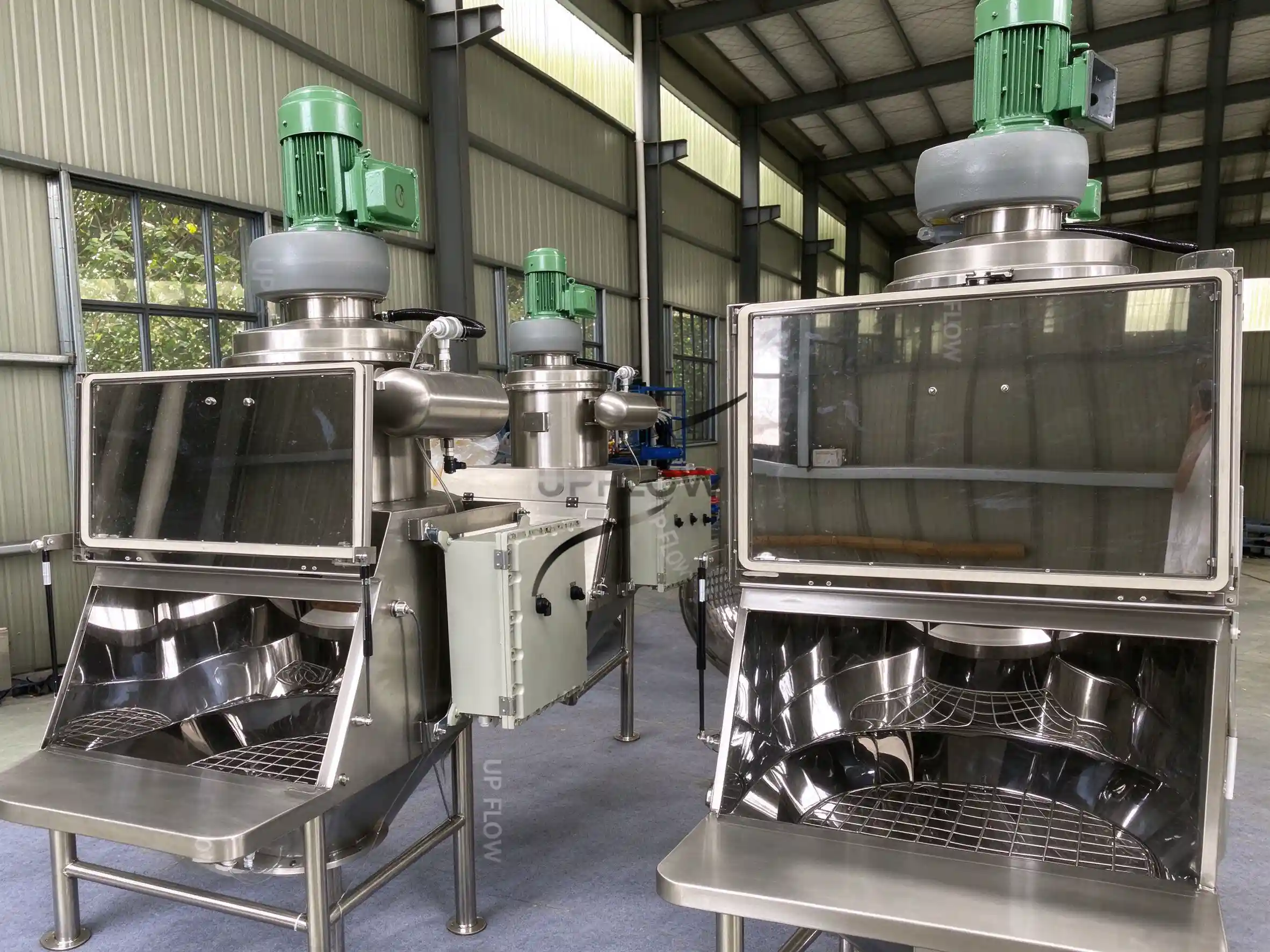
When selecting an industrial bag emptying system for powder handling and production material supply, one of the most important questions for manufacturers is how many bags can be processed per hour, because the actual bag emptying capacity directly influences operator workload, raw material replenishment frequency and the ability of the feeding station to maintain a consistent supply to downstream production equipment.
However, the throughput of a bag dumping or sack emptying station cannot be determined simply by looking at the hopper dimensions or dust collector specifications, since the actual operating capacity depends on several interconnected factors, including bag weight, operator handling time, material flowability, packaging dimensions, screening requirements and the receiving capacity of the downstream conveying system.
For manufacturers handling 20 kg, 25 kg or 50 kg bags, understanding these factors before selecting equipment can help determine whether a standard manual bag emptying arrangement is sufficient or whether additional material handling equipment is required to meet the production target.
This article explains how to calculate bag emptying capacity, estimate powder feeding rates and evaluate the equipment configuration required for different industrial applications, including chemical processing, food ingredient handling, pharmaceutical manufacturing and mineral powder production.
1. What Determines the Capacity of an Industrial Bag Emptying System?
The capacity of a bag emptying system is generally expressed in bags per hour or kilograms per hour, but these two measurements describe different aspects of the material handling process and should be evaluated together.
Bags per hour indicates how many individual packages can be opened and emptied within a given period, whereas kilograms per hour represents the actual quantity of material introduced into the production system.
For example, processing 40 bags of 25 kg material per hour represents a different material throughput from processing 40 bags of 50 kg material per hour, even though the number of packages handled is identical.
The main factors influencing industrial bag emptying capacity include:
Bag weight and dimensions: Larger or heavier bags may require additional time for lifting, positioning, opening and emptying, particularly when the operator must handle each package manually.
Operator handling cycle: The time required to position a bag, open the packaging, discharge the contents and remove the empty packaging directly influences the number of bags processed per hour.
Material flowability: Free-flowing granules and powders may discharge more easily than cohesive materials that tend to bridge, form lumps or adhere to hopper surfaces.
Receiving hopper design: Hopper dimensions, outlet geometry and internal structures influence how consistently the discharged material moves toward downstream equipment.
Screening requirements: An integrated vibrating sieve or screening unit introduces additional material separation and cleaning considerations that may affect the overall operating cycle.
Dust extraction arrangement: The enclosure and extraction configuration should allow operators to work efficiently while maintaining appropriate dust containment.
Downstream equipment capacity: Screw feeders, vacuum conveying systems and receiving hoppers must be able to accept the incoming material without creating a bottleneck.
Consequently, the rated capacity of an industrial sack emptying station should be evaluated as part of the complete powder handling process rather than as an isolated equipment specification.
2. How to Calculate Bags per Hour
A practical starting point for estimating bag emptying capacity is to calculate the average time required to complete one bag handling cycle.
The basic theoretical formula is:
Theoretical Bag Emptying Capacity = 3,600 ÷ Average Bag Handling Time (seconds)
For example, if the complete handling cycle takes an average of 90 seconds per bag, the theoretical throughput would be:
3,600 ÷ 90 = 40 bags per hour.
However, this calculation assumes continuous operation without interruptions, whereas actual production includes time for material replenishment, empty packaging handling, cleaning, repositioning and other routine activities.
A more practical estimation is:
Effective Bags per Hour = (3,600 ÷ Average Cycle Time) × Operating Efficiency
Operating efficiency should be established from actual working conditions or representative production trials rather than treated as a universal value applicable to every bag tipping station.
Illustrative Bag Handling Cycle Comparison
The following examples demonstrate how different handling cycles affect theoretical capacity. These are calculation examples, not guaranteed equipment performance ratings.
| Average cycle time | Theoretical capacity |
| 45 seconds | 80 bags/hour |
| 60 seconds | 60 bags/hour |
| 75 seconds | 48 bags/hour |
| 90 seconds | 40 bags/hour |
| 120 seconds | 30 bags/hour |
| 150 seconds | 24 bags/hour |
The actual cycle time should be measured consistently, from the moment an operator begins handling one bag until the station is ready to receive the next one.
For applications involving heavy packaging, difficult bag opening or cohesive powders, the cycle may require additional time, while an organized working area and suitable bag positioning arrangements may help reduce unnecessary operator movements.
3. How to Convert Bag Emptying Rate into Kilograms per Hour
When evaluating a powder feeding station, buyers should also calculate material throughput in kilograms per hour, because this figure can be compared directly with the production line’s required material consumption.
The formula is:
Powder Feeding Capacity (kg/h) = Bags per Hour × Weight per Bag (kg)
For example, consider a production line that handles 25 kg bags and requires 1,000 kg of raw material per hour.
The required number of bags is:
1,000 ÷ 25 = 40 bags per hour.
The feeding station therefore needs to process an average of 40 bags per hour to meet the specified material demand, assuming the entire contents of each bag are discharged and the process operates continuously.
The following table illustrates how different packaging weights influence the required bag emptying rate for the same material throughput.
| Bag weight | Bags required for 1,000 kg/h |
| 10 kg | 100 bags/h |
| 20 kg | 50 bags/h |
| 25 kg | 40 bags/h |
| 40 kg | 25 bags/h |
| 50 kg | 20 bags/h |
This comparison demonstrates why packaging weight must be confirmed before estimating the required equipment capacity, particularly when a production facility uses several packaging formats for different raw materials.
4. How Material Characteristics Affect Bag Emptying Capacity
The physical properties of the material can significantly influence the time required to empty each bag and maintain a consistent powder feeding rate.
4.1 Free-Flowing Powders and Granules
Free-flowing materials generally discharge more easily through a receiving hopper, provided that the hopper outlet and downstream equipment are appropriately sized.
Examples may include certain plastic granules, coarse mineral materials, dry food ingredients and granular additives.
For these applications, the main capacity limitations may be related to bag handling, packaging opening and the receiving capacity of downstream equipment rather than material discharge itself.
4.2 Fine Powders
Fine powders such as calcium carbonate, silica powder and certain chemical additives may generate airborne dust during bag opening and material tipping.
The bag emptying station therefore needs an appropriate enclosure and dust extraction arrangement, while the operator’s working procedure should allow sufficient time for material discharge without excessive powder escaping from the feeding area.
The dust collection system should be designed according to the actual opening geometry and operating conditions rather than assuming that increasing fan capacity will automatically increase the number of bags processed per hour.
4.3 Cohesive and Poor-Flowing Materials
Some powders tend to form bridges, adhere to hopper walls or accumulate around discharge openings, especially when moisture content, particle characteristics or storage conditions affect their flowability.
In these applications, additional equipment such as hopper vibration devices, mechanical massage pads or suitable agitation mechanisms may be considered to support material discharge.
The selected assistance device should be compatible with the material and hopper design, because excessive vibration or mechanical action may create unwanted dust or affect material characteristics.
4.4 Hygroscopic Materials
Materials that absorb moisture from the surrounding environment may become more difficult to discharge after exposure to humid conditions.
For these applications, equipment selection should consider material storage, packaging opening time, environmental conditions and the need for suitable enclosure or drying arrangements.
5. Does an Integrated Vibrating Sieve Affect Bag Emptying Capacity?
An industrial bag emptying station can be equipped with an integrated vibrating sieve when incoming materials require preliminary separation of oversized particles, agglomerates or selected foreign materials before entering downstream production equipment.
However, adding a screening stage changes the material handling process and may influence the effective feeding rate, particularly when fine mesh sizes, cohesive materials or high screening loads are involved.
The main factors to evaluate include:
Screen mesh aperture and effective screening area.
Material distribution across the screen surface.
Potential mesh blockage and cleaning frequency.
Quantity of oversized material retained.
Accessibility for screen replacement and maintenance.
Capacity of the receiving hopper beneath the screen.
For applications requiring screening, the equipment should be evaluated using representative material to confirm that the combined bag emptying and screening process can meet the required production rate.
For a more detailed discussion, read Bag Dump Station with Integrated Sifter: When Should Screening Be Added?.
6. How to Improve Powder Feeding Efficiency
Increasing the number of bags processed per hour does not necessarily require increasing the size of the feeding station, because improvements in operator workflow, equipment arrangement and downstream material handling may have a significant influence on overall productivity.
6.1 Optimize the Operator Working Area
The feeding station should provide sufficient access for operators to position and open bags without unnecessary lifting, turning or repeated movement around the equipment.
The height of the working platform, bag placement area and empty packaging collection point should be considered together to establish an efficient operating sequence.
6.2 Use Suitable Bag Handling Assistance
When packaging weight or daily feeding volume is relatively high, a suitable hoist or lifting arrangement may help reduce the physical handling required from operators.
The equipment should be selected according to bag dimensions, lifting requirements, available factory space and applicable workplace safety requirements.
6.3 Select an Appropriate Hopper Design
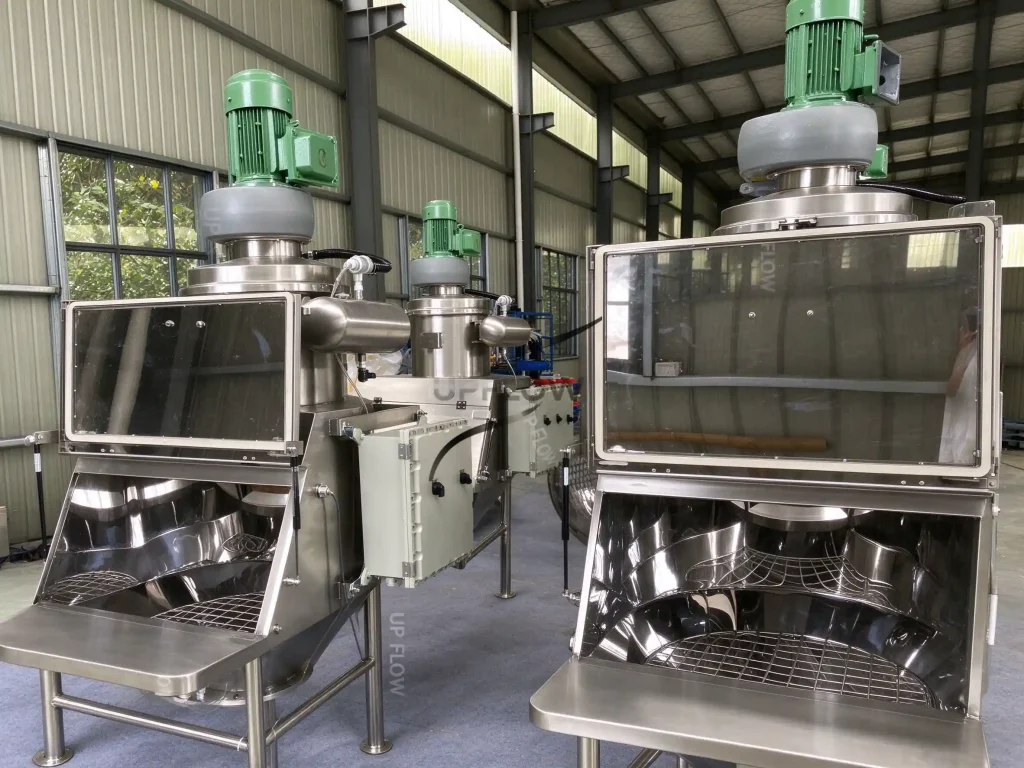
A properly designed receiving hopper should accommodate the required material volume while providing suitable discharge geometry for the actual powder characteristics.
If the hopper is too small, material may accumulate faster than downstream equipment can remove it, while an unsuitable outlet arrangement may cause bridging or irregular feeding.
6.4 Coordinate with Downstream Conveying Equipment
A bag emptying station can only maintain a consistent operating rate when the downstream system can accept the incoming material.
For example, if the feeding station discharges material faster than the screw feeder or vacuum conveying system can transfer it, the receiving hopper may fill up and force operators to stop emptying bags.
The capacity of the complete feeding and conveying system should therefore be coordinated during equipment selection.
UPFLOW’s Pneumatic Conveying System can be evaluated when powders need to be transported from the bag emptying area to remote storage silos, mixers or production equipment.
6.5 Consider Multiple Feeding Stations
For applications requiring high material throughput or handling several ingredients simultaneously, multiple bag emptying stations may be considered instead of relying on a single operator and one feeding point.
The final arrangement should consider operator availability, material routing, receiving hopper capacity, dust collection and the production sequence.
7. How to Select the Right Industrial Bag Emptying Equipment
Before requesting a quotation, buyers should establish the actual production requirement and determine the number of bags that need to be emptied during each operating period.
The following information is particularly useful:
| Selection parameter | Information required | Engineering purpose |
| Bag weight | 20 kg, 25 kg, 40 kg, 50 kg or other | Determines bags per hour |
| Bag dimensions | Length, width and height | Determines working area |
| Material name | Powder or granule type | Evaluates material behavior |
| Bulk density | kg/m³ or t/m³ | Helps estimate hopper volume |
| Required throughput | kg/h or bags/h | Establishes capacity target |
| Working hours | Daily operating schedule | Determines total handling demand |
| Number of operators | One or multiple operators | Influences handling cycle |
| Screening requirements | With or without vibrating sieve | Determines feeding arrangement |
| Dust requirements | Enclosure and filtration needs | Determines dust collection design |
| Downstream equipment | Screw feeder, vacuum conveyor or mixer | Determines receiving capacity |
For example, a manufacturer requiring 2,000 kg of material per hour using 25 kg bags needs to empty 80 bags per hour, which means the supplier should evaluate whether one feeding station with the proposed operating arrangement can meet the target or whether additional handling assistance or multiple feeding points would be more appropriate.
This is a capacity calculation, not a universal rating for a standard industrial bag emptying system.
8. UPFLOW Powder Feeding and Conveying Project References
8.1 Magnesium Silicate Pneumatic Conveying and Batching Project
UPFLOW supplied a customized magnesium silicate conveying and batching system for an overseas industrial customer, integrating manual bag dumping, pneumatic conveying, weighing hoppers, screw feeding equipment, storage and centralized control.
The project demonstrates how manual material introduction can be coordinated with downstream conveying and weighing equipment to create an integrated powder handling process rather than treating the bag emptying station as an independent feeding machine.
The actual equipment configuration was developed according to the customer’s material characteristics and production requirements, and the project should not be interpreted as a published bags-per-hour performance test.
Read more about the Magnesium Silicate Pneumatic Conveying and Batching System Project.
8.2 PVC Powder Feeding and Vacuum Conveying Project
For a new materials manufacturer, UPFLOW supplied a customized PVC powder feeding and vacuum conveying system incorporating bag unloading equipment, vacuum conveying units, stainless steel pipelines, receiving hopper modifications, dust collection connections and centralized electrical control.
The system connected the bag unloading area with multiple downstream receiving points, demonstrating how the feeding station, conveying equipment and production interfaces can be coordinated according to the factory layout.
This project provides a relevant reference for manufacturers that need to connect manual bag unloading with enclosed powder transportation, although its specific feeding capacity should not be inferred without corresponding operating data.
Read more about the PVC Powder Feeding and Vacuum Conveying System Project.
9. Frequently Asked Questions
Q1. How many bags per hour can an industrial bag emptying station handle?
There is no single capacity applicable to every industrial bag emptying station, because the actual number of bags processed per hour depends on bag weight, operator cycle time, material flowability, equipment arrangement and downstream receiving capacity. The required capacity should be established through production calculations and representative operating conditions.
Q2. How do I calculate the required number of bags per hour?
Divide the required material throughput in kilograms per hour by the weight of each bag. For example, a production line requiring 1,000 kg/h of material supplied in 25 kg bags needs 40 bags per hour.
Q3. Does a heavier bag reduce the number of bags that can be handled per hour?
Heavier bags may require more time for lifting, positioning and emptying, depending on the operator arrangement and handling assistance. The actual effect should be evaluated using bag dimensions, packaging type and working procedures.
Q4. Can one operator handle a high-volume bag emptying process?
The suitability of one operator depends on bag weight, operating cycle, daily working hours, material characteristics and workplace safety requirements. For high-volume applications, lifting assistance or additional feeding stations may be worth considering.
Q5. Does a vibrating sieve affect powder feeding capacity?
It can. Screen mesh size, material flowability, screen area, blockage and cleaning frequency may affect the effective throughput of the combined feeding and screening process.
Q6. Can a bag emptying station connect to a vacuum conveying system?
Yes. A receiving hopper or suitable feeding interface can connect the bag emptying station to a vacuum conveying system, allowing the discharged powder to be transferred through enclosed pipelines to a storage or production destination.
Q7. What information is needed to obtain an industrial bag emptying system quotation?
Buyers should provide bag weight and dimensions, material name, bulk density, required bags per hour or kilograms per hour, dust collection requirements, screening requirements and downstream equipment information so that the supplier can evaluate the appropriate configuration.
Conclusion: Calculate Bag Emptying Capacity Before Selecting Equipment
The number of bags an industrial bag emptying system can process per hour depends on the complete operating cycle rather than a single equipment dimension or motor specification, and a reliable capacity estimate should account for bag weight, operator handling time, material flowability, screening requirements and the receiving capacity of downstream equipment.
By converting the required material throughput into bags per hour and evaluating actual working conditions, manufacturers can establish a more realistic capacity target and determine whether a standard sack emptying station, an assisted handling arrangement or multiple feeding points are required.
UPFLOW provides customized powder feeding and bag emptying equipment with dust collection, optional screening and connections to screw or pneumatic conveying systems according to material characteristics and production requirements.
Planning an industrial bag emptying system for your production line? Send UPFLOW your bag weight, material specifications, required bags per hour and downstream equipment information so that our engineering team can evaluate a suitable feeding configuration.
Explore the UPFLOW Manual Bag Dump Station and Pneumatic Conveying System, or contact our engineering team to discuss your project requirements.