
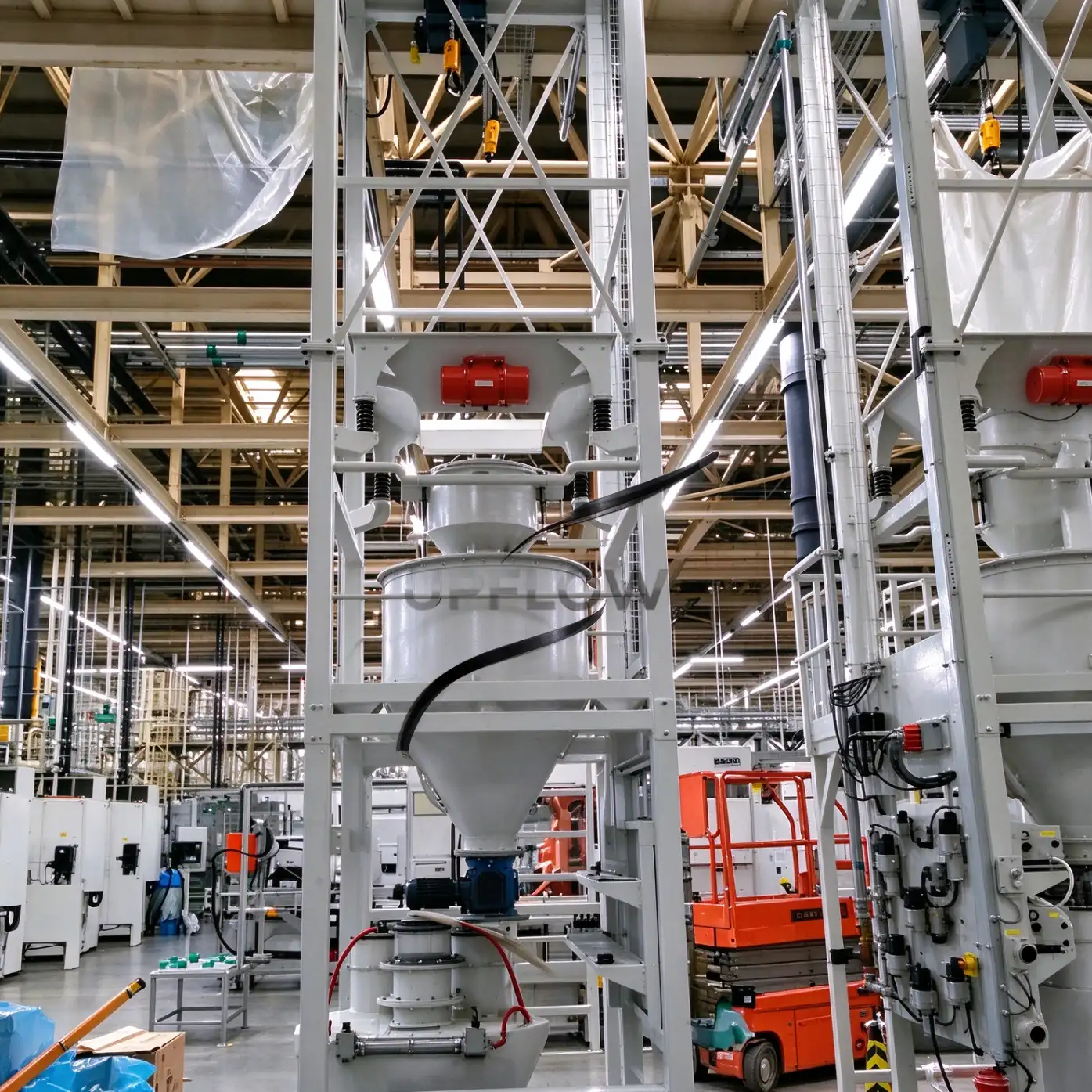
Poor-flowing powders can create significant challenges during bulk bag unloading, particularly when cohesive materials form stable arches above the discharge outlet, accumulate along the lower sides of the FIBC bag or remain trapped inside the bag after gravity discharge. These problems can interrupt material feeding, increase manual intervention, reduce the effective unloading rate and create additional powder handling and cleaning requirements.
To improve discharge performance, industrial bulk bag unloaders can be equipped with additional flow-assistance devices, with pneumatic bag massage pads and mechanical or pneumatic vibrators being two commonly considered options. Although both technologies are intended to improve material discharge, they work through different mechanisms and should not be treated as interchangeable solutions, because the effectiveness of each depends on powder cohesion, moisture content, particle characteristics, bag construction and the geometry of the unloading equipment.
For equipment buyers, the important question is not simply whether massage pads or vibrators provide stronger assistance, but which mechanism is more appropriate for the actual material and unloading process.
1. Why Do Poor-Flowing Powders Remain Inside FIBC Bulk Bags?
Bulk bags are widely used to transport powders and granular materials because they provide convenient storage, transportation and large-volume material handling, but the discharge performance of different materials can vary considerably even when they are packed in bags with similar dimensions.
Free-flowing materials generally move toward the discharge spout under gravity, whereas cohesive powders may develop internal structures that prevent continuous material movement.
Common problems include:
1.1 Bridging Above the Discharge Outlet
Bridging occurs when powder particles form a stable structure above the discharge opening, preventing material from flowing downward even when there is still a considerable amount of powder inside the bag.
This problem is more likely to occur with certain cohesive powders, especially when particle interactions, moisture or storage conditions promote the formation of stable material structures.
1.2 Ratholing and Incomplete Discharge
Ratholing occurs when material flows through a relatively narrow central channel while powder remains along the surrounding sides of the bag or hopper.
As a result, the bag may appear partially empty even though a significant amount of material remains attached to its lower sections, making additional discharge assistance or a different unloading configuration necessary.
1.3 Material Compaction and Residual Powder
Some powders become more difficult to discharge after transportation and storage because vibration, compression or moisture exposure can change their packing condition and flow behavior.
In these situations, simply opening the discharge spout may not provide sufficient material movement, and the unloading equipment may need an additional mechanism to help release accumulated powder.
1.4 Unstable Feeding to Downstream Equipment
When the material does not discharge consistently, the receiving hopper and downstream screw feeder or pneumatic conveying system may experience an irregular material supply, which can affect the stability of the complete production process.
For continuous production lines, it is therefore important to evaluate the unloading assistance mechanism together with the downstream feeding requirements rather than focusing only on whether the bulk bag can be emptied.
2. What Are Bulk Bag Massage Pads?
Bulk bag massage pads are mechanical or pneumatic devices designed to apply controlled external pressure to selected areas of an FIBC bag, encouraging the material to move toward the discharge outlet when gravity alone cannot provide sufficiently stable flow.
Depending on the unloading station design, the massage devices may be installed on opposite sides or around the lower section of the bag support frame, allowing the system to apply pressure at selected intervals during the unloading cycle.
2.1 How Do Pneumatic Massage Pads Work?
In a pneumatic arrangement, air cylinders or other pneumatic actuators move pressure plates against the outer surface of the bulk bag, creating controlled compression that helps loosen powder accumulated around the lower sections of the bag.
The operating sequence may involve alternating pressure between different sides of the bag, allowing material to move toward the discharge outlet without continuously applying the same compression force to the entire bag.
The pressure, movement range and operating sequence should be adjusted according to the bag construction and powder characteristics, because excessive compression may damage the FIBC fabric, create unwanted material compaction or place unnecessary loads on the supporting structure.
2.2 Advantages of Bulk Bag Massage Pads
Massage pads can be useful when the material tends to remain along the sides or lower sections of the bulk bag, particularly when the main unloading difficulty is insufficient material movement toward the discharge spout.
Their potential advantages include:
Applying controlled mechanical assistance to selected areas of the bag.
Helping release material accumulated around the lower bag sections.
Supporting more consistent discharge when used with a suitable hopper and outlet design.
Allowing the unloading sequence to be integrated with pneumatic controls.
Providing an adjustable assistance method according to the material and bag arrangement.
However, massage pads cannot automatically solve every bridging or ratholing problem, because the actual result depends on the powder’s flow properties, the bag geometry, the pressure application points and the discharge outlet design.
3. What Are Vibrators Used for in Bulk Bag Unloading Systems?
Vibrators are devices that generate mechanical vibration to assist material movement, and they may be installed on a hopper, receiving bin, supporting structure or other suitable equipment component depending on the intended application.
In bulk powder handling, vibration is often used to help reduce material accumulation on suitable contact surfaces and encourage material movement toward an outlet, although its effectiveness depends on how the vibration is transmitted through the equipment and the behavior of the powder being handled.
3.1 Hopper Vibrators
A hopper vibrator is installed on the hopper or an appropriate supporting structure to introduce vibration into the material-contacting equipment.
When correctly selected and positioned, the vibration can help reduce powder adhesion and material accumulation on the hopper walls, particularly in applications where the discharge problem is associated with material sticking to the hopper surface.
However, hopper vibration and FIBC bag massage perform different functions, because a vibrator mounted on the hopper does not necessarily provide effective assistance to powder that remains compacted or bridged inside the bulk bag itself.
3.2 Bulk Bag Vibrating Devices
Some unloading arrangements use vibration devices associated with the bag support or unloading structure to encourage material movement during discharge.
The suitability of this arrangement depends on the FIBC construction, supporting frame stiffness, material behavior and the way vibration is transmitted through the complete equipment structure.
The design should avoid excessive vibration that could create unnecessary mechanical loads, damage bag fabric or affect nearby equipment.
3.3 Advantages and Limitations of Vibrators
Vibrators may be appropriate when the discharge problem involves material accumulation on a hopper wall or when a suitable vibration arrangement can improve material movement through the receiving section.
Their advantages and limitations should be evaluated together:
They can assist material movement in suitable hopper and bin configurations.
They can be installed as auxiliary devices within an integrated unloading arrangement.
Their effectiveness depends on vibration frequency, amplitude, mounting position and equipment stiffness.
Excessive or unsuitable vibration may increase structural stress, noise or material compaction in certain applications.
Vibration does not necessarily resolve bridging inside the bulk bag itself.
For this reason, equipment suppliers should distinguish between bag-mounted or frame-mounted vibration and hopper-mounted vibration when preparing a customized bulk bag unloading solution.
4. Massage Pads vs Vibrators: Which Solution Is More Suitable?
The main difference is that massage pads apply controlled external pressure to the bag, while vibrators introduce mechanical vibration into a selected equipment structure or material-contacting component.
| Comparison factor | Pneumatic massage pads | Vibrators |
| Working principle | Controlled compression of the bag | Mechanical vibration |
| Main application area | Lower sides of the FIBC bag | Hopper, bin or suitable support structure |
| Typical objective | Encourage powder movement toward the outlet | Reduce material accumulation and assist flow |
| Operating method | Pneumatic or mechanical actuation | Electric or pneumatic vibration |
| Adjustment | Pressure, stroke and operating sequence | Frequency, amplitude and operating time |
| Main design concern | Bag fabric strength and compression conditions | Vibration transmission and structural loads |
| Suitable problem to investigate | Material remaining along bag sides | Material accumulation on hopper surfaces |
| Main limitation | May not resolve all internal bridging conditions | May not effectively release material trapped inside the bag |
4.1 When Should You Consider Massage Pads?
Massage pads are worth evaluating when powder remains around the lower sides of the bulk bag or when the material requires controlled external assistance to move toward the discharge outlet.
For example, if the discharge spout is open but material continues to accumulate in the lower corners of the FIBC, a suitable bag massage arrangement may help improve material movement by applying pressure at selected locations.
The actual design should be based on the FIBC dimensions, fabric strength, filling condition and the location of the discharge opening.
4.2 When Should You Consider Vibrators?
Vibrators are worth evaluating when the main problem is material accumulation on the receiving hopper or when the material tends to adhere to suitable equipment surfaces during discharge.
A hopper vibrator may be useful for certain cohesive powders, but the equipment supplier should verify the hopper geometry, wall material, mounting position and expected vibration transmission before selecting the device.
If the primary problem occurs inside the bulk bag rather than in the receiving hopper, installing a vibrator on the hopper alone may not provide the required improvement.
4.3 Can Massage Pads and Vibrators Be Used Together?
Yes, a customized bulk bag unloading station may incorporate both bag massage devices and hopper vibration equipment when the process conditions justify their combined use.
For example, massage pads may be used to encourage powder movement inside the FIBC, while a separately selected hopper vibrator may assist material movement through the receiving section.
However, using both devices does not automatically guarantee better discharge performance, because the combined operating sequence, mechanical loads and material response must be evaluated to avoid unnecessary compression or vibration.
The preferred approach is to identify where the material flow problem occurs and select the assistance mechanism according to that specific problem.
5. How Material Characteristics Affect the Selection
The same unloading device may perform differently with different powders, which is why equipment selection should begin with material evaluation rather than choosing massage pads or vibrators based only on the material name.
| Material characteristic | Potential effect on unloading | Design consideration |
| Fine particle size | May increase cohesion and dust generation | Evaluate discharge outlet, containment and flow assistance |
| High moisture content | May increase adhesion or promote agglomeration | Check moisture conditions and possible material conditioning requirements |
| High bulk density | Increases material load on the bag and support structure | Evaluate frame and bag loading conditions |
| Poor flowability | May cause bridging or incomplete discharge | Consider massage pads, hopper geometry and suitable flow assistance |
| Hygroscopic properties | Material may absorb moisture during storage | Evaluate packaging, liner and storage conditions |
| Strong material adhesion | Powder may accumulate on equipment surfaces | Consider hopper design and suitable vibration assistance |
Material testing is particularly valuable for difficult powders because flowability cannot be reliably determined from the material name or particle size alone.
When the application involves fine chemical powders, battery materials, minerals or other cohesive substances, representative material samples and actual FIBC specifications can help the supplier evaluate whether additional discharge assistance is necessary.
6. Other Design Factors That Should Not Be Ignored
Although massage pads and vibrators can help improve material discharge in suitable applications, they should not be used to compensate for an unsuitable unloading station design.
Several other factors need to be reviewed before finalizing the equipment configuration.
6.1 Discharge Spout and Outlet Dimensions
An undersized or poorly matched discharge outlet may restrict material flow even when additional assistance devices are installed.
The discharge spout dimensions, connection structure, receiving hopper opening and downstream feeder should therefore be evaluated together.
6.2 Hopper Geometry
The hopper angle, outlet size and internal surface condition can influence how easily powder moves toward the discharge point.
For cohesive powders, the hopper should be designed according to the material’s flow properties rather than relying on a standard geometry for every application.
6.3 Dust Collection and Enclosure
Additional mechanical movement may generate or release airborne powder, particularly when handling fine materials, so the unloading station should maintain suitable containment and dust extraction arrangements throughout the operating cycle.
The dust collection system should be selected according to the material, enclosure configuration and expected dust load, with the necessary filtration and safety requirements confirmed for the actual application.
6.4 Downstream Feeding Equipment
A bulk bag unloading station connected to a screw feeder, rotary valve or pneumatic conveying system should provide a suitable material discharge rate for the downstream process.
If the downstream equipment cannot accept the discharged material at the required rate, improving the bag discharge mechanism alone may not increase the throughput of the complete system.
7. UPFLOW Bulk Bag Unloading Solutions for Poor-Flowing Powders
UPFLOW provides customized bulk bag unloading equipment for industrial powder handling applications, with equipment configurations selected according to material characteristics, FIBC dimensions, required capacity and factory installation conditions.
The company’s published bulk bag unloading system includes a pneumatic tapping mechanism as part of its standard configuration, while additional equipment and flow-assistance arrangements can be evaluated according to individual project requirements.
For applications involving poor-flowing powders, the engineering review can consider:
Pneumatic bag massage or tapping arrangements.
Suitable hopper geometry and discharge outlet design.
Receiving hopper and intermediate storage configuration.
Screw feeder or rotary valve integration.
Dust collection and enclosed discharge arrangements.
Connection with downstream pneumatic conveying or automatic batching systems.
The final configuration should be confirmed against the actual powder and bag specifications, because the presence of a tapping mechanism does not mean that every material will discharge completely without further evaluation.
You can explore the UPFLOW Bulk Bag Unloading System for more information about the available unloading configurations.
8. Related Bulk Bag Unloading Project References
8.1 European Battery Material Manufacturer: Multiple Anode Material Unloading Systems
UPFLOW supplied multiple customized big bag unloading systems for a European battery material manufacturer, supporting the controlled discharge and transfer of anode material powders into the customer’s downstream production process.
The project involved an integrated material handling arrangement covering FIBC bag positioning, controlled powder discharge, dust collection interfaces and downstream material transfer connections.
Read more about the Anode Material Big Bag Unloading System Project.
8.2 Cement Big Bag Unloading and Pneumatic Conveying Project
For an industrial customer in Egypt, UPFLOW supplied a customized cement big bag unloading and pneumatic conveying solution, combining bulk bag unloading equipment, powder feeding and enclosed material transportation.
This project demonstrates how the unloading station can be integrated with downstream conveying equipment to create a complete powder handling process rather than operating as an isolated discharge machine.
Read more about the Cement Big Bag Unloading and Pneumatic Conveying Project.
These project references demonstrate UPFLOW’s experience in customized bulk bag unloading and integrated powder handling, but they should not be interpreted as evidence that a specific massage pad or vibrator configuration was used in either project.
9. Frequently Asked Questions
Q1. What is the difference between bag massage pads and bulk bag vibrators?
Bag massage pads apply controlled external pressure to the sides of an FIBC bag to encourage material movement toward the discharge outlet, while vibrators introduce mechanical vibration into a hopper, support or other suitable equipment structure. Their functions and installation positions are different, so the appropriate choice depends on where the material flow problem occurs.
Q2. Are massage pads suitable for cohesive powders?
They may be suitable for certain cohesive powders that remain around the lower sides of the bulk bag, provided that the pressure, movement range and operating sequence are designed according to the FIBC construction and material properties. Material testing may be necessary for difficult applications.
Q3. Can a hopper vibrator solve bridging inside a bulk bag?
Not necessarily, because a hopper vibrator primarily assists material movement in the hopper or the equipment structure to which it is mounted, and its vibration may not effectively reach a bridge formed inside the FIBC bag. The location of the flow restriction should be identified before selecting the assistance device.
Q4. Can massage pads and vibrators operate simultaneously?
They can be incorporated into the same unloading station when the application requires different types of flow assistance, but their operating sequence should be evaluated to avoid excessive compression, unnecessary vibration or additional structural loading.
Q5. Does every poor-flowing powder require a special bulk bag unloader?
No. Some materials can be handled using a properly designed standard unloading station, while others may require additional massage, tapping, vibration or customized hopper arrangements. The final configuration depends on the actual flow properties and unloading conditions.
Q6. What information should I provide when requesting a bulk bag unloading system for poor-flowing powders?
Buyers should provide the material name, particle size, bulk density, moisture content, bulk bag dimensions, bag weight, discharge spout specifications, required unloading capacity and downstream equipment information. Representative material samples and FIBC drawings can further support engineering evaluation.
Conclusion: Select Flow Assistance According to the Actual Discharge Problem
Choosing between pneumatic massage pads and vibrators for a bulk bag discharger requires an understanding of where material flow becomes restricted, because powder trapped along the sides of an FIBC bag, material bridging above the discharge outlet and powder adhering to hopper walls may require different engineering solutions.
Massage pads can provide controlled mechanical assistance to the bulk bag, while vibrators may help improve material movement in suitable hoppers and equipment structures; in some applications, a combination of these technologies may be worth evaluating, provided that the bag construction, structural loads and material response are properly considered.
UPFLOW provides customized bulk bag unloading systems, powder feeding equipment and pneumatic conveying solutions according to material properties, production requirements and factory conditions.
Handling powders that do not discharge smoothly from FIBC bags? Send UPFLOW your material specifications, bulk bag drawings, required unloading capacity and downstream process information so that our engineering team can evaluate a suitable discharge assistance arrangement.
Explore the UPFLOW Bulk Bag Unloading System or contact our engineering team to discuss your application.