
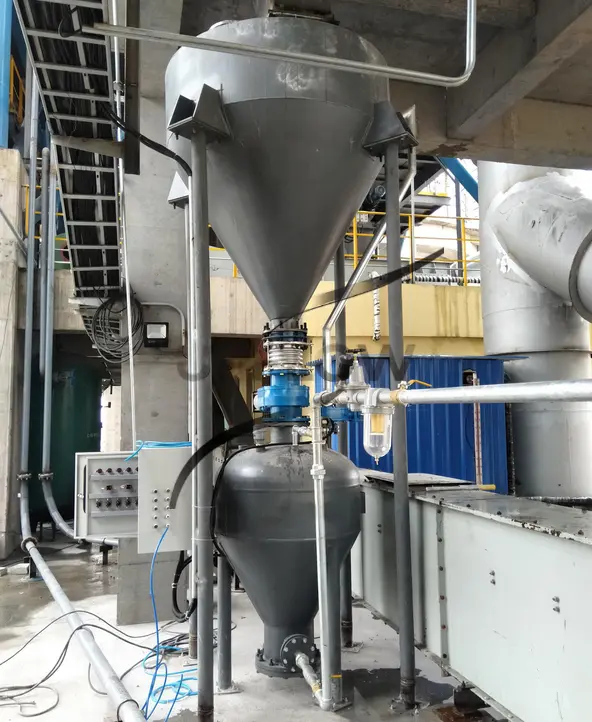
When designing a pneumatic conveying system, understanding the main differences between dilute phase conveying and dense phase conveying is essential for achieving efficient, reliable, and cost-effective material handling. These two conveying methods represent the primary operating principles in pneumatic transport systems, and their differences directly affect material suitability, conveying distance, energy consumption, and long-term maintenance costs.
In this guide, we will provide a comprehensive comparison to help engineers and plant managers choose the right solution.
What Is Dilute Phase Conveying?
Dilute phase conveying (also known as lean phase conveying) transports materials by suspending them fully in a high-velocity air stream. The material particles remain dispersed throughout the pipeline in what is commonly referred to as suspension flow.
Typical characteristics include:
Air velocity: 15-30 m/s (sometimes up to 40 m/s)
Low material concentration
Lower operating pressure
Continuous conveying mode
Since the particles are completely suspended, dilute phase systems are relatively simple in design and widely used in general industrial applications.
What Is Dense Phase Conveying?
Dense phase conveying moves materials at lower velocity but higher pressure. Instead of full suspension, materials travel in plugs, slugs, or wave-like formations. This flow pattern is often described as plug flow or fluidized dense phase flow.
Typical characteristics include:
Air velocity: 2-15 m/s
High material concentration
Higher operating pressure
Reduced particle impact
Dense phase systems are commonly selected for abrasive, fragile, or high-density materials.
Main Differences Between Dilute Phase Conveying and Dense Phase Conveying
Understanding the main differences between dilute phase conveying and dense phase conveying requires analyzing several technical parameters.
1. Air Velocity and Material Concentration
The most obvious distinction lies in airflow speed and solids concentration.
Dilute phase conveying uses high air velocity and low material concentration. The particles are fully suspended and evenly distributed in the pipeline.
Dense phase conveying uses low air velocity and high material concentration. Materials move in compact formations rather than floating freely.
This fundamental difference determines wear rate, energy efficiency, and product protection.
2. Solids-to-Air Ratio (Key Technical Indicator)
The solids-to-air ratio is one of the most widely used quantitative indicators to distinguish between the two systems.
Dilute phase conveying typically operates below 6:1 (sometimes defined below 10:1).
Dense phase conveying usually exceeds 10:1 and can reach ratios above 25:1.
Higher solids loading in dense phase conveying allows more material to be transported with less airflow, improving efficiency under certain conditions.
3. Conveying Distance and Energy Efficiency
When comparing the main differences between dilute phase conveying and dense phase conveying, conveying distance and energy consumption are critical considerations.
Dilute phase conveying is generally suitable for short to medium distances, typically 100-300 meters. Due to high air velocity, energy consumption increases significantly over long distances.
Dense phase conveying is more energy-efficient for long-distance applications. Effective transport distances can range from 100-1000 meters, depending on system design. The lower velocity reduces air demand and improves overall energy performance.
For long-distance systems, you may also refer to our Positive Pressure Pneumatic Conveying System for Long-distance Transport.
4. Material Suitability
Material characteristics play a decisive role.
Dilute Phase Conveying is Suitable for:
Free-flowing materials
Light weight powders
Low-density granules
Non-fragile particles
Typical examples include flour, sugar, milk powder, plastic pellets, and chemical additives.
Dense Phase Conveying is Suitable for:
Fragile materials
Abrasive powders
High-density solids
Poor-flowing materials
Examples include cement, fly ash, limestone powder, mineral ores, and certain chemical raw materials.
The lower velocity in dense phase conveying significantly reduces particle breakage and pipeline wear.
5. System Design and Maintenance
Another important aspect of the main differences between dilute phase conveying and dense phase conveying is engineering complexity.
Dilute phase systems:
Simpler structure
Lower initial investment
Easier maintenance
Higher pipeline wear due to velocity
Dense phase systems:
More complex design
Require pressure vessels and advanced controls
Higher initial investment
Lower long-term wear and maintenance
If dust control is a concern, you may also explore our Negative Pressure Pneumatic Conveying System.
6. Operational Stability and Product Protection
In industries such as food, pharmaceuticals, and specialty chemicals, product integrity is critical.
Dilute phase conveying may cause degradation due to high-speed particle collision.
Dense phase conveying minimizes impact and protects fragile materials, making it suitable for high-value products.
For a broader overview, visit our Typical Applications of Pneumatic Conveying Systems in Industry.
How to Choose Between Dilute Phase and Dense Phase Conveying
There is no universal system. The right choice depends on:
Material density and particle size
Abrasiveness
Fragility
Required conveying distance
Energy efficiency goals
Budget constraints
If your application involves short-distance transport of lightweight materials, dilute phase conveying is often the most economical solution.
If your application requires long-distance transport of heavy or fragile materials, dense phase conveying may provide better long-term performance.
Understanding the main differences between dilute phase conveying and dense phase conveying allows you to balance initial investment, operating cost, and system reliability.
Conclusion
The main differences between dilute phase conveying and dense phase conveying lie in air velocity, solids concentration, conveying mechanism, energy consumption, material suitability, and system complexity. Dilute phase systems are flexible and cost-effective for general-purpose applications, while dense phase systems offer superior performance for long-distance, abrasive, or fragile material transport.
Careful evaluation of material characteristics and operational requirements will ensure you select the most efficient and reliable pneumatic conveying solution for your facility.