
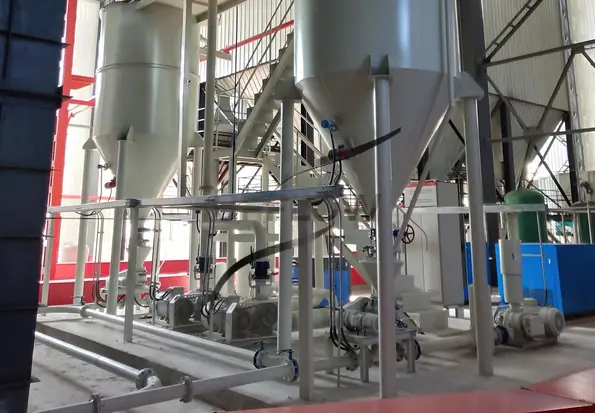
Introduction: High-Capacity Solutions for Long-Distance Material Transfer
A positive pressure pneumatic conveying system for long-distance transport is widely recognized as an efficient and reliable solution for industries that require continuous movement of powders, granules, and bulk solids across extended distances, especially in large-scale production environments where stable material flow is essential. By utilizing compressed air to push materials through sealed pipelines, this type of air conveying system enables high-capacity transport while maintaining a controlled and enclosed process, which significantly improves both operational efficiency and workplace cleanliness.
As industrial plants continue to expand in size and complexity, the need for robust and flexible feeding systems has increased, making positive pressure conveying a preferred choice for modern automated production lines.
Working Principle of Positive Pressure Conveying Systems
A positive pressure pneumatic conveying system for long-distance transport operates by generating compressed air through a blower or air compressor, which then pushes materials from the feeding point into the conveying pipeline and transports them to the receiving equipment such as silos, hoppers, or processing units. Unlike vacuum-based systems that rely on suction, this approach provides stronger conveying force and higher throughput, making it particularly suitable for long-distance and high-capacity applications.
Within the system, materials are introduced through a controlled feeding system, where devices such as rotary valves or screw feeders regulate the flow and maintain a stable air-to-material ratio, ensuring consistent performance throughout the entire conveying process.
Material Types and Conveying Characteristics
The design of a positive pressure pneumatic conveying system for long-distance transport must consider the specific characteristics of the materials being handled, as different powders and granules exhibit varying behaviors during conveying. Common materials include cement, fly ash, plastic pellets, chemical powders, food ingredients, and pharmaceutical bulk solids, each requiring tailored conveying conditions to ensure stability and efficiency.
For example, fine powders such as cement and flour are prone to dust generation and require well-sealed powder conveying systems to prevent leakage, while plastic pellets and grains are free-flowing and better suited for granular conveying applications that require higher conveying velocities. In addition, abrasive materials such as mineral powders may require wear-resistant pipelines, while lightweight powders may require airflow optimization to prevent excessive dispersion during transport.
Advantages for Long-Distance Conveying Applications
One of the main advantages of a positive pressure pneumatic conveying system for long-distance transport is its ability to move large volumes of material efficiently over long distances, often exceeding hundreds of meters, while maintaining consistent flow and minimizing manual intervention. This capability makes it ideal for large industrial plants where materials must be transferred between multiple production units or storage areas.
In addition, the flexibility of pipeline routing allows the air conveying system to adapt to complex layouts, enabling vertical, horizontal, and inclined conveying paths within the same system, while integrated feeding systems ensure continuous and stable material supply across the production line.
Limitations and Considerations
Although a positive pressure pneumatic conveying system for long-distance transport offers significant advantages, certain factors must be considered during system design and operation to ensure optimal performance. Energy consumption can be relatively high in systems that operate with large airflow volumes, particularly when handling lightweight materials, which requires careful optimization of airflow and pressure settings.
Additionally, maintaining proper sealing and dust control is essential, as high-pressure systems may lead to potential dust leakage if pipelines and connections are not properly designed, while regular maintenance of compressors, valves, and pipelines is necessary to sustain long-term reliability.
Applications Across Industries
A positive pressure pneumatic conveying system for long-distance transport is widely applied across multiple industries due to its versatility and high conveying capacity, supporting efficient material handling in diverse production environments. In the cement and construction industry, it is used to transport cement, fly ash, and mineral powders over long distances, while in the food industry it handles materials such as sugar, flour, and grains through hygienic powder conveying and granular conveying systems.
In chemical and plastic industries, the system is used to convey plastic pellets, resins, and additives within automated production lines, while in pharmaceutical applications it supports the transport of bulk powders under controlled and enclosed conditions. These diverse applications highlight the flexibility and efficiency of modern air conveying systems in industrial material handling.
How to Choose the Right System Configuration
Selecting the appropriate positive pressure pneumatic conveying system for long-distance transport requires careful evaluation of several factors, including material properties, conveying distance, required capacity, and plant layout. Materials with high density or abrasiveness may require specialized system configurations, while long-distance applications may benefit from optimized pipeline design and pressure control.
By working with experienced suppliers, companies can design customized feeding systems and conveying solutions that ensure efficient operation, reduce energy consumption, and meet specific production requirements.
Conclusion: A Reliable Solution for High-Capacity Transport
A well-designed positive pressure pneumatic conveying system for long-distance transport provides a powerful, flexible, and efficient solution for handling bulk materials in modern industrial environments, enabling manufacturers to achieve continuous production, reduce manual handling, and maintain clean and controlled operations. With its ability to support large-scale conveying and complex layouts, this system remains a key technology for industries seeking reliable and scalable material handling solutions.