
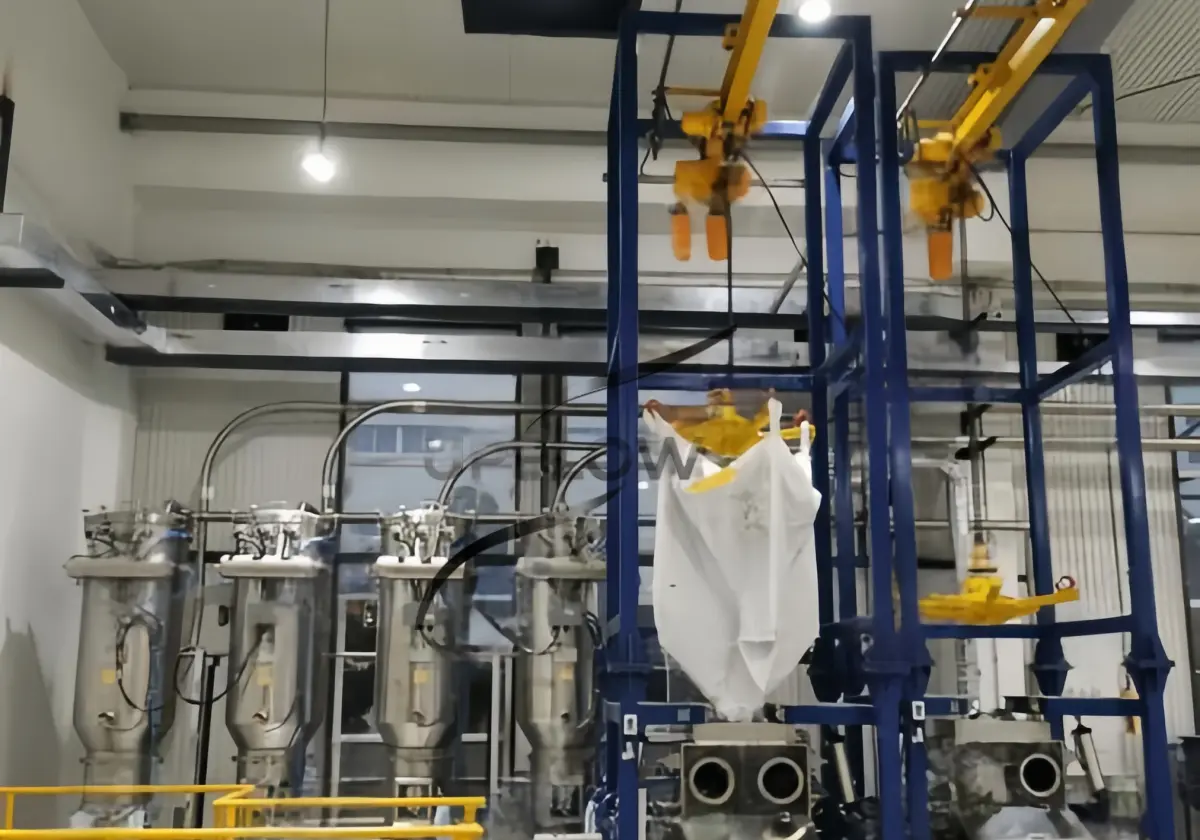
When unloading powders from Flexible Intermediate Bulk Containers (FIBCs), also known as bulk bags or jumbo bags, the discharge spout connection is one of the most important areas to consider when designing a dust-controlled bulk bag unloading system. An improperly connected discharge spout can allow fine powder to escape during bag opening, material discharge or bag disconnection, resulting in material loss, workplace contamination, additional cleaning requirements and potential exposure of operators to airborne particles.
A reliable FIBC discharge spout connection should therefore provide a secure mechanical interface between the bulk bag outlet and the unloading equipment, maintain suitable containment throughout the discharge process, and allow operators to connect and disconnect bags without unnecessarily exposing the material to the surrounding environment. The appropriate design depends on the bag construction, spout dimensions, material characteristics, discharge method and dust collection arrangement rather than relying on a single universal sealing mechanism.
1. Why Does Dust Escape from FIBC Discharge Spout Connections?
Dust leakage during bulk bag unloading does not necessarily originate from the unloading machine itself, because the connection between the bag outlet and the equipment can become a weak point whenever the bag spout is not properly positioned, secured or sealed.
Several common situations can contribute to material leakage:
1.1 Incorrect Bag Spout Dimensions
FIBC bags are available in different configurations, including different discharge spout diameters, lengths, outlet constructions and inner liner arrangements, so a connection designed around an assumed standard bag size may not provide sufficient contact or sealing when the actual bag is installed.
If the discharge spout is too short, too narrow or incorrectly positioned relative to the docking connection, operators may struggle to secure the bag properly, while an oversized or loosely fitted outlet can create gaps through which fine powder escapes.
1.2 Inadequate Clamping and Sealing
A discharge spout needs to remain securely positioned during material unloading, particularly when the weight of the material, bag movement or changes in the bag shape place additional stress on the connection.
If the clamping mechanism does not provide sufficient retention or the sealing surface is unsuitable for the bag material, powder may escape around the connection even when the unloading equipment itself is enclosed.
1.3 Improper Handling of the Inner Liner
Some FIBCs contain an internal polyethylene liner to provide additional moisture protection or product containment, and the liner may need to be positioned and secured separately from the outer fabric spout during connection.
If the liner is folded incorrectly, trapped between sealing surfaces or not adequately secured, material can accumulate around the connection and escape during discharge or bag replacement.
1.4 Uncontrolled Dust During Bag Opening
Even when the connection is mechanically secure, dust can still escape when the operator opens the discharge spout, releases the liner or starts material flow, because fine powders can become airborne during the initial opening stage.
For this reason, a suitable discharge connection should be evaluated together with the unloading chamber and dust extraction arrangement rather than treating the bag clamp as an independent dust-control component.
2. Common FIBC Discharge Spout Connection Designs
The connection method should be selected according to whether the bulk bag is reusable, whether its discharge spout can be untied, and whether the material requires a more enclosed unloading arrangement.
| Connection design | Working principle | Typical application |
| Manual spout connection | The operator positions and secures the bag outlet to the receiving connection | Applications with relatively simple bag handling requirements |
| Clamp-type docking connection | A mechanical clamping arrangement secures the bag spout against a receiving interface | Controlled discharge where repeatable bag positioning is required |
| Sealed bag-untie connection | The spout is enclosed and sealed before the inner closure is released | Reusable FIBCs and applications requiring controlled opening |
| Bag-breaking unloading chamber | The bag is opened within an enclosed chamber, with dust collection controlling airborne powder | Non-reusable bags and applications using a cutting or puncturing discharge method |
2.1 Clamp-Type Discharge Spout Connection
A clamp-type connection is used to secure the bulk bag outlet around the unloading interface, helping maintain the correct position of the spout while material flows into the receiving hopper or downstream feeding equipment.
The design should provide sufficient access for operators to position the bag outlet, check the sealing condition and release the connection after unloading, while the clamping mechanism must be compatible with the actual spout dimensions and fabric construction.
2.2 Sealed Bag-Untying System for Reusable FIBCs
For reusable bulk bags, a sealed bag-untie arrangement can provide a more controlled way of opening the discharge spout because the bag outlet is positioned and sealed within the unloading interface before the inner closure is released.
UPFLOW’s sealed bag-untie bulk bag unloading design uses a pneumatic bag-clamping and sealing mechanism to secure the discharge spout, allowing operators to untie the bag within an enclosed connection area.
This approach is particularly relevant when customers need to reuse their FIBC bags and want to reduce direct operator exposure to the powder during the opening process.
2.3 Bag-Breaking Unloading Chamber for Non-Reusable Bags
When the FIBC bags are not intended for reuse, a bag-breaking unloading arrangement may be more appropriate because the bag can be opened inside an enclosed unloading chamber rather than requiring the operator to manually untie every discharge outlet.
In this configuration, the bag is positioned above an integrated knife or cutting structure, while the enclosed chamber, pneumatic sealing doors and dust collection unit help control the powder generated during bag opening and discharge.
The appropriate choice between sealed bag untying and bag breaking should be determined by the customer’s packaging arrangement, operating procedure, material properties and cleaning requirements.
3. Five Design Considerations for Preventing Powder Leakage
A reliable bulk bag discharge connection requires more than selecting a suitable clamp, because the bag interface, supporting structure, receiving equipment and dust collection system must function together throughout the unloading cycle.
3.1 Confirm the FIBC Discharge Spout Dimensions
Before finalizing the unloading station design, the equipment supplier should obtain the actual FIBC drawing or representative bag sample, including the outlet diameter, spout length, fabric construction, liner arrangement and bag capacity.
The connection should be checked against the actual bag dimensions rather than relying only on nominal FIBC specifications, particularly when a customer uses bags from multiple suppliers or operates different packaging formats within the same production facility.
3.2 Design a Suitable Sealing and Clamping Interface
The clamping arrangement should hold the discharge spout in the correct position without damaging the bag fabric or creating folds that interfere with sealing.
The engineering review should consider the available contact area, clamp movement, sealing material compatibility, operator access and the method used to release the bag after unloading.
For fine powders, even relatively small gaps around the outlet may become a source of visible dust escape, so the sealing interface should be checked under representative operating conditions.
3.3 Coordinate the Connection with Dust Collection
Dust collection should be considered as part of the complete unloading arrangement, because the opening of a bulk bag and the movement of powder into a receiving hopper can generate airborne particles even when the mechanical connection is properly secured.
Depending on the material and equipment arrangement, a dust extraction connection may be integrated into the unloading chamber or connected to a dedicated dust collector, with airflow and filtration selected according to the expected dust load and process requirements.
A negative-pressure arrangement may help prevent dust from escaping through small openings, but its effectiveness depends on the enclosure design, extraction airflow, filter condition and the actual operating process; it should not be treated as a substitute for a properly sealed mechanical connection.
3.4 Consider Material Flow and Discharge Stability
The material characteristics also influence the connection design, because fine, cohesive, hygroscopic or poorly flowing powders may accumulate around the discharge outlet and create additional cleaning or operating difficulties.
For example, materials with poor flowability may require additional discharge assistance, while highly dusty powders may require more careful containment during initial opening and final emptying.
The design should therefore consider the bulk density, particle size, moisture content, flowability and discharge behavior of the actual material instead of assuming that the same FIBC connection arrangement will work equally well for every powder.
3.5 Provide a Safe and Practical Bag Change Procedure
A dust-controlled connection should also allow operators to complete the unloading cycle safely, including positioning the bag, securing the outlet, opening the discharge spout, monitoring material flow and disconnecting the empty bag.
If the operator must manually reach into an exposed powder area or release a connection while material is still flowing, the unloading procedure may introduce dust exposure even when the equipment has a suitable enclosure.
The equipment layout should therefore provide sufficient working space, accessible clamps and a clearly defined sequence for bag connection, unloading and disconnection.
4. FIBC Discharge Connection Design Checklist for Equipment Buyers
Before purchasing a bulk bag unloading station, buyers should confirm the following information with the equipment manufacturer so that the connection can be designed around the actual packaging and process requirements.
| Design item | Information to confirm | Why it matters |
| FIBC dimensions | Bag width, height and rated capacity | Determines the supporting frame and loading arrangement |
| Discharge spout | Diameter, length and construction | Determines the docking and clamping interface |
| Inner liner | Liner material, arrangement and closure | Influences sealing and opening procedures |
| Bag reuse | Reusable or single-use FIBC | Helps determine the appropriate unloading design |
| Material properties | Particle size, bulk density, moisture and flowability | Influences discharge and dust-control requirements |
| Dust collection | Extraction point, airflow and filtration requirements | Supports control of airborne powder |
| Downstream connection | Hopper, screw feeder, rotary valve or conveying line | Ensures compatibility with the following process |
| Cleaning requirements | Manual cleaning, access and material changeover | Influences the equipment structure and maintenance design |
| Operating procedure | Bag positioning, opening and disconnection | Helps establish a practical and safe unloading cycle |
A well-prepared technical specification should include an FIBC drawing or sample, the intended discharge method, material data and the downstream equipment interface, allowing the supplier to evaluate the complete connection rather than quoting only a standard unloading machine.
5. How Does the FIBC Connection Integrate with a Complete Bulk Bag Unloading System?
The discharge spout connection is only one part of the complete bulk bag unloading process, because the bag support structure, unloading chamber, feeding equipment and downstream conveying system must be coordinated to achieve reliable material transfer.
A typical process can be arranged as follows:
FIBC Bag Loading → Discharge Spout Connection → Sealing and Clamping → Controlled Bag Opening → Material Discharge → Receiving Hopper → Screw Feeder or Pneumatic Conveying System
For applications requiring continuous production feeding, the receiving hopper can be connected to a screw feeder, rotary valve or other suitable discharge device, depending on the material characteristics and required feeding rate.
When the material needs to be transported to a remote silo, mixer or production line, the unloading station can also be integrated with a pneumatic conveying system, creating a more complete material handling arrangement that reduces repeated manual transfer between equipment.
For more information, see UPFLOW’s Bulk Bag Unloading and Conveying System Guide.
You can also review the Ton Bag Unloading System to understand the available sealed bag-untie and bag-breaking unloading configurations.
6. UPFLOW Project Experience in Bulk Bag Unloading and Dust-Controlled Feeding
The design of a reliable FIBC discharge connection should be considered in the context of the actual material handling process, and real industrial projects can help buyers understand how bulk bag unloading equipment is integrated with downstream feeding and conveying operations.
6.1 European Battery Material Manufacturer: Multiple Anode Material Big Bag Unloading Systems
UPFLOW supplied multiple customized big bag unloading systems for a European battery material manufacturer, providing an enclosed powder feeding arrangement for anode material handling.
The project involved the integration of bulk bag unloading equipment with the customer’s downstream material transfer process, where controlled powder discharge, reduced dust generation and reliable material supply were important considerations.
Read more about the Anode Material Big Bag Unloading System Project.
6.2 Cement Big Bag Unloading and Pneumatic Conveying Project
For an industrial customer in Egypt, UPFLOW supplied a customized cement big bag unloading and pneumatic conveying solution, combining bulk bag unloading equipment, powder feeding, dust collection and enclosed material transportation.
The project illustrates how an unloading station can form the upstream section of a larger powder handling system rather than operating as an isolated piece of equipment.
Read more about the Cement Big Bag Unloading System Project.
These projects demonstrate UPFLOW’s experience in supplying customized bulk bag unloading and integrated powder handling equipment, although the exact discharge connection and dust-control configuration must always be confirmed against the individual project’s drawings and equipment scope.
7. Frequently Asked Questions About FIBC Discharge Spout Connections
Q1. Why does powder leak from a bulk bag discharge spout?
Powder may escape because of incorrect spout dimensions, inadequate clamping, damaged bag fabric, an improperly positioned inner liner or uncontrolled dust generated during bag opening and discharge. The connection should be checked using the actual FIBC dimensions and operating procedure.
Q2. How can a bulk bag discharge spout be connected without dust leakage?
A suitable connection generally combines correct spout positioning, an appropriate clamping and sealing interface, controlled bag opening and a compatible dust collection arrangement. The complete design should be verified under representative operating conditions rather than relying on the clamp alone.
Q3. What is the difference between a sealed bag-untie system and a bag-breaking system?
A sealed bag-untie system secures and encloses the discharge spout before the operator releases the inner closure, making it suitable for applications involving reusable FIBCs. A bag-breaking system opens non-reusable bags inside an enclosed unloading chamber, typically using a cutting or puncturing arrangement with dust collection.
Q4. Is negative pressure necessary for FIBC unloading?
Negative-pressure dust extraction can be useful when handling fine powders because it helps draw airborne dust toward the filtration system, but the required arrangement depends on the material, enclosure design and unloading process. A suitable mechanical seal remains necessary.
Q5. Can a bulk bag unloading station connect directly to a pneumatic conveying system?
Yes. A bulk bag unloading station can be integrated with suitable feeding equipment and a pneumatic conveying system to transport discharged powder to a storage silo, mixer or other production equipment. The interface must be designed according to the required conveying capacity, material properties and downstream equipment arrangement.
Q6. What information should buyers provide when requesting a customized FIBC unloading system?
Buyers should provide the FIBC dimensions, discharge spout drawing, material name, particle size, bulk density, moisture content, required unloading capacity, bag reuse requirements and downstream equipment information so that the supplier can evaluate the connection, feeding and dust collection arrangements together.
Conclusion: Design the FIBC Connection as Part of the Complete Unloading System
Preventing leaks and dust escape during bulk bag unloading requires a coordinated approach to FIBC dimensions, discharge spout sealing, clamping, bag opening, dust collection and downstream material transfer, because a connection that is mechanically secure but poorly matched to the actual bag or unloading process may still create dust and material loss during operation.
For industrial buyers, the most reliable starting point is to provide the equipment supplier with the actual FIBC drawing, material characteristics and downstream process requirements before selecting a standard or customized discharge connection.
UPFLOW provides customized bulk bag unloading systems, bag dump stations, powder feeding equipment and pneumatic conveying solutions for industrial powder handling applications.
Planning a bulk bag unloading project? Contact UPFLOW with your FIBC dimensions, material properties, required capacity and downstream connection requirements to discuss a suitable discharge spout and dust-control arrangement.
Explore UPFLOW Bulk Bag Unloading Systems or contact our engineering team to discuss your project.