
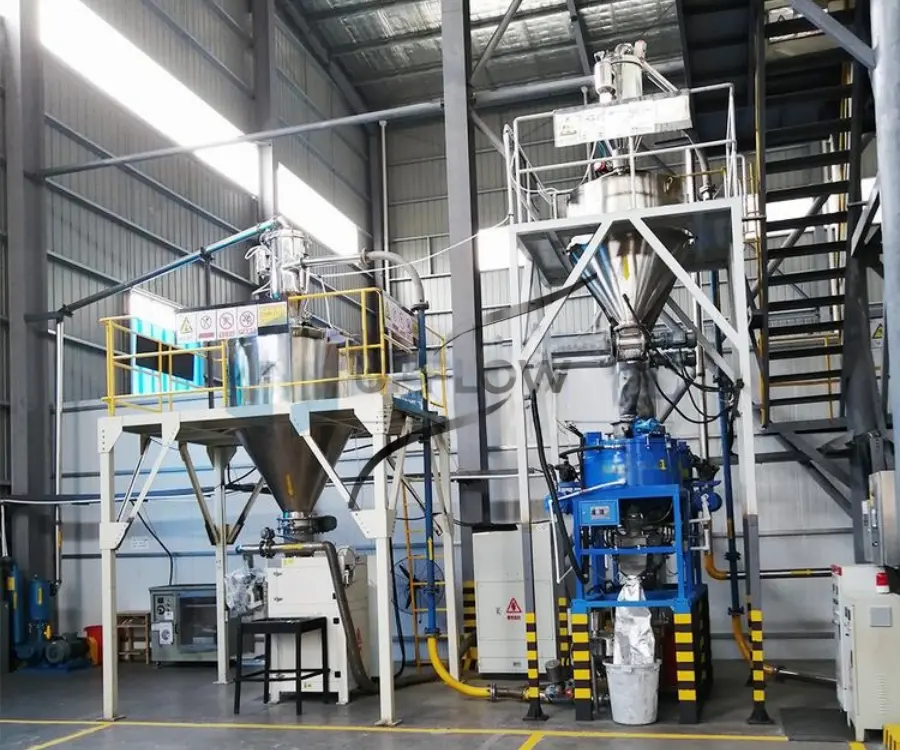
Introduction to Flame Retardant Powder Materials
Flame retardant powders are widely used in plastics, rubber, coatings, and construction materials to improve fire resistance and reduce flame spread. Common materials include aluminum hydroxide (ATH), magnesium hydroxide (MDH), ammonium polyphosphate (APP), brominated flame retardants, and phosphorus-based additives.
These powders typically have a bulk density of 0.4–1.2 g/cm³, with fine or micron-sized particles that are abrasive, dusty, and sometimes hygroscopic, making them difficult to handle in open systems. Therefore, a stable and enclosed conveying method is required to ensure safe and clean transport.
What is Flame Retardant Powder Pneumatic Conveying System
A flame retardant powder pneumatic conveying system is a technology that uses airflow to transport materials such as aluminum hydroxide powder, magnesium hydroxide powder, and ammonium polyphosphate powder through sealed pipelines.
It is also known as a positive pressure conveying system for aluminum hydroxide flame retardant powder, a negative pressure conveying system for ammonium polyphosphate powder, or a fully enclosed conveying system for magnesium hydroxide powder, depending on system design and working conditions.
The system forms a gas-solid flow inside pipelines, enabling dust-free and continuous material transport.
Key Design Points
The main design focus of a flame retardant powder pneumatic conveying system is safety, stability, and efficiency, especially when handling fine powders like APP and ATH.
Pipeline materials should be wear-resistant, anti-static, and corrosion-resistant, while the layout should minimize long distances and unnecessary bends to reduce pressure loss and avoid blockage.
For connection design, smooth joints and large-radius bends are preferred to ensure stable flow and reduce material impact inside the pipeline.
System Types and Working Principle
The system can operate as:
Positive pressure conveying system for aluminum hydroxide powder
Negative pressure (vacuum) conveying system for ammonium polyphosphate powder
Enclosed pneumatic conveying system for magnesium hydroxide flame retardant powder
In positive pressure systems, air pushes material through pipelines, while in vacuum systems, material is sucked into the pipeline by negative pressure. Both methods ensure enclosed and controlled transport.
Safety and Control Requirements
Because flame retardant powders are fine and dusty, the system must include dust collection, pressure monitoring, and static grounding protection.
Fire detection devices such as smoke and temperature sensors can be added for higher safety levels. Real-time monitoring helps maintain stable operation and prevents abnormal conditions.
Maintenance and Application
Regular maintenance includes pipeline cleaning, filter replacement, and equipment inspection to ensure long-term stable operation.
The system is widely used in plastic modification, rubber compounding, chemical production, and building material industries, where flame retardant powders like ATH, MDH, and APP are continuously processed.
UPFLOW Solution
UPFLOW provides customized flame retardant powder pneumatic conveying systems with stable performance, low energy consumption, and safe enclosed design.
Whether it is a positive pressure system, vacuum system, or fully enclosed conveying system for aluminum hydroxide or ammonium polyphosphate powder, UPFLOW helps improve efficiency, reduce dust, and ensure safe production.