
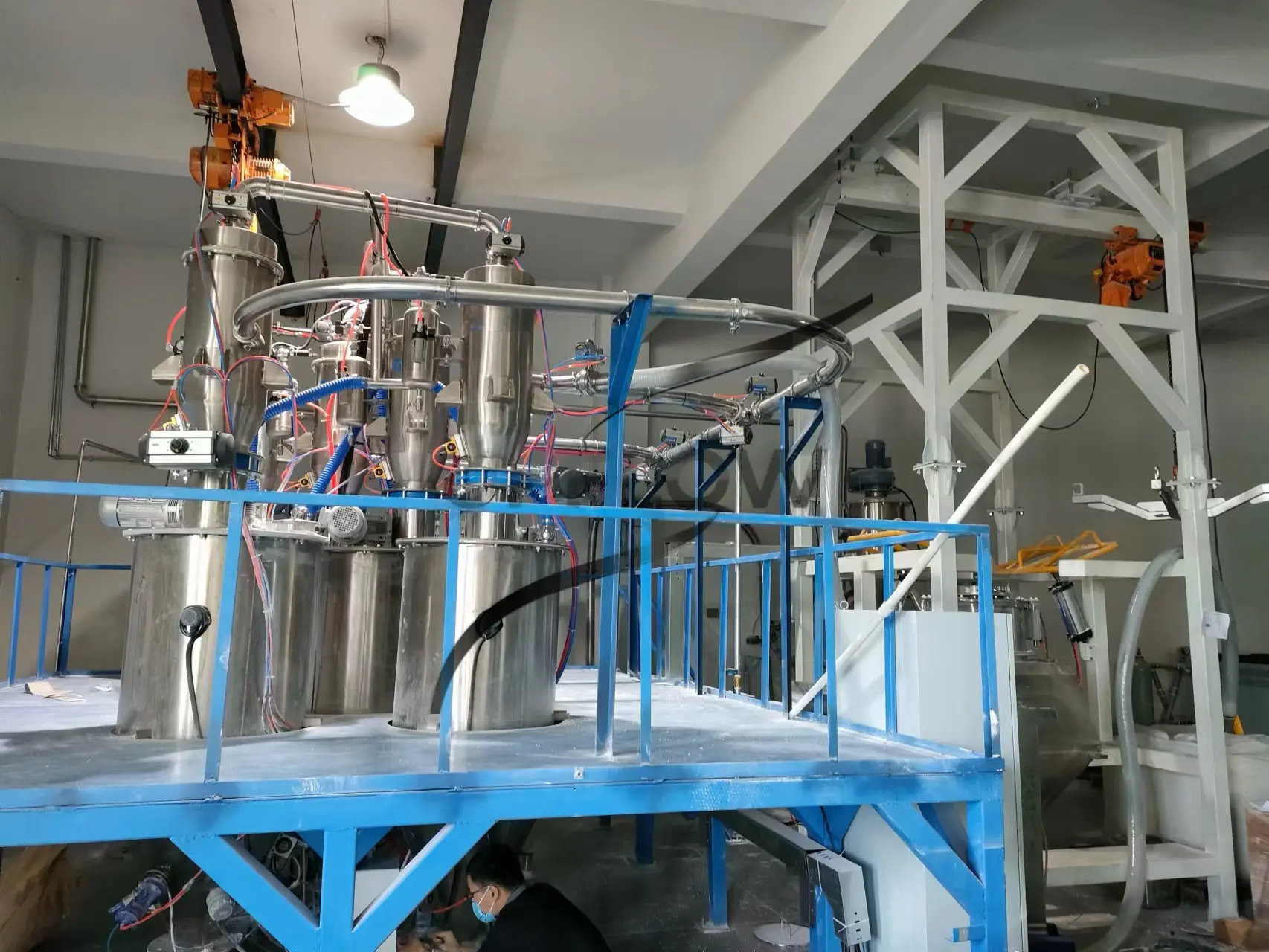
Introduction: Hygienic Powder Handling for Sensitive Industries
In modern processing environments, pneumatic conveying systems for food and pharmaceutical industries play a critical role in ensuring that powders and granules are transferred safely, efficiently, and without contamination, especially as manufacturers demand higher standards of hygiene, automation, and process consistency. Compared with traditional conveying methods that often expose materials to open environments, these systems provide a fully enclosed solution that minimizes dust, reduces manual handling, and improves overall production reliability.
By combining airflow-driven transport with advanced automation, this type of pneumatic conveying system has become a preferred material handling solution for industries where product purity and process control are essential.
Material Characteristics in Food and Pharmaceutical Applications
The design of pneumatic conveying systems for food and pharmaceutical industries must carefully consider the unique physical properties of the materials being handled, as these powders often exhibit fine particle size, low bulk density, and high sensitivity to moisture, temperature, and contamination. Common food materials include flour, sugar powder, starch, milk powder, and cocoa powder, while pharmaceutical applications involve active pharmaceutical ingredients (APIs), excipients, calcium powders, and nutritional supplements, all of which require gentle and controlled handling.
These materials may also present challenges such as poor flowability, tendency to agglomerate, or electrostatic behavior, which means the system must be designed to maintain stable flow conditions while preventing degradation or segregation during transport.
Working Principles and Conveying Methods
A pneumatic conveying system for food and pharmaceutical industries operates by using airflow or gas pressure to move materials through sealed pipelines, and depending on the process requirements, it can be configured as a positive pressure conveying system, a pressure conveying system, or a suction pneumatic conveying system, each offering different advantages in terms of flexibility, cleanliness, and conveying distance.
For applications requiring minimal product damage and reduced dust generation, a dense phase conveying system can be applied to transport materials in a slow-moving, compact flow, while in other cases, a mixed conveying system may be used to balance efficiency and product protection, ensuring optimal performance across various production conditions.
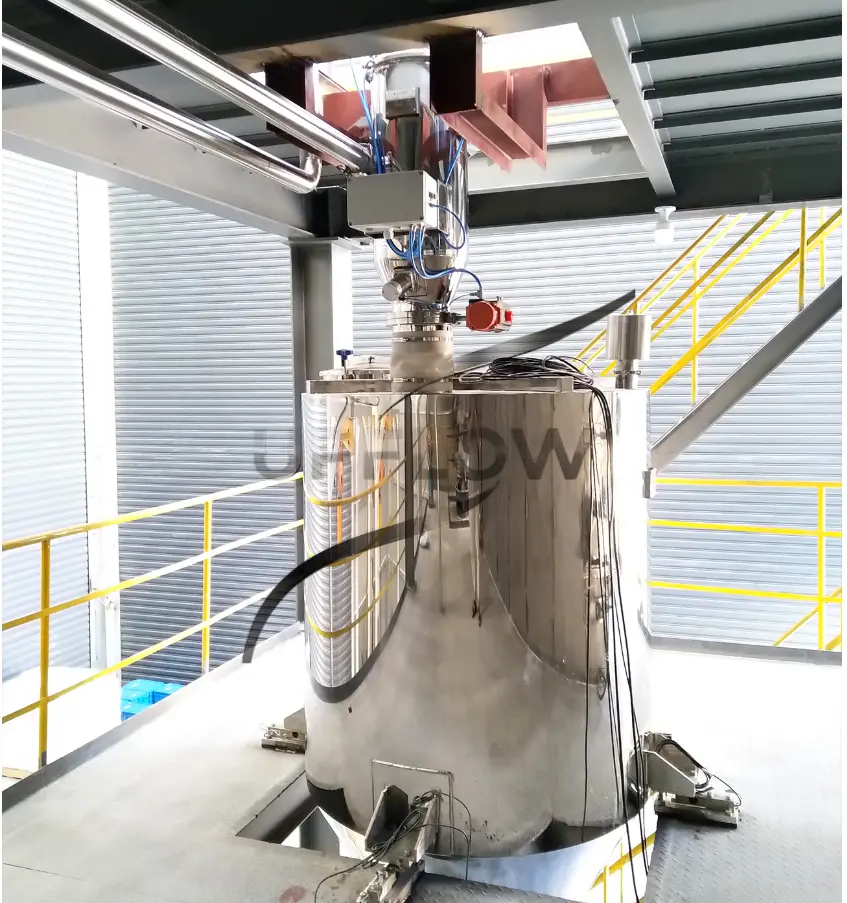
System Design and Integration in Production Lines
A complete pneumatic conveying system for food and pharmaceutical industries typically consists of air supply equipment, feeding devices, conveying pipelines, separation and filtration units, and receiving hoppers, all of which are integrated into a closed-loop system to maintain hygiene and operational stability. These systems are often connected with upstream and downstream equipment such as batching units, mixers, dryers, and packaging lines, forming a fully automated material handling network within the plant.
Through intelligent control systems and PLC-based automation, operators can monitor and adjust key parameters such as airflow, pressure, and material flow rate, ensuring consistent production quality and reducing the risk of human error.
Hygiene and Contamination Control Advantages
One of the most important reasons for adopting pneumatic conveying systems for food and pharmaceutical industries is their ability to provide a clean and contamination-free conveying environment, as materials are transported within sealed pipelines that prevent exposure to external contaminants such as dust, bacteria, or foreign particles. This is particularly critical in pharmaceutical production, where even minimal contamination can affect product safety and compliance with regulatory standards.
Additionally, the use of food-grade stainless steel pipelines with smooth internal surfaces allows for easy cleaning and maintenance, supporting strict hygiene protocols such as GMP and HACCP requirements.
Efficiency, Flexibility and Automation Benefits
Modern pneumatic conveying systems for food and pharmaceutical industries are designed to deliver high efficiency and operational flexibility, allowing materials to be transported over long distances both horizontally and vertically, while adapting to complex plant layouts without requiring significant floor space. This flexibility makes it possible to implement centralized feeding or multi-point distribution systems, improving overall production efficiency and simplifying plant design.
At the same time, automation reduces labor intensity and ensures consistent material handling performance, which is essential for maintaining stable production output in highly regulated industries.
Environmental and Safety Performance
In addition to process efficiency, pneumatic conveying systems for food and pharmaceutical industries also contribute to improved workplace safety and environmental protection, as integrated dust collection and filtration systems capture airborne particles and prevent them from being released into the surrounding environment. This not only reduces health risks for workers but also helps companies comply with environmental regulations and industry standards.
Conclusion: A Core Technology for Modern Hygienic Production
Overall, pneumatic conveying systems for food and pharmaceutical industries provide a reliable, clean, and highly automated solution for handling powders and granules in modern production environments, enabling manufacturers to improve efficiency, maintain product quality, and meet strict hygiene requirements. By selecting the appropriate conveying method and system configuration, companies can achieve a balance between performance, safety, and long-term operational stability.