
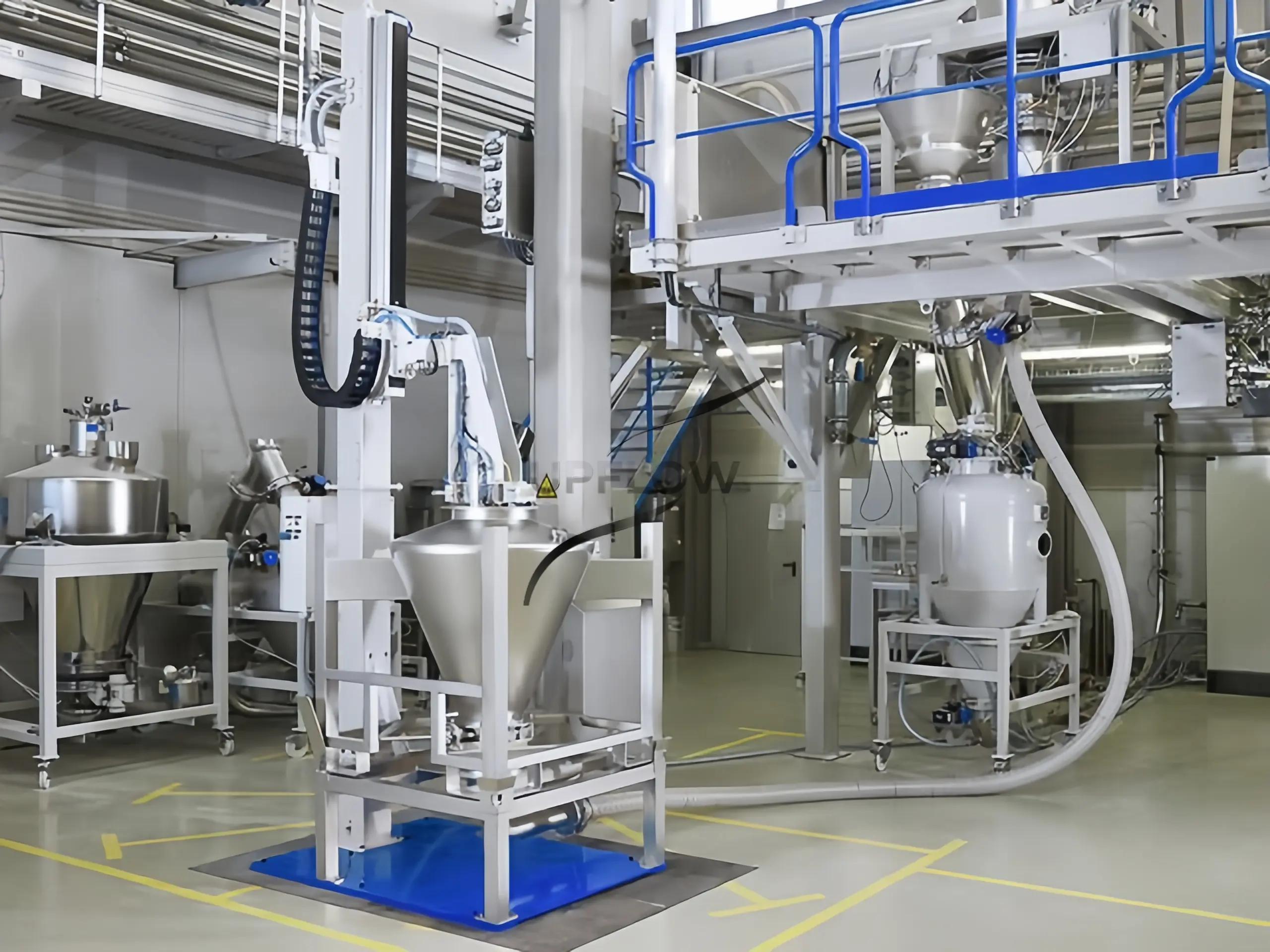
As modern chemical, pharmaceutical, food, fertilizer, mineral, and advanced manufacturing plants continue to increase automation and improve production consistency, the transportation of granulated powders has become an important process that directly affects product quality, material loss, dust control, and overall production efficiency, particularly because granulated materials do not always behave like conventional fine powders and therefore require a conveying system designed around their particle size, bulk density, flowability, friability, and resistance to degradation.
A properly engineered granulated powder pneumatic conveying system can provide a flexible solution for transferring granular or agglomerated powder materials between storage silos, intermediate hoppers, processing machines, packaging equipment, and production lines, while the conveying method can be configured according to the characteristics of the material, the required capacity, conveying distance, elevation, feeding conditions, and downstream process requirements.
Understanding Granulated Powder and Its Material Characteristics
Granulated powder generally refers to a powder material that has been processed into larger, more uniform particles or agglomerates through granulation, spray drying, agglomeration, extrusion, or another particle-forming process, creating a material that is different from conventional fine powder in both physical behavior and conveying requirements.
Unlike a single chemical substance, granulated powder is a material form rather than a specific chemical compound, which means that it does not have one universal scientific name or chemical formula; depending on the industry, it may also be described as granulated material, granular powder, agglomerated powder, granulated product, or powder granules, while the chemical formula is determined by the original material, such as a pharmaceutical excipient, fertilizer, food ingredient, chemical compound, ceramic material, or mineral powder.
The bulk density of granulated powder can vary considerably according to its composition, particle size, moisture content, porosity, and granulation process, but many industrial granulated powders commonly fall within approximately 0.4–1.2 g/cm³, while the true density of the individual solid particles can be substantially higher.
The most important physical characteristics include relatively larger particle size than fine powder, improved flowability in many applications, controlled particle distribution, variable moisture sensitivity, and potential friability, because granules may break apart when exposed to excessive pneumatic velocity, repeated impact, abrupt pressure changes, or unsuitable conveying equipment.
For this reason, the design of a granulated powder pneumatic conveying system should not simply copy a conventional fine-powder conveying configuration, since maintaining particle integrity can be just as important as achieving the required conveying capacity.
Why Granulated Powder Requires Specialized Pneumatic Conveying
Granulated materials are often produced specifically to improve flowability, reduce dust, improve dosing accuracy, or obtain a more consistent particle structure, meaning that excessive mechanical or pneumatic stress during transportation can partially destroy the benefits achieved during the granulation process.
One of the main challenges is particle degradation, because fragile granules can collide with pipeline walls, elbows, valves, diverters, and receiving equipment, gradually generating fines that can change the particle-size distribution and create additional dust during subsequent processing.
Another important consideration is conveying velocity, because excessively high air velocity may increase particle acceleration and impact energy, whereas insufficient velocity can create unstable conveying conditions, material accumulation, or pipeline blockage.
A well-designed granulated powder pneumatic conveying system therefore needs to balance conveying capacity with gentle material handling, using suitable air-to-material ratios, pipeline diameters, pressure levels, feeding devices, and conveying distances to achieve stable transportation without unnecessarily damaging the granules.
Working Principle of a Granulated Powder Pneumatic Conveying System
The basic operating principle is based on using a controlled airflow to transport granulated material through a closed pipeline from a feeding point to a receiving destination.
Depending on the application, the system may use vacuum conveying, positive pressure conveying, or a combination of different pneumatic conveying configurations, with the appropriate solution selected according to the material properties and plant layout.
In a vacuum configuration, the conveying air is drawn through the pipeline by a vacuum source, creating negative pressure that moves the granulated material from the pickup point toward the receiving vessel, which can be particularly useful when multiple feeding points need to be connected to a central receiving system.
A granulated powder vacuum conveying system can also help reduce the escape of material into the surrounding working environment because the conveying pipeline operates under negative pressure, while the receiving unit separates the conveyed material from the air before the cleaned air reaches the vacuum equipment.
For applications requiring longer conveying distances or higher throughput, pressure conveying may provide greater flexibility, especially when material needs to be transported from one central feeding point to several downstream destinations.
The final design should therefore be based on actual material testing and process requirements rather than simply selecting a conveying method according to capacity alone.
Pipeline Design and Particle Integrity
Pipeline design plays a particularly important role in granulated material transportation because every change in direction creates an opportunity for particle impact and degradation.
Long-radius elbows, appropriate pipeline diameter, optimized routing, and controlled conveying velocity can reduce unnecessary collisions between particles and the internal pipe wall, while the number of bends should ideally be minimized when the plant layout permits.
For fragile granules, the objective of a granulated powder pneumatic conveying system is not simply to move material as quickly as possible but to create a stable transportation environment in which the material reaches the destination with acceptable particle integrity.
Pipeline material and internal surface quality should also be selected according to the application, with stainless steel commonly used where corrosion resistance, cleanliness, and easy maintenance are important.
In abrasive applications, wear-resistant components may be required around elbows, feeding points, and other areas exposed to concentrated particle flow.
Granulated Powder Vacuum Conveying System for Flexible Material Transfer
A granulated powder vacuum conveying system is suitable for many applications in which the material must be collected from one or multiple sources and transferred to a central hopper, processing machine, or packaging line.
The negative-pressure operating principle can provide operational advantages when the production environment requires controlled material transfer, particularly because air leakage tends to move toward the conveying system rather than allowing product dust to escape outward.
Vacuum conveying can also simplify the connection of several pickup points, allowing a central vacuum source and receiving station to serve different process locations through properly designed valves and pipeline branches.
For sensitive granules, however, the vacuum level and conveying velocity still need to be carefully controlled, because negative pressure alone does not automatically guarantee gentle transportation.
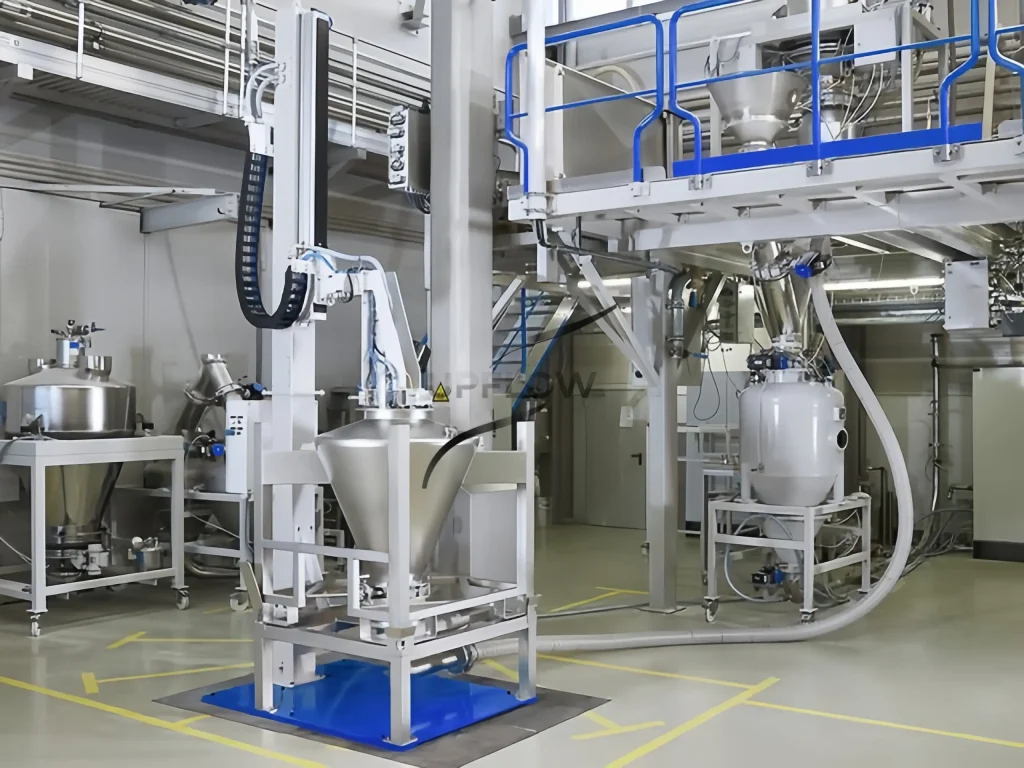
Granulated Powder Pneumatic Conveying System for Automated Production
Automation is another important reason why manufacturers are increasingly adopting pneumatic material handling instead of relying entirely on manual transfer or mechanical transportation.
A modern granulated powder pneumatic conveying system can integrate feeding equipment, storage hoppers, rotary valves, vacuum receivers, filters, level sensors, pressure transmitters, automatic valves, and PLC-based controls into a coordinated material transfer process.
The control system can monitor hopper levels, conveying pressure, vacuum conditions, valve status, and material transfer sequences, allowing the equipment to automatically start or stop according to production requirements.
This type of automation can reduce manual handling, improve production continuity, and make the material flow between different process stages more predictable.
For factories with multiple production lines, an appropriately designed granulated powder material automation system can also coordinate several conveying destinations and feeding points, helping operators manage material transfer without manually moving bags or containers between process areas.
Granulated Powder Enclosed Conveying System for Dust Control
Dust management is an important consideration when handling granulated products because even materials that generate relatively little dust during normal operation can produce fines through abrasion and particle breakage.
A granulated powder enclosed conveying system keeps the material inside a sealed pipeline during transportation, reducing direct contact between the product and the surrounding production environment.
Compared with open manual transfer, an enclosed conveying configuration can reduce dust dispersion, improve housekeeping, and provide a cleaner material-handling route between storage and processing equipment.
The receiving unit can incorporate filtration and dust separation components so that the conveying air is separated from the product before being discharged or returned to the conveying circuit.
For food, pharmaceutical, chemical, and other controlled production environments, the specific sealing materials, filtration configuration, cleaning method, and surface finish should be selected according to the required hygiene and production standards.
Granulated Powder Material Automation System and Process Integration
A granulated powder material automation system becomes particularly valuable when pneumatic conveying is not an isolated transfer operation but part of a complete production process.
For example, granulated material may need to move from a storage silo to a weighing hopper, then to a mixer, reactor, dryer, screening machine, filling machine, or packaging line, requiring the conveying system to communicate with upstream and downstream equipment.
By integrating material-level sensors, automated valves, feeding devices, weighing systems, and PLC controls, the system can establish a controlled sequence in which material is transferred only when the receiving equipment is ready.
This approach can reduce unnecessary intermediate handling and create a more continuous production workflow.
A properly engineered granulated powder material automation system can also provide useful operating data, such as conveying cycles, material transfer status, pressure trends, filter conditions, and equipment alarms, which can support preventive maintenance and production management.
Selecting a Granulated Powder Pneumatic Conveying Manufacturer
Choosing an experienced granulated powder pneumatic conveying manufacturer is important because the performance of the final system depends on the interaction between material characteristics, conveying parameters, equipment selection, and plant layout rather than on any single component.
Before designing the system, the manufacturer should ideally understand the material’s bulk density, particle-size distribution, moisture content, flowability, temperature, abrasiveness, friability, and expected conveying capacity.
The conveying distance, vertical lift, number of elbows, feeding method, receiving equipment, available installation space, and required operating schedule should also be evaluated.
Where material degradation is a concern, testing or pilot-scale evaluation can help determine suitable conveying velocity and operating conditions before the final system is manufactured.
An experienced granulated powder pneumatic conveying manufacturer should therefore be capable of providing more than individual equipment, offering system engineering, pipeline design, feeding solutions, filtration, automatic control, and integration with the customer’s existing production equipment.
Conclusion
As manufacturers continue to pursue cleaner production, automated material handling, and greater consistency in powder processing, pneumatic conveying is becoming an increasingly practical method for transporting granulated products between different stages of industrial production.
The key to successful transportation is not simply achieving the highest possible conveying capacity, but designing the system around the actual behavior of the granulated material, particularly its particle size, bulk density, flowability, friability, dust generation, and sensitivity to mechanical impact.
A properly engineered granulated powder pneumatic conveying system can combine controlled airflow, optimized pipeline design, automated feeding, enclosed material transfer, and intelligent process control to create a reliable transportation solution while helping manufacturers maintain product quality and improve production efficiency.
For applications requiring flexible pickup, a granulated powder vacuum conveying system can provide an effective negative-pressure solution, while a granulated powder enclosed conveying system can support cleaner and more controlled material transportation.
When pneumatic conveying becomes part of a broader granulated powder material automation system, the result can be a highly integrated material-handling process that reduces manual intervention and connects storage, processing, and packaging operations into a more efficient production workflow.