
Introduction
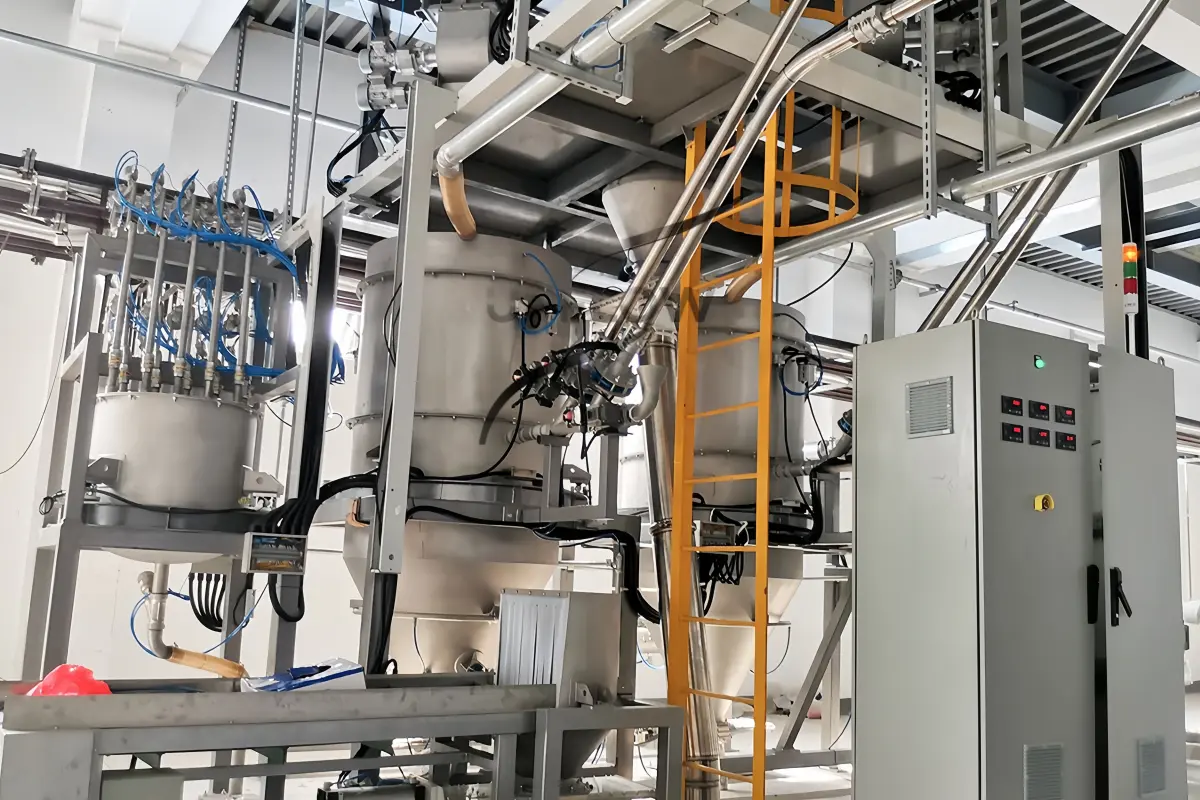
A magnesium sulfate pneumatic conveying system is a highly efficient solution for transporting fine particles through enclosed pipelines using controlled airflow, widely applied in chemical processing, fertilizers, pharmaceuticals, and building materials industries, where clean handling, automation, and long-distance conveying are essential for stable production.
Magnesium Sulfate Material Characteristics
Magnesium sulfate (chemical formula: MgSO₄), also known as Epsom salt in its hydrated form, is commonly found as powder or crystalline particles, with magnesium sulfate heptahydrate (MgSO₄·7H₂O) being one of its most widely used forms. The bulk density typically ranges from 0.9 to 1.3 t/m³, depending on particle size and moisture condition.
The material generally has good solubility and moderate flowability, but it is also hygroscopic, meaning it can absorb moisture and form lumps during storage or conveying. Therefore, a well-designed magnesium sulfate pneumatic conveying system is required to ensure stable feeding, prevent agglomeration, and maintain product quality during transport.
Working Principle of Magnesium Sulfate Pneumatic Conveying System
The magnesium sulfate pneumatic conveying system operates by controlling airflow velocity and direction within a pipeline, using the interaction between gas flow and solid particles to move material from the source point to the destination. The conveying process relies on aerodynamic forces such as drag and inertia, which keep particles suspended or moving in clusters along the pipeline.
By adjusting air pressure and valve operation, the system can precisely regulate flow rate and conveying conditions, making it suitable for both short and long-distance pipeline conveying systems.
Main Components of the System
The system is composed of several key components working together to ensure efficient conveying performance.
The air supply unit, typically using compressed air, acts as the driving force, providing stable pressure and flow rate. The pipeline network, made from wear-resistant and corrosion-resistant materials such as stainless steel, ensures smooth internal surfaces to reduce friction and material degradation.
The valve control system plays a critical role in regulating airflow direction and volume, using control valves and diverters to achieve accurate conveying. Together, these components form a reliable centralized feeding system that supports continuous and controlled material transfer.
Working Process
The conveying process begins with air supply activation, where compressed air is adjusted to the required pressure level and delivered into the pipeline system. Material is then introduced into the system through feeding equipment.
Next, airflow is regulated to create sufficient velocity and direction, allowing magnesium sulfate particles to move steadily through the pipeline. The material is transported under controlled conditions until it reaches the destination, where it is discharged after airflow is stopped and valves are closed.
This process ensures smooth conveying with minimal dust emission and stable performance.
Advantages and Industrial Applications
The magnesium sulfate pneumatic conveying system offers high efficiency and stable operation, allowing continuous material transport that improves overall production performance and product consistency.
Compared with mechanical systems, it provides lower energy consumption and reduced operational costs, making it a cost-effective solution for modern industries. In addition, it can be configured as a dense phase conveying system or a positive pressure conveying system, depending on process requirements and material characteristics.
Magnesium sulfate pneumatic conveying systems, including those suitable for conveying various types of raw materials, are widely used in the chemical industry, metallurgical field, building materials field, and other fields.
Another key advantage is its high level of automation, enabling remote monitoring and intelligent control, which significantly reduces labor intensity while improving operational accuracy.
Finally, the system supports environmentally friendly production, as it operates with minimal noise and vibration, does not require lubrication, and ensures enclosed conveying that prevents dust pollution.
Conclusion
In conclusion, the magnesium sulfate pneumatic conveying system is a versatile and efficient solution that integrates centralized feeding systems, positive pressure conveying systems, and long-distance pipeline conveying systems into a single automated platform. With its advantages in efficiency, flexibility, and environmental performance, it plays an increasingly important role in modern industrial material handling.