
Material Profile: Understanding Monoammonium Phosphate (MAP)
Monoammonium phosphate, commonly abbreviated as MAP fertilizer, is a widely used phosphorus-based fertilizer with the chemical formula NH₄H₂PO₄, and it is also known as ammonium dihydrogen phosphate, phosphate fertilizer, or MAP powder/granules depending on its processing form. It is valued for its high phosphorus content and excellent water solubility, making it suitable for direct soil application as well as industrial blending processes.
In industrial handling, MAP is typically available as granular MAP for agricultural use and powdered MAP for chemical processing and blending, with a bulk density ranging from approximately 0.8 to 1.1 g/cm³, depending on moisture content and particle size distribution. It is characterized by good flowability in dry conditions, moderate hygroscopicity, and a tendency to cake under high humidity, which requires controlled and enclosed conveying methods to maintain material stability.
What Is a Monoammonium Phosphate (MAP) Pneumatic Conveying System?
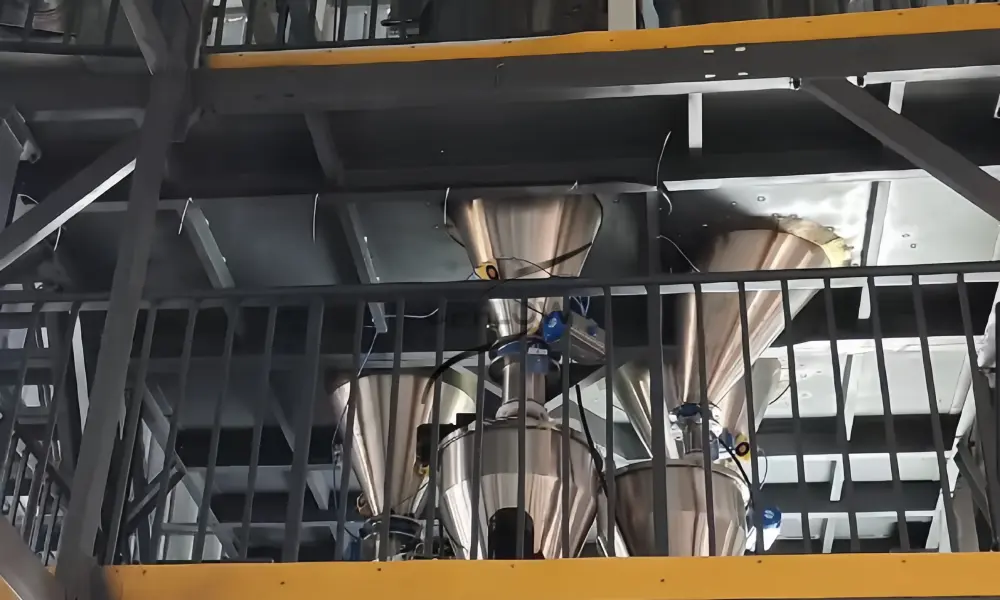
A monoammonium phosphate (MAP) pneumatic conveying system is a modern bulk material handling solution that uses airflow or gas flow to transport MAP powder or granules through pipelines in a controlled and enclosed environment.
In practical applications, it is also referred to as a sealed conveying system for MAP fertilizer powder, a long-distance conveying system for monoammonium phosphate materials, a powder transfer system for MAP fertilizer handling, or a pneumatic powder conveying system for ammonium phosphate materials, depending on system design and operational requirements.
By creating a stable gas-solid flow inside pipelines, this powder conveying system for MAP fertilizer materials ensures continuous, efficient, and dust-free transportation in fertilizer production plants and logistics systems.
Conveying Principle and System Operation
The monoammonium phosphate pneumatic conveying system operates on the principle of gas-solid two-phase flow, where compressed air or controlled airflow is used to move MAP particles through sealed pipelines.
In a positive pressure long-distance conveying system for MAP fertilizer powder, compressed air pushes the material from a feeding point toward storage or processing units, making it suitable for large-scale fertilizer plants. In contrast, a vacuum-based enclosed conveying system for MAP powder materials draws material into the pipeline using negative pressure, ensuring cleaner operation and reduced dust emissions.
During the conveying process, MAP particles may either remain suspended in the airflow or move in clusters depending on system configuration, ensuring stable transport while minimizing degradation or material loss.
Key Advantages of MAP Pneumatic Conveying Systems
The monoammonium phosphate pneumatic conveying system offers several advantages over traditional conveying methods, particularly in maintaining environmental compliance and improving operational efficiency.
As a fully enclosed conveying system for MAP fertilizer powder, it effectively prevents dust leakage and reduces environmental pollution, which is critical in modern fertilizer production and storage environments. In addition, it supports long-distance conveying and flexible pipeline routing, making it suitable for complex plant layouts and centralized material handling.
Furthermore, as a powder transfer system for monoammonium phosphate materials, it reduces manual handling, improves feeding accuracy, and enhances overall process automation.
Industrial Applications of MAP Powder Conveying Systems
The monoammonium phosphate pneumatic conveying system is widely used in fertilizer manufacturing plants, blending facilities, and bulk material handling operations.
As a long-distance conveying system for MAP fertilizer materials, it is commonly applied in transporting materials from production units to storage silos or packaging lines. In fertilizer blending processes, a powder conveying system for MAP powder materials ensures consistent and accurate feeding into mixing systems, improving product uniformity.
In storage and logistics environments, a sealed conveying system for monoammonium phosphate materials enables efficient loading, unloading, and transfer operations while minimizing material loss and dust emissions.
Conclusion
The monoammonium phosphate (MAP) pneumatic conveying system provides a reliable, efficient, and environmentally friendly solution for handling fertilizer powders and granules. By integrating sealed conveying systems, long-distance conveying systems, powder transfer systems, and pneumatic powder conveying systems for MAP materials, manufacturers can achieve improved productivity, better environmental control, and stable material handling performance in modern fertilizer processing operations.