When searching for a pneumatic conveying system supplier vs manufacturer, many buyers assume both terms mean the same thing. In reality, choosing between a supplier and a manufacturer can significantly impact your project cost, system performance, and long-term reliability.
Some factories prioritize low price and choose traders. Others look for engineering capability and prefer direct manufacturers. The challenge is knowing which option fits your specific project.
This guide breaks down the real differences, hidden risks, and decision criteria–so you can avoid costly mistakes.
Not sure which option fits your project? Contact us for a free consultation.
First, Let’s Clarify the Terms (They Are NOT the Same)
Manufacturer
A manufacturer is a company that:
Designs and produces equipment
Has its own factory
Controls production and quality
In many cases, manufacturers also provide system design.
Supplier (or Trader)
A supplier may:
Source equipment from different factories
Combine components into a solution
Focus on sales rather than production
Key point: Not all suppliers are engineers, and not all manufacturers are system experts.
The Real Difference: Who Controls the Project?
Manufacturer-Controlled Project
Full control over design
Direct production
Faster problem-solving
Supplier-Controlled Project
Depends on multiple factories
Communication layers
Possible delays
This directly affects:
Delivery time
System stability
After-sales support
What Really Happens During a Project (Behind the Scenes)
To truly understand the difference between a pneumatic conveying system supplier vs manufacturer, you need to look at what happens during an actual project—not just on paper.
Supplier-Based Workflow
Customer sends inquiry
Supplier contacts multiple factories
Quotes are collected
Proposal is assembled
Potential Issues:
No unified system design
Components may not match perfectly
Communication delays
Manufacturer-Based Workflow
Direct material analysis
Engineering design based on data
Integrated system solution
In-house production
Advantages:
Better system integration
Faster response time
Higher design accuracy
The difference becomes very clear once the project starts—not when you receive the quotation.
When a Manufacturer Is the Better Choice
Scenario 1: Complex System Design
If your project involves:
Multiple conveying lines
Centralized systems
Automation integration
You need a manufacturer with engineering capability
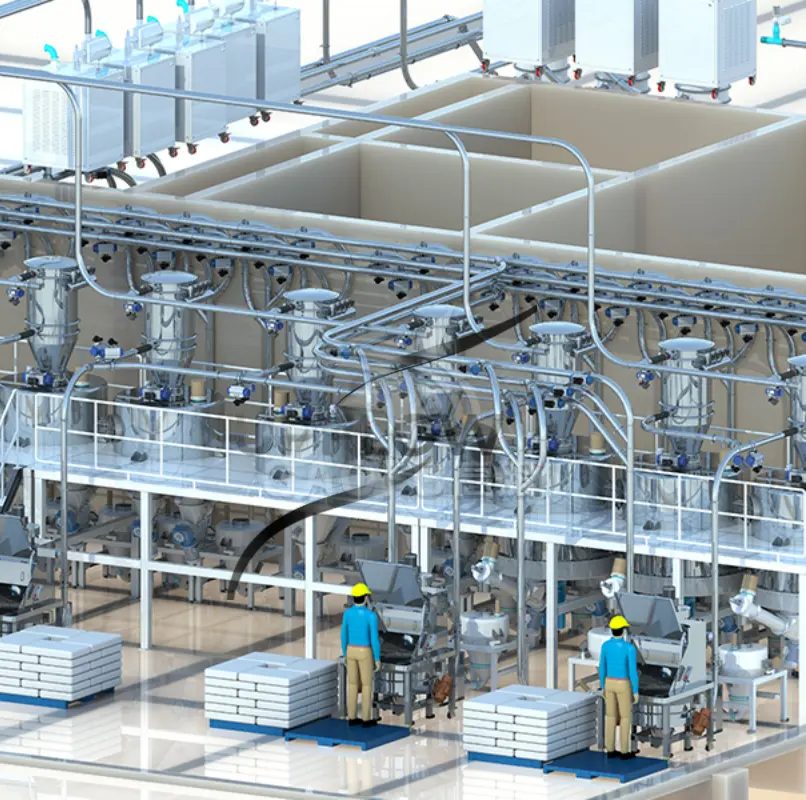
Example system:
Scenario 2: High Reliability Requirements
Industries like:
Food
Pharmaceutical
Chemical
require stable, precise systems.
Scenario 3: Long-Term Operation
If you plan to run the system for years:
Manufacturer support is critical
Manufacturers are better for long-term, complex, and high-value projects.
When a Supplier Might Be a Good Option
Scenario 1: Small or Simple Projects
Short conveying distance
Standard equipment
Scenario 2: Budget-Constrained Buyers
Suppliers may offer:
Lower upfront cost
Faster quotation
Scenario 3: Multi-Brand Integration
Some suppliers combine:
Different brands
Specialized components
But this comes with risks.
Hidden Risks Most Buyers Don’t See
Risk 1: No Real Engineering Support
Many suppliers:
Cannot calculate airflow
Do not optimize system design
Risk 2: Inconsistent Quality
Components may come from:
Different factories
Different standards
Risk 3: Difficult After-Sales Support
If something fails:
Who is responsible?
Who provides spare parts?
This is where many projects fail.
Related reading: How to Choose the Right Pneumatic Conveying System for Your Factory
Why Many Low-Cost Projects Fail
Many factories choose suppliers based on price, but this often leads to problems.
Common Failure Reasons
1. Lack of System-Level Thinking
Some suppliers focus on selling equipment, not designing a system.
Result:
Mismatched components
Poor system performance
2. No Material Testing
Without proper testing:
Airflow may be incorrect
Blockage risk increases
3. Poor Pipeline Design
Improper design can cause:
Pressure loss
High energy consumption
4. No Long-Term Support
After installation:
Limited technical support
Difficult troubleshooting
A cheap system that doesn’t work is the most expensive investment.
A Practical Comparison (What Actually Matters)
| Factor | Manufacturer | Supplier |
| Engineering | Strong | Limited |
| Customization | High | Medium |
| Price | Medium-High | Low-Medium |
| Reliability | High | Variable |
| After-sales | Direct | Indirect |
The real question is not which is cheaper,but which is more reliable over time.
Real Project Insight: Why One Client Switched
Industry: Chemical Powder Processing
Initial Choice:
Low-cost supplier
Standard system
Problems:
Frequent blockage
High energy consumption
Poor support
After Switching to Manufacturer:
We redesigned:
Pipeline layout
Airflow system
Feeding method
Results:
Stable operation
Lower maintenance cost
Improved efficiency
Related solution:Chemical Powder Pneumatic Conveying System
Cost Perspective: Short-Term vs Long-Term Thinking
When comparing a supplier vs manufacturer, cost should not be evaluated only at the quotation stage.
Short-Term Cost (What You See)
Equipment price
Installation cost
Long-Term Cost (What You Don’t See)
Energy consumption
Maintenance cost
Downtime loss
Spare parts
Real Difference
Supplier Option:
Lower upfront cost
Higher long-term cost
Manufacturer Option:
Higher initial investment
Lower lifetime cost
Many industrial buyers now focus on Total Cost of Ownership (TCO) instead of just price.
Choosing the right partner can reduce total cost by 20-30% over time.
So Which One Should YOU Choose?
Instead of asking:
Supplier or manufacturer?
Ask:
Key Decision Questions
Does your project require custom design?
Is system reliability critical?
Do you need long-term support?
Is your material difficult to handle?
Decision Logic:
YES-Choose manufacturer
NO-Supplier may be enough
Still unsure? Send us your material details, we will recommend the best option.
Hybrid Model: When Supplier + Manufacturer Combination Works
In some cases, a hybrid approach may be the best option.
When It Works
Supplier has strong engineering team
Manufacturer provides high-quality equipment
Clear project responsibility
When It Fails
Supplier lacks technical knowledge
No coordination between parties
No clear responsibility
Key rule: If you choose a supplier, make sure they act like an engineer—not just a trader.
About UPFLOW: Engineering-Focused Manufacturer
At UPFLOW, we operate as an engineering-driven manufacturer, not just a supplier.
We provide:
Customized pneumatic conveying systems
Turnkey project solutions
Material-based system design
Our experience covers:
Food powder conveying
Plastic pellet systems
Chemical powder handling
We don’t just supply equipment, we design solutions that work.
A Simple Rule Used by Experienced Buyers
After years of project experience, many buyers follow this rule:
Decision Shortcut
Small project → supplier is acceptable
Medium project → depends on complexity
Large/critical project → choose manufacturer
Another Simple Test
Ask yourself:
“If this system fails, who can fix it quickly?”
If the answer is unclear → avoid that supplier
If the answer is direct → good choice
Clarity of responsibility is more important than price.
Conclusion: Choose Based on Value, Not Just Price
The difference between a supplier and a manufacturer is not just terminology-it affects your entire project outcome.
Choosing the right partner means:
Better system performance
Lower long-term cost
Reliable operation
A good decision today prevents years of operational problems.
CTA
Need help choosing the right partner?
We offer:
FREE system consultation
Custom design solutions
Professional engineering support