
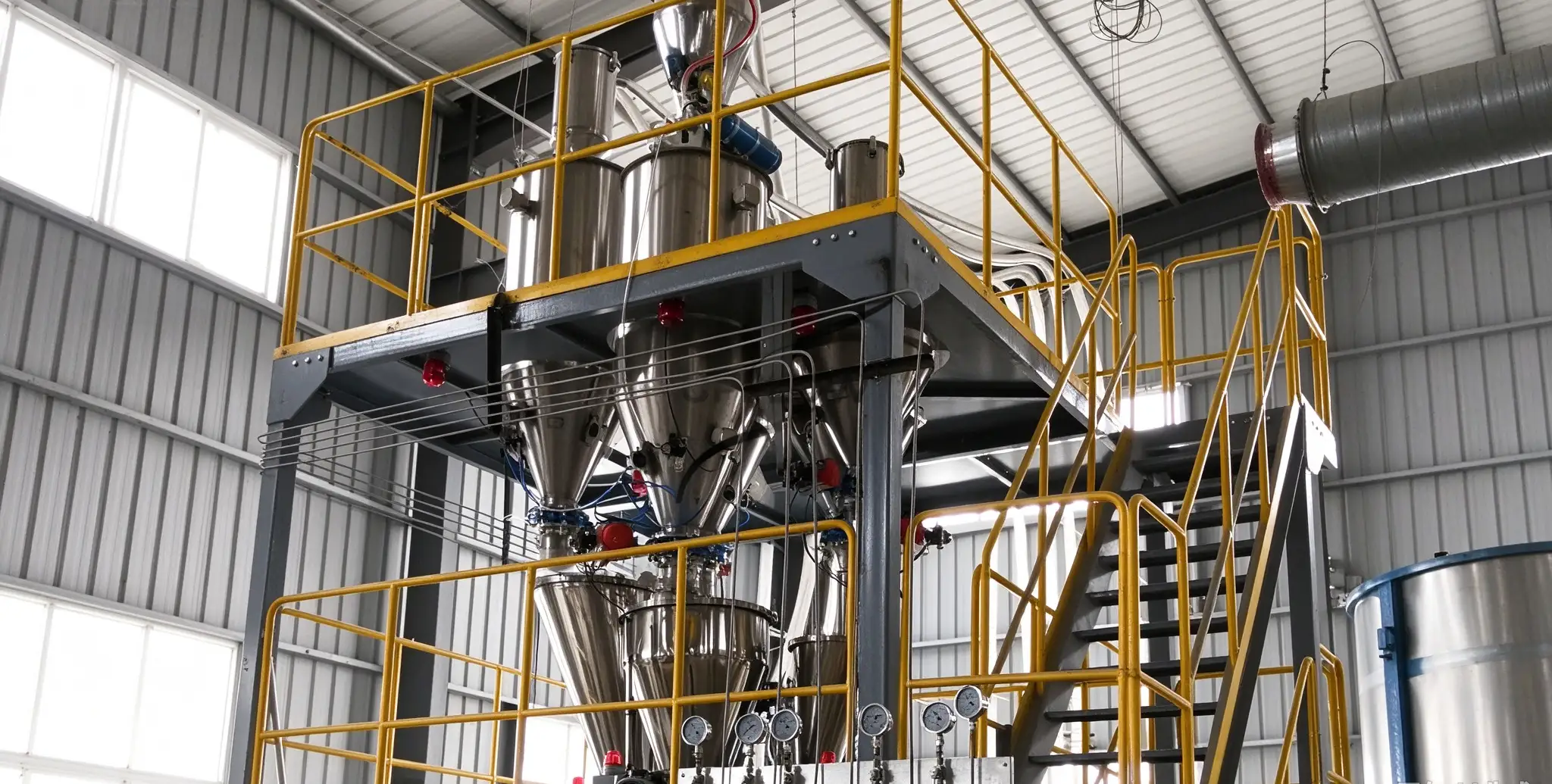
Overfeeding is a common operational problem in automatic powder dosing systems. When a feeder delivers more material than the programmed target weight, the result may include inaccurate batch proportions, raw material waste, inconsistent product quality and additional cleaning or rework.
In industrial applications involving chemical powders, food ingredients, minerals and battery materials, accurate dosing requires more than setting a target weight in the PLC. The feeding equipment, material flow characteristics, weighing feedback and feeder stopping response must work together.
This article explains the common causes of powder overfeeding and practical engineering methods to improve dosing control.
1. What Causes Overfeeding in Automatic Powder Dosing Systems?
Overfeeding occurs when the actual material quantity exceeds the programmed dosing target.
Several factors can contribute to this problem:
Feeder stopping delay: Material continues moving after the stop command is issued.
Excessive feeding rate: The feeder delivers material faster than the control system can respond.
Material flow variations: Changes in bulk density or flowability affect the actual feeding rate.
Residual material: Powder remaining inside the feeder or discharge chute continues entering the weighing hopper.
Unstable weighing signals: Vibration or mechanical interference affects weight measurement.
Incorrect control parameters: Poorly configured cutoff values and feeding sequences cause dosing deviations.
Identifying the actual cause is the first step toward selecting an effective solution.
2. Use Coarse and Fine Feeding to Control Material Flow
One practical way to reduce overfeeding is to divide the dosing process into coarse feeding and fine feeding stages.
During coarse feeding, the screw feeder or other feeding device operates at a relatively high speed to deliver most of the required material quickly.
When the measured weight approaches the target, the system switches to fine feeding at a lower speed.
The feeder then stops when the remaining target quantity has been reached.
This two-stage feeding strategy helps balance production efficiency and dosing control.
For materials requiring more precise dosing, the control system can also use adjustable feeding speeds and cutoff thresholds according to actual material behavior.
3. Apply Material-in-Flight Compensation
One important reason for overfeeding is that material does not stop flowing immediately when the feeder receives a stop command.
Powder already inside the screw feeder outlet, discharge chute or connecting pipe may continue falling into the weighing hopper.
This additional quantity is often referred to as material-in-flight.
A dosing controller can account for this behavior by stopping the feeder before the measured weight reaches the final target.
For example, if a dosing process consistently delivers an additional 0.5 kg after the stop command, the controller can use an appropriate preliminary cutoff value based on verified operating data.
However, this compensation should not rely on an arbitrary fixed value. Material flow, feeding speed, equipment configuration and batch size may all affect the residual quantity.
Periodic testing and adjustment are therefore necessary when operating conditions change.
4. Improve Weighing Feedback and Feeder Coordination
Reliable dosing depends on accurate and stable weight feedback.
In a gravimetric dosing system, load cells continuously measure the weight change in the weighing hopper or receiving vessel. The PLC uses this information to control the feeder.
Several factors should be checked:
Correct load cell selection and installation.
Stable hopper support structures.
Appropriate weighing signal filtering.
Protection against external vibration.
Correct feeder speed and stopping parameters.
Proper coordination between the feeder and weighing controller.
Mechanical vibration, rigid pipeline connections and unstable support structures may affect weight readings and lead to incorrect feeding decisions.
For more information, see Powder Batching Hopper Design: Load Cells, Vibration and Isolation.
5. Select the Right Feeder for Different Powder Materials
Different powders have different flow characteristics, and the feeding equipment should be selected accordingly.
For example:
Screw Feeders
Screw feeders provide controlled material discharge and adjustable feeding rates. They are commonly considered for powder dosing applications requiring coarse and fine feeding stages.
Rotary Valves
Rotary valves can provide controlled material discharge from hoppers and silos. Their actual dosing suitability depends on material properties, valve configuration and the required measurement method.
Loss-in-Weight Feeders
Loss-in-weight systems determine feeding rate by measuring the decrease in the weight of the feeding hopper over time. They are suitable for applications requiring continuous gravimetric feeding.
The correct selection should consider bulk density, particle size, flowability, required feeding capacity and dosing tolerance.
6. How to Verify and Reduce Overfeeding
After configuring the feeder and control system, actual dosing performance should be verified through repeated tests.
A practical procedure includes:
Set a defined target weight for the material.
Run the feeder under normal operating conditions.
Record the final discharged weight.
Calculate the deviation between actual and target weights.
Repeat the test to evaluate consistency.
Adjust feeder speed and cutoff compensation according to the results.
The basic dosing deviation can be calculated as:
Dosing Deviation (%) = (Actual Weight − Target Weight) ÷ Target Weight × 100%
For example, if the target is 100 kg and the actual discharged quantity is 101 kg, the positive dosing deviation is 1%.
The acceptance tolerance should be defined according to the production recipe and process requirements rather than assuming one universal tolerance applies to every powder.
For further guidance, read Powder Batching Accuracy: How to Define and Verify ±0.2% Tolerance.
7. Integrating Powder Dosing with Automatic Batching Systems
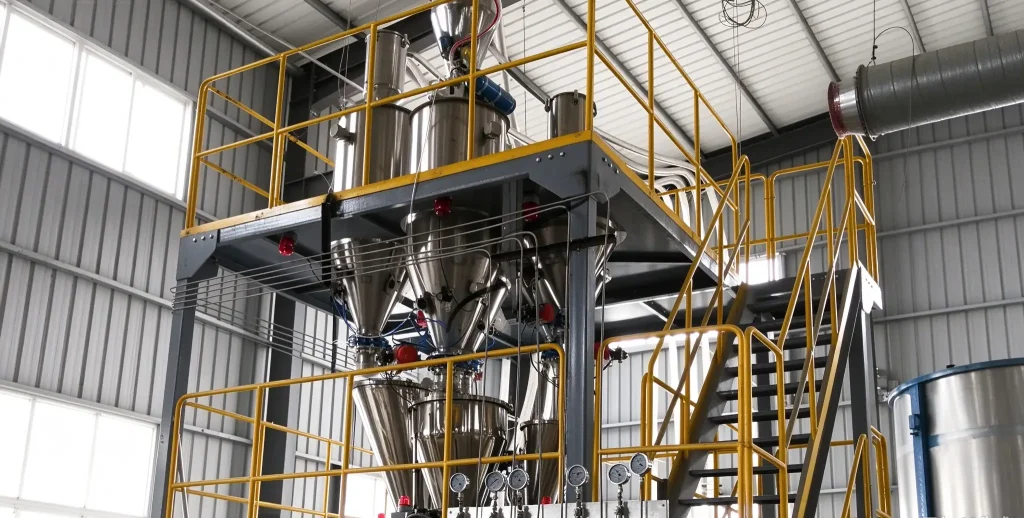
Preventing overfeeding requires coordination between material storage, feeding equipment, weighing instruments and the control system.
A typical automatic powder dosing arrangement may include:
Raw material storage hoppers or silos.
Screw feeders or controlled discharge devices.
Weighing hoppers and load cells.
PLC-based dosing control.
Discharge valves and downstream mixing equipment.
Dust collection and material transfer connections.
UPFLOW provides customized Automatic Batching Systems for multi-ingredient weighing and dosing applications.
For enclosed powder transfer between storage and production equipment, a Pneumatic Conveying System or Vacuum Feeding System may also be integrated according to the material characteristics and process layout.
For related engineering guidance, see Multi-Ingredient Powder Batching: Sequential vs Parallel Weighing.
8. UPFLOW Project References
Artificial Graphite Airflow Mixing Project
UPFLOW has supplied 12 airflow mixing machines to a battery material manufacturer through four separate contracts.
Each machine has a design volume of 60 m³ and a maximum loading weight of 30 tonnes per batch. The project also specifies C3-class weighing load cells or better, a mixing cycle of no more than 30 minutes and a mixing uniformity requirement of CV ≤5%.
This project demonstrates the importance of coordinating material feeding, weighing equipment and process control in large-capacity powder processing.
Read more about the Artificial Graphite Airflow Mixing Project.
Magnesium Silicate Pneumatic Conveying and Batching Project
UPFLOW supplied a customized system integrating manual bag dumping, pneumatic conveying, weighing hoppers, screw feeding equipment and centralized control.
The project demonstrates how material feeding and weighing equipment can be integrated into an industrial powder handling process.
Read more about the Magnesium Silicate Conveying and Batching Project.
PVC Powder Feeding and Conveying Project
UPFLOW supplied a customized PVC powder feeding and vacuum conveying system incorporating bag unloading equipment, conveying units, receiving hopper modifications, pipelines and centralized electrical control.
The project provides an additional reference for coordinating powder feeding equipment with existing production interfaces.
Read more about the PVC Powder Feeding and Vacuum Conveying Project.
9. Frequently Asked Questions
Q1. What is the main cause of overfeeding in powder dosing systems?
Common causes include feeder stopping delays, excessive feeding rates, residual material in discharge connections and unstable weighing feedback.
Q2. How does coarse and fine feeding prevent overfeeding?
The feeder initially operates at a higher speed and switches to a lower speed as the target weight approaches, reducing the quantity of material delivered after the cutoff command.
Q3. What is material-in-flight compensation?
It is a control method that accounts for material continuing to move after the feeder stops, allowing the system to issue the stop command before reaching the final target weight.
Q4. Can a screw feeder provide accurate powder dosing?
Yes. A properly selected and controlled screw feeder can support accurate dosing through adjustable feeding speeds, weighing feedback and suitable cutoff compensation.
Q5. How can I check whether a powder dosing system is overfeeding?
Compare the actual discharged weight with the programmed target weight over repeated batches and calculate the dosing deviation under representative operating conditions.
Conclusion
Preventing overfeeding in automatic powder dosing systems requires coordinated control of feeding speed, weighing feedback, material flow and feeder stopping response.
Coarse and fine feeding, material-in-flight compensation, suitable feeder selection and repeated weighing verification can help improve dosing consistency and reduce material waste.
UPFLOW provides customized automatic batching, powder feeding and pneumatic conveying solutions according to material characteristics, production capacity and dosing requirements.
Planning an automatic powder dosing project? Contact UPFLOW with your material properties, target batch weight, required dosing tolerance and production capacity to discuss a suitable system configuration.