
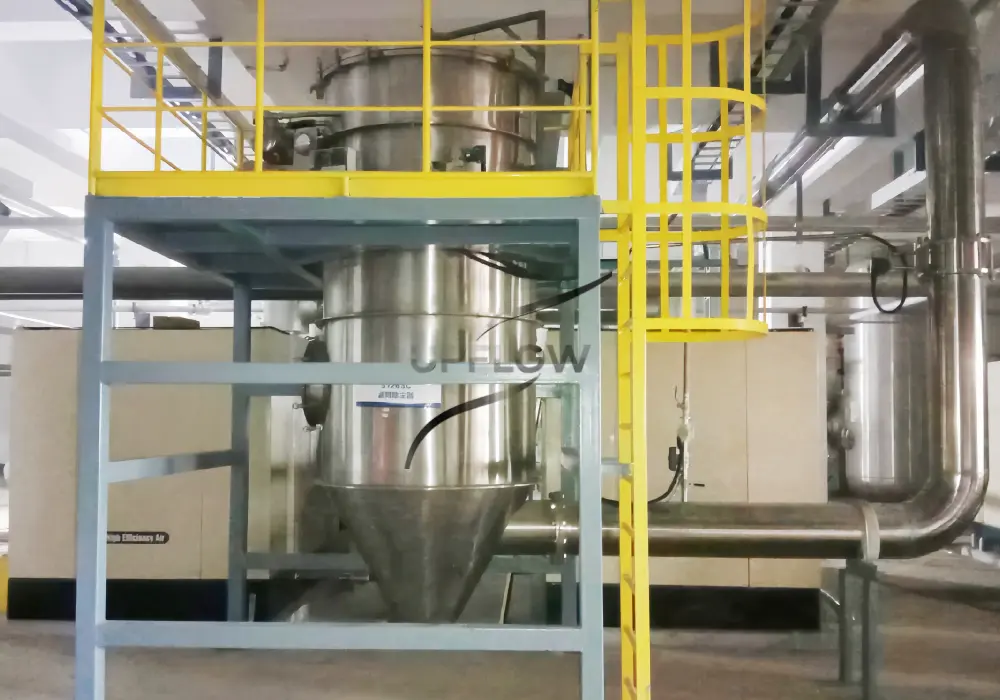
Material Overview: Properties of PVDF Powder
PVDF powder, also known as polyvinylidene fluoride powder, PVDF resin powder, or fluoropolymer binder, is a high-performance material widely used in lithium battery electrodes, fluorocarbon coatings, membranes, and engineering plastics.
In practical applications, PVDF is typically handled as a fine, lightweight powder, with a bulk density ranging from approximately 0.4 to 0.7 g/cm³, and it is characterized by excellent chemical resistance, strong weatherability, high electrical insulation, and moderate flowability, while also showing cohesion and sensitivity to shear during conveying. PVDF materials can be classified into battery-grade PVDF binder, coating-grade PVDF, and membrane-grade PVDF, each requiring precise and stable handling conditions.
Why Choose a PVDF Powder Pneumatic Conveying System?
A PVDF powder pneumatic conveying system is designed to transport fluoropolymer powders through enclosed pipelines using controlled airflow, ensuring clean, stable, and contamination-free transfer.
In industry, it is also referred to as a powder conveying system for PVDF binder materials, a dense phase pneumatic conveying system for PVDF powder, or a vacuum conveying system for PVDF resin powder, depending on the configuration.
Compared with dilute phase systems, a dense phase pneumatic conveying system for PVDF powder materials operates at lower velocity, which reduces particle damage, minimizes dust generation, and lowers energy consumption, making it more suitable for sensitive polymer powders.
Dense Phase Conveying Process for PVDF Powder
In a typical PVDF powder pneumatic conveying system, dried PVDF powder is first discharged into a buffer hopper and then fed into a pressure vessel (sending tank) by gravity.
During filling, air inside the vessel is displaced and filtered through a dust collector, ensuring a clean and closed process. Once the vessel reaches the set material level, valves close automatically, and compressed air is introduced to pressurize and fluidize the powder, forming a plug flow conveying mode for PVDF powder transfer.
Under controlled pressure, the PVDF powder is slowly pushed into the pipeline, where additional air injection points help maintain steady movement toward the destination silo. This low-velocity powder conveying system for PVDF materials ensures stable transport while preventing segregation or degradation.
Flexible Distribution and Continuous Operation
The material pneumatic conveying system for PVDF powder is typically designed with multiple receiving silos and automatic switching valves, allowing flexible distribution.
When one silo reaches a high-level limit, the system automatically redirects the material flow to another silo, ensuring continuous operation without interruption. This alternating conveying process improves system efficiency and supports automated powder conveying systems for PVDF binder production lines.
Advantages of PVDF Powder Pneumatic Conveying Systems
The PVDF powder pneumatic conveying system offers several key advantages for industrial applications.
As a fully enclosed powder conveying system for PVDF resin powder, it prevents contamination and protects material purity, which is critical for battery-grade applications. In addition, the use of dense phase airflow systems for PVDF powder conveying reduces pipeline wear and energy consumption while ensuring stable and gentle handling.
Furthermore, the system enables automatic feeding, flexible routing, and reliable operation, making it ideal for modern production lines requiring high consistency and process control.
Conclusion
The PVDF powder pneumatic conveying system provides an efficient and reliable solution for handling sensitive fluoropolymer powders. By integrating dense phase conveying technology, enclosed airflow systems, and automated powder transfer solutions for PVDF materials, manufacturers can achieve stable operation, improved product quality, and reduced operational costs in advanced industrial environments.