
Description
Email: in**@************ry.com
Product Description
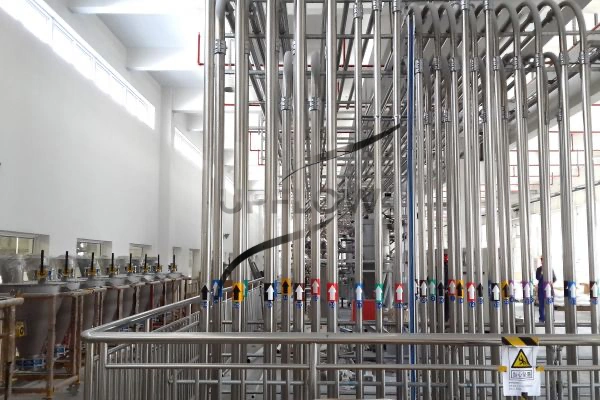
UPFLOW pneumatic conveying systems use airflow as the conveying medium to efficiently transport powders and granular materials from one or multiple sources to designated destinations. Designed to meet different material characteristics, process requirements, system scales, and factory layouts, these systems provide reliable, dust-free, and automated material handling for modern industrial production lines.
Types of Pneumatic Conveying Systems
1. Positive Pressure Pneumatic Conveying
Positive pressure systems, also called pressure-type systems, use a fan or air compressor to introduce air above atmospheric pressure into the feeder. The material mixes with the airflow and is conveyed through the pipeline to a separator or storage bin. Gas-solid separation is performed at the end, and dust-laden air is filtered before safe discharge. Positive pressure pneumatic conveying is suitable for long-distance, high-capacity, and continuous conveying applications.
2. Negative Pressure Pneumatic Conveying
Negative pressure, or suction-type, systems use a vacuum pump or fan to create a pressure below atmospheric pressure. Material is drawn into the pipeline from suction points and transported to the separator, where gas-solid separation occurs. Filtered air is then safely discharged. This type is ideal for short-distance, small-batch, or multi-point material collection, offering clean and flexible operation.
3. Dilute Phase, Dense Phase, and Semi-Dense Phase(Classification by material conveying state (solid-to-gas ratio)
Dilute Phase Conveying: Materials are suspended in high-velocity airflow, ensuring continuous and fast transport. Features include low pressure, low material-to-air ratio, and high conveying speed, though it may cause more wear on materials and pipelines.
Dense Phase Conveying: Materials move in intermittent dense and sparse phases using high-pressure, low-velocity airflow. This reduces wear, protects material integrity, and saves energy.
Semi-Dense Phase Conveying: Combines characteristics of both dilute and dense phase, balancing speed and material protection.
Key Features of UPFLOW Pneumatic Conveying Systems
1.Flexible and Space-Saving: Modular pipeline layouts adapt to complex factory environments, optimizing process flow and saving valuable floor space.
2.Easy Operation and Low Maintenance: Highly automated design reduces operator requirements, simplifies operation, and minimizes maintenance costs.
3.Modular Multi-Process Capabilities: Metering, batching, screening, mixing, iron removal, and impurity removal can be performed simultaneously for improved efficiency.
4.Clean, Pollution-Free Conveying: Closed-pipeline design and high-precision dust removal devices ensure dust-free feeding and leak-free transport, improving workshop hygiene.
5.Material Protection: Prevents contamination, dampness, or mixing with other materials, maintaining material quality throughout the process.
6.Energy-Efficient and Reliable: Optimized air-to-material ratios and system design balance speed, efficiency, and energy consumption.
Applications
UPFLOW pneumatic conveying systems are widely used in industries such as:
Food & Beverage
Pharmaceuticals & Chemicals
Plastics & Polymers
Cement, Fly Ash, and Building Materials
Powder and Granular Material Handling
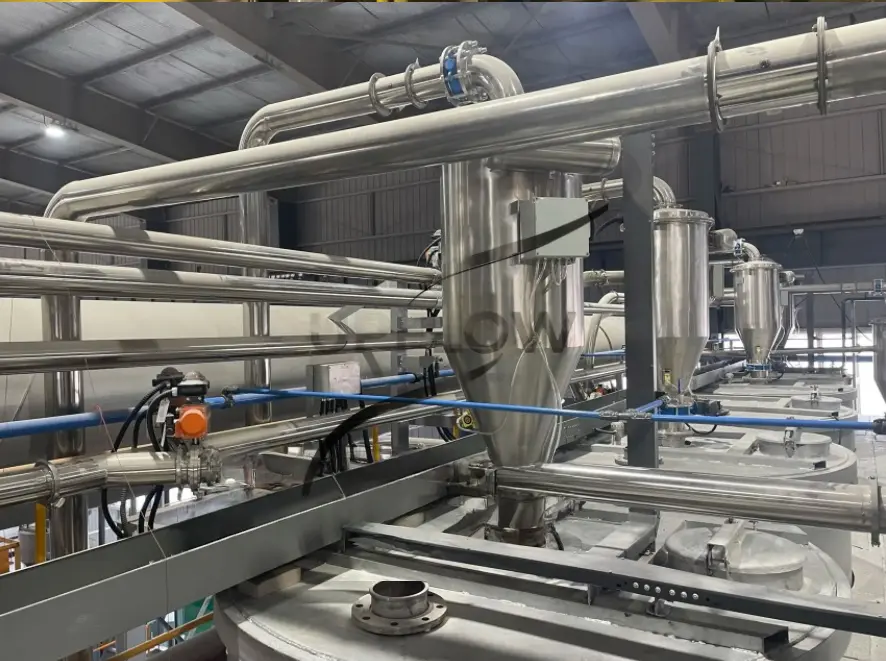
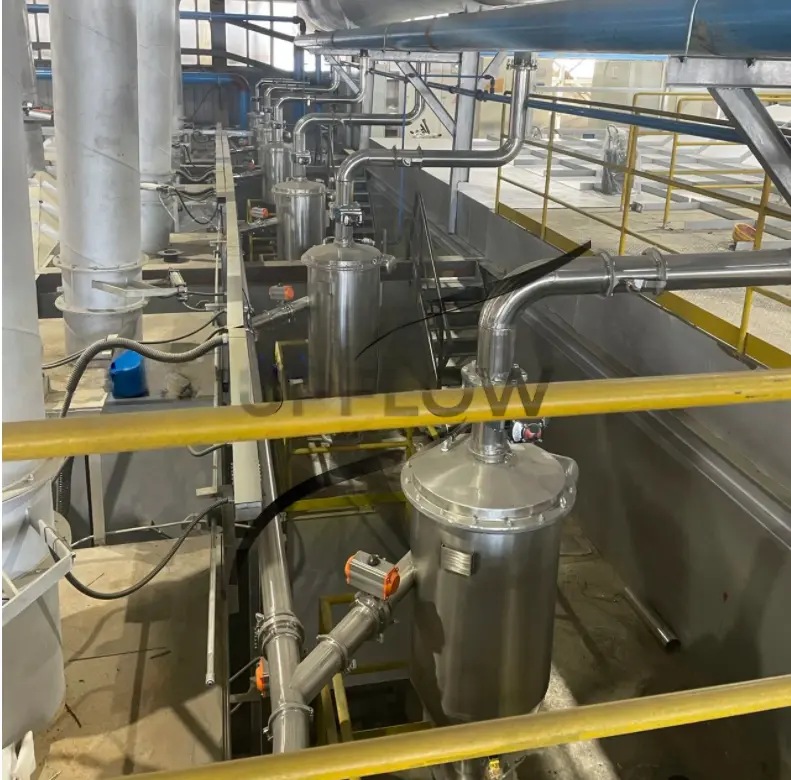
Product Cases
For more project cases:
Alumina Pneumatic Conveying System Project | Wear Resistant Solution for Abrasive Powder Handling
Calcium Carbonate and Barium Carbonate Positive Pressure Pneumatic Conveying System Project for European Customer
PVC Powder Feeding and Vacuum Conveying System Project for a New Materials Manufacturer
FAQ
1. What is a pneumatic conveying system and how does it work?
A pneumatic conveying system is an automated material handling solution that uses controlled airflow to transport powders, granules, and bulk materials through pipelines. The system usually consists of a blower or vacuum source, feeding device, conveying pipeline, filter system, receiver, and control unit. By controlling air velocity, pressure, and conveying conditions, the system can achieve efficient and enclosed material transfer while reducing dust emission and material contamination. UPFLOW designs customized pneumatic conveying systems based on material characteristics, conveying capacity, conveying distance, and production requirements to meet different industrial applications.
2. What materials can be conveyed by a pneumatic conveying system?
A pneumatic conveying system can handle a wide range of powder and granular materials used in different industries, including pharmaceutical powders, food ingredients, chemical powders, mineral materials, and battery materials. Common applications include calcium carbonate, silica, starch, lactose, carbon black, aluminum oxide, lithium battery materials, magnesium oxide, and other fine powders. However, the suitability of a conveying system depends on factors such as particle size, bulk density, moisture content, flowability, and material sensitivity.For example, sensitive powders may be suitable for a vacuum conveying system, while high-capacity applications may require a positive pressure conveying system. UPFLOW evaluates these material characteristics before designing a suitable powder conveying solution for each application.
3. How do I choose the right pneumatic conveying system for my application?
Choosing the right pneumatic conveying system requires evaluating several important factors, including material properties, required conveying capacity, conveying distance, installation layout, and production requirements. Different materials may require different conveying methods, such as vacuum conveying for sensitive or hygienic powder handling applications, or positive pressure conveying for longer distances and higher capacity requirements. UPFLOW engineers analyze customer requirements, including material information, process conditions, and system configuration, to select the most suitable conveying technology and develop a customized powder handling solution.
4. What information is required before designing a pneumatic conveying system?
Before designing a pneumatic conveying system, engineers need detailed information about the material and production process to ensure reliable system performance. The required information usually includes material name, bulk density, particle size, moisture content, material characteristics, required conveying capacity, conveying distance, pipeline layout, feeding method, and discharge conditions. Based on this information, UPFLOW can evaluate the appropriate conveying method, determine suitable equipment configuration, and design a customized pneumatic conveying system according to the customer’s actual production requirements.
5. Does UPFLOW provide customized pneumatic conveying system solutions?
Yes, UPFLOW provides customized pneumatic conveying system solutions for different industries and material handling applications. Our engineering team supports customers from initial requirement analysis and system design to equipment manufacturing and project implementation. Depending on project requirements, UPFLOW can provide vacuum conveying systems, positive pressure conveying systems, powder feeding solutions, bag unloading integration, and complete powder handling systems. With experience in pharmaceutical, food, chemical, and battery material applications, UPFLOW focuses on delivering reliable and efficient conveying solutions based on each customer’s specific production conditions.