
Pneumatic Conveying RFQ Datasheet: What to Send Before a Quote
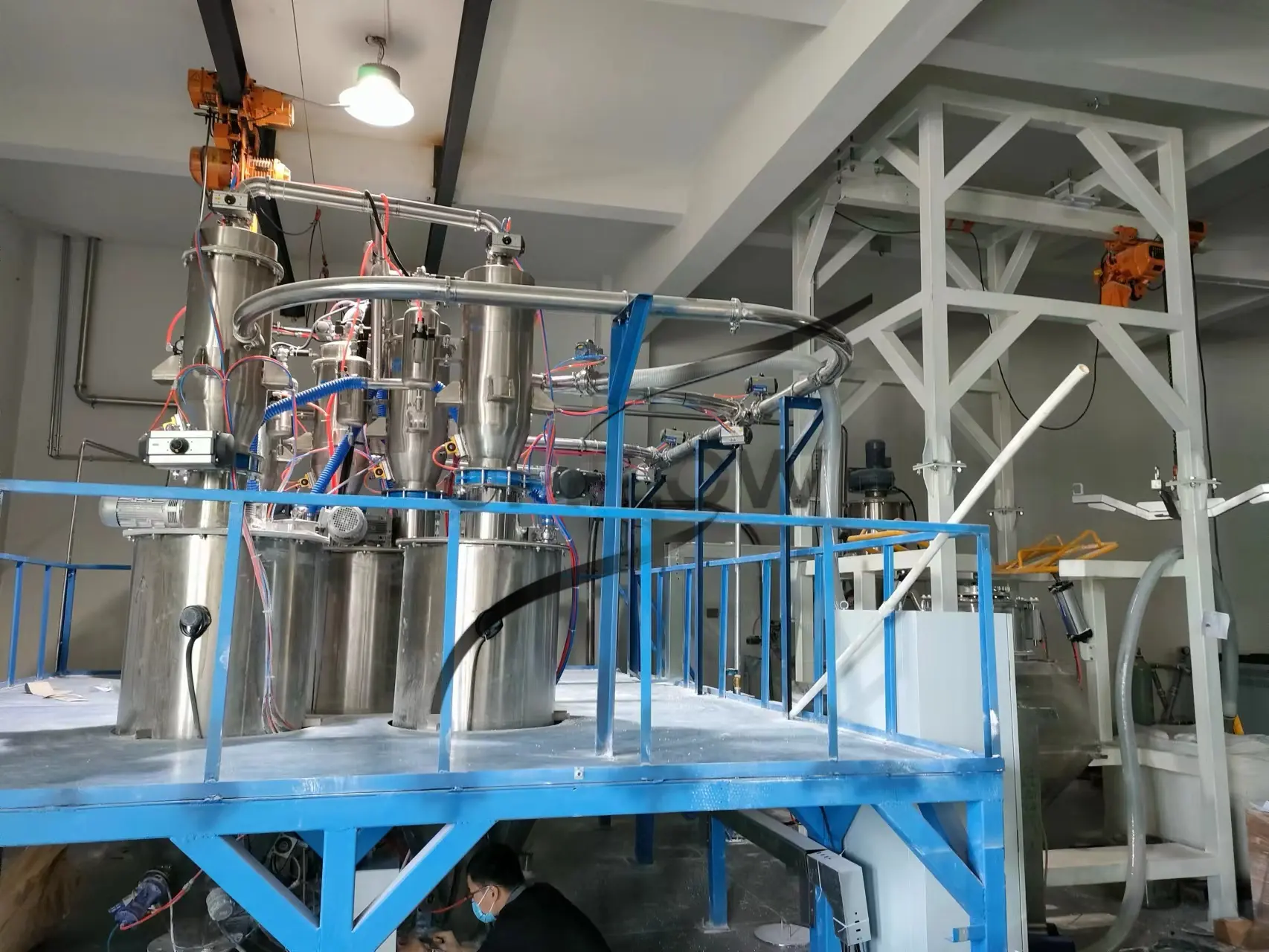
Project reference: UPFLOW PVC powder conveying equipment. Receiver interfaces, pipeline routing and installation space are practical inputs for a system RFQ.
A useful pneumatic conveying RFQ describes the material, the transfer route and the production duty. Before selecting a conveyor model, a supplier needs to know what powder will move, how much must be delivered, where it starts and ends, and what the receiving process requires.
This checklist helps purchasing and engineering teams prepare those inputs in one place. If an item is not yet known, mark it as to be confirmed and identify who will provide it. Clear gaps are more useful than estimates presented as verified data.
What should a pneumatic conveying RFQ include?
At minimum, include the material name and grade, available powder properties, required throughput, operating schedule, conveying distance and elevation, feeding method, receiving equipment, utilities and a marked plant layout. Add product-quality requirements and the proposed supply boundary so that quotations can be compared on the same basis.
Use the following datasheet as a starting point for a custom pneumatic conveying system.
| RFQ section | Information to provide | Why it matters |
|---|---|---|
| Material identity | Product name, grade, supplier and applicable SDS | Similar material names can describe different powders |
| Powder properties | Bulk density with measurement basis, particle-size distribution, moisture and temperature | Supports an application-specific assessment of feeding and transfer |
| Handling behaviour | Known bridging, sticking, dusting, abrasion or particle-damage concerns | Identifies issues that a nominal capacity cannot describe |
| Required throughput | Normal and peak kg/h or t/h, plus batch weight where relevant | Defines the actual production demand |
| Operating duty | Running hours, batch frequency, refill interval and allowable interruptions | Distinguishes intermittent transfer from continuous demand |
| Material source | Small bags, FIBCs, silo, drum or existing hopper | Defines unloading and feeding interfaces |
| Conveying route | Horizontal route, vertical lift, approximate bends and proposed pipe path | Helps assess the complete transfer route |
| Receiving points | Number, elevation and whether they require material simultaneously | Defines distribution and control requirements |
| Receiving equipment | Mixer, hopper, silo or vessel details and connection drawings | Establishes the mechanical and process interfaces |
| Site conditions | Indoor/outdoor location, ambient conditions and available access | Helps identify installation and maintenance constraints |
| Utilities | Electrical supply and available compressed-air, vacuum or other relevant services | Clarifies what the new system must include |
| Product requirements | Agreed limits for contamination, moisture pickup, residue or particle change | Establishes what must be checked during evaluation |
| Hazard information | SDS plus available material-specific hazard assessments and test data | Allows relevant risks to be reviewed before configuration |
| Automation | Existing PLC interfaces, material-demand signals and operating sequence | Defines how the equipment will coordinate |
| Supply boundary | Equipment, pipelines, controls, installation, commissioning and documents | Prevents gaps between apparently similar quotations |
| Acceptance | Proposed test material, test conditions, measurements and deliverables | Makes acceptance requirements discussable before ordering |
1. Describe the powder you actually use
Write the commercial material name and grade rather than a broad description such as “chemical powder.” Attach available specifications and explain whether properties vary between suppliers or batches.
For bulk density, state whether the value is loose, tapped or measured by another method. For particle size, provide the distribution or supplier specification where available, rather than relying only on a single nominal size. Include operating moisture and temperature, particularly when the material can change during storage or processing.
Also describe observed behaviour. Does the powder bridge in the current hopper? Does it adhere to surfaces? Is maintaining particle condition important? Existing operating observations help define what the proposed system needs to address.
An SDS is useful input, but it does not replace every property or hazard assessment needed for equipment design. The review should use the actual material and operating conditions.
For a grade-specific example of the information to collect, see our magnesium oxide pneumatic conveying guide, which explains why the supplied MgO grade, bulk density and feeding behaviour belong in the design brief.
2. Define throughput and the production schedule together
“500 kg/h” is incomplete without an operating duty. A line that supplies material continuously has a different requirement from a receiver that must refill between mixer batches.
State the normal demand, the peak demand and the time available to deliver each batch. Identify any production equipment that must keep running during a refill. If several receiving points share the system, explain whether they can be supplied in sequence or need material at the same time.
Where conveying connects with weighing or recipe preparation, specify batch weights and the required dosing function separately. Discuss the relationship with the automated batching system rather than assuming that transfer capacity alone defines weighing performance.
3. Send a route drawing, not just a distance
A marked layout should show the feeding position, every receiving point, approximate horizontal routing, vertical changes and areas where pipework must pass around existing equipment.
Include photos of the source and destination connections. For an existing hopper, useful information includes the inlet connection, available headroom, discharge arrangement, access space and any operating pressure conditions that affect the interface.
UPFLOW’s PVC powder feeding and vacuum conveying project illustrates why those details matter: the scope combined conveying equipment with pipework, receiving-hopper modifications and control integration. A quotation for a standalone conveyor would describe a different supply scope.
4. Let the application determine the system concept
An RFQ can state a preferred technology, but it should also explain the reason for that preference. This allows the supplier to review the requirement against the material, route, receiver arrangement and process constraints.
For example, compare a vacuum conveying system with a positive pressure conveying system using the same duty information. Do not assume that the same equipment configuration, air source or conveying conditions apply to every powder.
For battery applications, add the material-specific quality and handling requirements described in our guide to pneumatic conveying for lithium battery materials.
For PET pellets, identify whether transfer occurs before or after drying and include the receiving-equipment interfaces. Our PET pellet conveying guide for drying and processing explains the additional information to include.
5. Agree on testing and acceptance before the order
If conveying behaviour or product quality cannot be established from existing information, ask whether a material trial is appropriate. Confirm feasibility, sample requirements, test scope and responsibilities before shipping samples.
The proposed trial should identify what will be measured, which material condition it represents and what constitutes an acceptable result. Depending on the application, review points may include throughput, receiver discharge, filtration behaviour, residual material or changes in the powder.
Avoid requesting a general performance guarantee without defining the material, route and operating conditions to which it applies. Record any unresolved assumptions in the quotation for engineering review.
Frequently asked questions
Can I request a quotation without complete powder data?
Yes. Send the information available and clearly mark missing items. An initial proposal may require assumptions; final equipment selection and performance commitments should follow confirmation of the relevant inputs.
Is conveying distance enough to choose a system?
No. The route also includes elevation, bends, feeding conditions and receiver interfaces. Material properties and operating duty must be reviewed with the layout.
Should I specify vacuum or positive pressure in the RFQ?
State your preference and the process reason, if there is one. Also provide the complete duty so that the supplier can assess the proposed concept and explain any alternative.
What is the most useful first package to send?
Send the material specification, target throughput and batch schedule, a marked layout, photos or drawings of the receiving equipment, and the requested supply scope. Add utilities and quality requirements as they become available.
Send UPFLOW your powder conveying requirements
Use the datasheet above to send UPFLOW your pneumatic conveying RFQ. Include the material, capacity, route and receiving equipment first, and list any details that still need confirmation. These inputs provide a clearer basis for discussing equipment configuration and the next engineering steps.