
Introduction
A potash fertilizer pneumatic conveying system is a modern solution that utilizes airflow to transport granular or powdered fertilizers within a closed pipeline, ensuring a clean, efficient, and pollution-free conveying process. This is particularly important for fertilizer production, which has extremely high requirements for material quality and environmental protection.
Potash Fertilizer Material Characteristics
Potash fertilizer refers to potassium-based materials widely used in agriculture, including potassium nitrate (KNO₃), potassium chloride (KCl), and potassium sulfate (K₂SO₄). Potash nitrate is a high-end water-soluble fertilizer that provides both potassium and nitrogen; potassium chloride is more economical but contains chlorides; potassium sulfate is a chloride-free alternative suitable for chloride-sensitive crops.
These materials are typically conveyed in powder or granular form, with a bulk density generally between 0.9 and 1.3 t/m³, depending on their composition and particle size. Some potash fertilizers are hygroscopic and may absorb moisture during storage and transportation, leading to clumping, unstable flow, or material loss. Therefore, a reliable powder conveying system is crucial.
System Overview
Potash fertilizer pneumatic conveying systems utilize airflow as the conveying medium to transport fertilizer materials from storage silos to processing or packaging units, eliminating the need for manual handling and reducing the risk of contamination.
Compared to traditional mechanical conveying, this system can be combined with vacuum conveying systems or low-pressure conveying designs, depending on the plant layout and conveying distance, to ensure stable and continuous material transport.
Working Principle
Potash fertilizer pneumatic conveying systems operate based on the principle of gas-solid two-phase flow. Compressed air or vacuum generates a controlled airflow that conveys granules through pipelines.
Materials enter the system through a controlled feed unit and mix with air in a specific ratio, forming a stable conveying flow. This process is commonly referred to as pneumatic conveying, and the related equipment is typically called a pneumatic conveyor.
System Structure
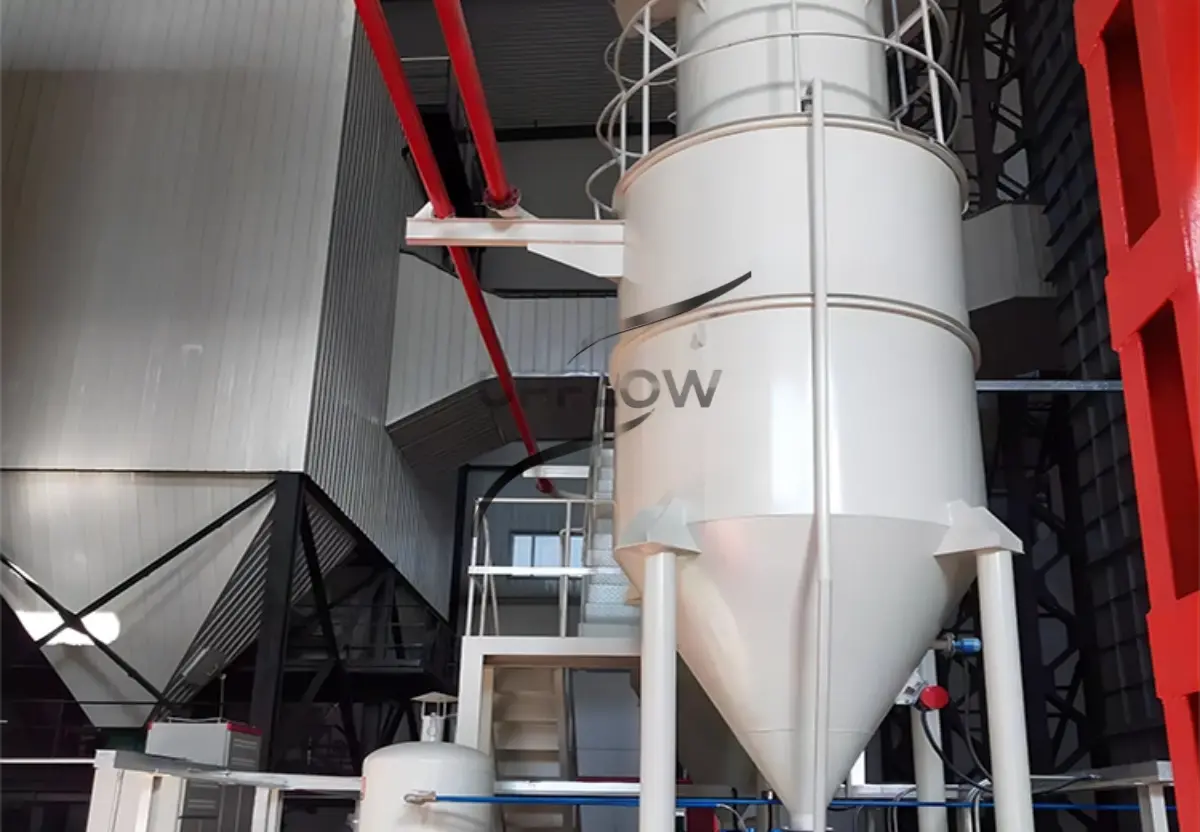
A complete potash fertilizer conveying solution comprises several key components. The air supply unit utilizes equipment to provide a stable airflow. The feed system ensures a continuous and uniform input of material. The pipeline network utilizes wear-resistant and corrosion-resistant materials for material transport. Dust collection devices ensure compliance with environmental requirements, while storage silos serve as buffers for the materials. A centralized control system monitors and regulates pressure, flow rate, and feed conditions to ensure stable system operation.
Advantages of the Potash Fertilizer Pneumatic Conveying System
The potash fertilizer pneumatic conveying system offers several operational advantages. Its enclosed design prevents materials from absorbing moisture and becoming contaminated, thus maintaining fertilizer quality during transport.
The system boasts high conveying efficiency, enabling long-distance, continuous, and rapid material transport, making it ideal for large-scale fertilizer plants. Its flexible pipeline layout adapts to complex plant structures, facilitating both horizontal and vertical transport.
Furthermore, reduced mechanical contact minimizes equipment wear, lowers maintenance costs, and extends system lifespan. Automation integration also improves operational efficiency and reduces labor requirements.
Potash fertilizer pneumatic conveying equipment offers a wide material transport range, high-efficiency conveying rates, convenient operation, and rapid conveying performance, while being easily automated.
The potash fertilizer pneumatic conveying system has minimal impact on the climate environment, employing a fully enclosed design to achieve zero-pollution transport. This system uses airflow as a medium to transport bulk materials from one or more sources to one or more destinations. The material and airflow form a gas-solid two-phase flow, ensuring the continuity and stability of material transport.
Environmental and Operational Benefits
Powder conveying systems specifically designed for potash fertilizer significantly reduce dust emissions, improve workplace safety, and comply with environmental regulations.
By employing low-pressure or vacuum conveying systems, energy consumption can be optimized while maintaining stable conveying performance. This makes the system suitable for modern fertilizer production lines that prioritize sustainability and efficiency.
Conclusion
Potash fertilizer pneumatic conveying systems are suitable for energy saving and emission reduction, long-distance and multi-location conveying, bulk material conveying, long-range conveying, and other material handling functions.
Potash fertilizer pneumatic conveying systems provide a reliable, efficient, and environmentally friendly solution for potash fertilizer processing. This system integrates the advantages of pneumatic conveyors, vacuum conveying systems, and advanced powder conveying systems, enabling stable and efficient material transport in industrial applications.