
Introduction to Fertilizer Powder Material Properties and Types
Fertilizer powder is a widely used agricultural bulk material that plays a critical role in modern farming production, soil nutrition improvement, and crop yield optimization. Common fertilizer materials include urea powder, compound fertilizer granules, ammonium phosphate, potassium chloride blends, ammonium sulfate powder, and NPK fertilizer mixtures, which are often processed into fine or semi-fine particulate forms for blending, storage, and automated dosing systems.
From a physical property perspective, fertilizer powders typically have a bulk density ranging from approximately 0.7 to 1.2 g/cm³ depending on formulation and moisture content, while particle sizes may vary from fine powder below 100 mesh to granulated particles up to several millimeters. These materials are often hygroscopic (easily absorbing moisture), prone to caking or agglomeration, and moderately abrasive, which makes them challenging to handle in open or mechanical conveying systems.
Because fertilizer materials are sensitive to environmental conditions and dust emission regulations are increasingly strict in agricultural and chemical industries, fully enclosed pneumatic conveying has become a preferred solution for safe and efficient material handling.
Overview of Fertilizer Powder Pneumatic Conveying System
A fertilizer powder pneumatic conveying system is an advanced bulk solid transport technology that uses controlled airflow to move fertilizer powder materials such as urea powder, NPK fertilizer blends, and ammonium-based compounds through sealed pipelines from storage units to processing, blending, or packaging points.
This system is also commonly referred to in industrial applications as a low-pressure conveying system for fertilizer powder and urea materials, a high-pressure pneumatic conveying system for compound fertilizer powder, a vacuum conveying system for fertilizer powder (negative pressure system), or a fully enclosed conveying system for NPK fertilizer powder, depending on process design, conveying distance, and production capacity requirements.
By forming a gas-solid two-phase flow inside pipelines, the system ensures continuous, stable, and dust-free transportation while minimizing material loss and preventing contamination or moisture exposure during handling.
Working Principle of Fertilizer Powder Pneumatic Conveying System
The working principle of a fertilizer powder pneumatic conveying system is based on the controlled use of air pressure differences to suspend and transport solid fertilizer particles inside enclosed pipelines.
In a positive pressure conveying system (high-pressure or low-pressure conveying system for fertilizer powder), compressed air generated by compressors pushes fertilizer particles through the pipeline toward the discharge point, enabling efficient long-distance transport with stable flow control. In contrast, a vacuum conveying system (negative pressure conveying system for fertilizer powder) uses a vacuum pump to create suction, drawing fertilizer powder such as urea or NPK blends into the pipeline and transporting it to downstream equipment in a fully sealed environment.
During transportation, fertilizer particles are fully suspended in airflow, and system parameters such as air velocity, pipeline diameter, and feeding rate are precisely controlled to prevent blockage, segregation, or excessive particle degradation, while integrated filtration systems continuously separate air from solids to ensure clean discharge.
System Structure and Key Components
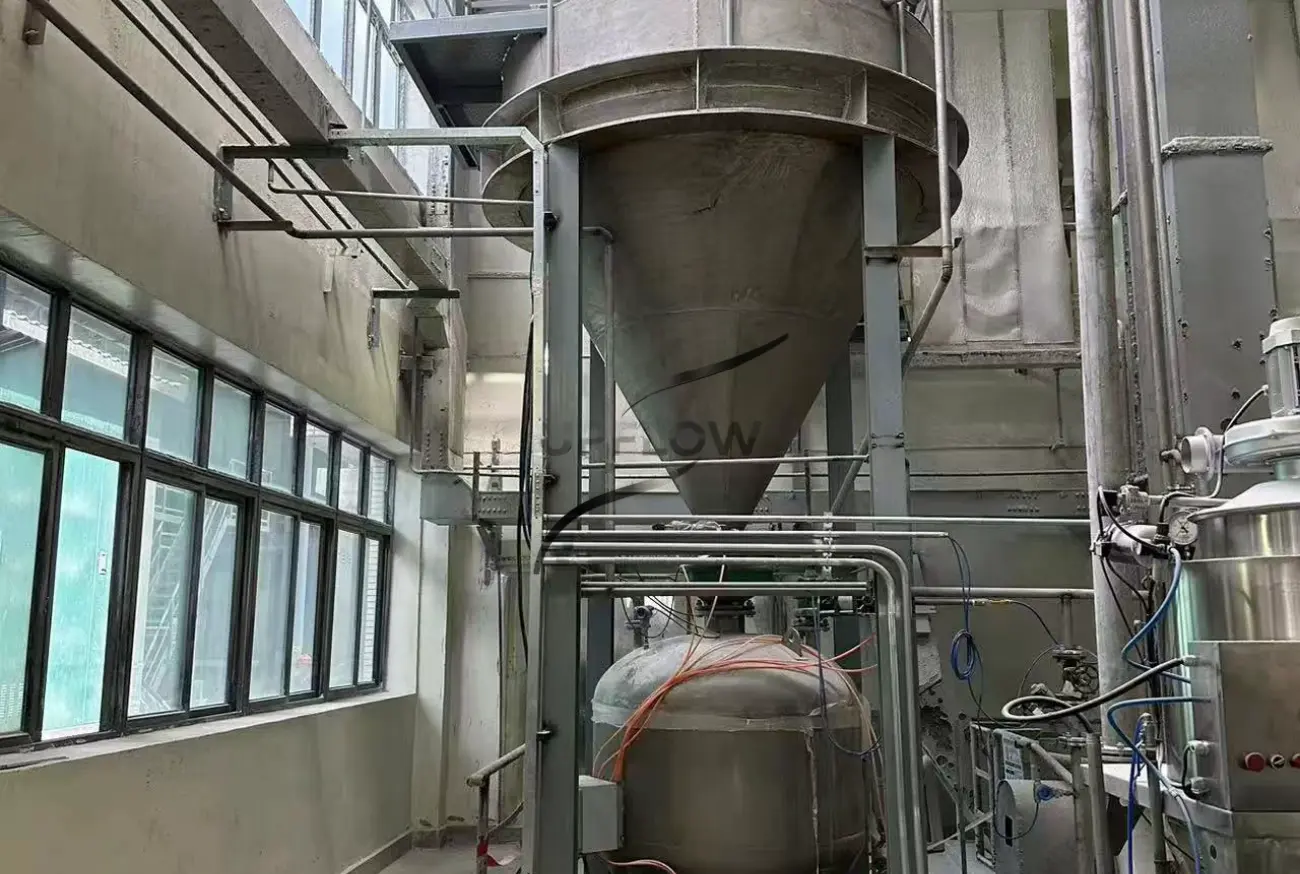
A complete enclosed fertilizer powder pneumatic conveying system consists of multiple integrated components designed to ensure stable, efficient, and safe operation across different industrial environments.
The feeding system typically includes screw feeders that ensure controlled and uniform feeding of fertilizer powder materials such as urea or compound fertilizer blends into the conveying pipeline. The pipeline network is designed with corrosion-resistant materials and optimized routing to minimize pressure loss and ensure stable flow over long distances.
Depending on the application scenario, the system may operate as a low-pressure conveying system for fertilizer powder and ammonium compounds, a high-pressure conveying system for NPK fertilizer powder, or a vacuum conveying system for urea powder materials, each configuration being selected based on plant layout, capacity requirements, and material characteristics.
Downstream equipment such as cyclone separators, dust collectors, and filtration units ensures effective separation of air and fertilizer particles, while preventing dust emission and improving material recovery efficiency. A centralized control system coordinates airflow pressure, feeding rate, and safety monitoring, enabling automated and stable system operation.
Advantages of Fertilizer Powder Pneumatic Conveying System
The fertilizer powder pneumatic conveying system offers significant advantages over traditional mechanical conveying methods, particularly in terms of environmental protection, efficiency, and system flexibility.
Because the system operates in a fully enclosed conveying system for fertilizer powder materials, it effectively eliminates dust leakage and prevents exposure of hygroscopic fertilizers such as urea and ammonium compounds to ambient humidity, thereby reducing caking and quality degradation risks during transport.
In addition, the system provides strong adaptability for different production scenarios, supporting long-distance pipeline routing, multi-point feeding, and complex plant layouts, while maintaining stable performance under continuous operation. Whether configured as a high-pressure conveying system for compound fertilizer powder, a low-pressure conveying system for granular fertilizer blends, or a vacuum (negative pressure) conveying system for urea powder, the system can be fully customized to meet industrial requirements.
Energy efficiency is another important advantage, as modern pneumatic conveying systems are designed with optimized airflow control and variable frequency drive technology, reducing energy consumption while maintaining high conveying efficiency and system stability.
Industrial Applications of Fertilizer Powder Pneumatic Conveying System
The fertilizer powder pneumatic conveying system is widely used across fertilizer production plants, agricultural chemical processing facilities, storage terminals, and logistics distribution centers, where efficient and clean material handling is essential.
In fertilizer manufacturing plants, it is commonly used for transporting raw materials such as ammonium phosphate, potassium chloride blends, and urea powder from storage silos to mixing reactors or granulation systems. In blending and packaging lines, it ensures accurate and continuous feeding of NPK fertilizer powders into batching systems, improving production consistency and automation levels.
In port and logistics applications, vacuum conveying systems are often used for unloading bulk fertilizer shipments from trucks, railcars, or vessels, significantly reducing manual labor intensity while improving unloading speed and environmental compliance.
UPFLOW Fertilizer Powder Conveying Technology Solutions
UPFLOW provides advanced engineering solutions for fertilizer powder pneumatic conveying systems, focusing on efficiency, reliability, and environmental sustainability in modern agricultural and chemical industries.
Through optimized system design and intelligent airflow control, UPFLOW ensures stable conveying performance for materials such as urea powder, compound fertilizer blends, and ammonium-based fertilizers, while minimizing wear, blockage risk, and energy consumption.
Whether implemented as a low-pressure conveying system for fertilizer powder materials, a high-pressure conveying system for NPK fertilizer production lines, or a vacuum (negative pressure) conveying system for urea powder handling, UPFLOW systems are designed to deliver consistent performance, long service life, and reduced maintenance requirements.
By integrating automated control systems, real-time monitoring, and efficient separation technology, UPFLOW helps fertilizer manufacturers achieve cleaner production processes, higher operational efficiency, and lower overall logistics costs, supporting the industry’s transition toward more sustainable and intelligent material handling solutions.