
Introduction to Dispersant Powder Materials and Physical Properties
Dispersant powders are functional chemical additives widely used in industrial processes to improve particle dispersion, reduce agglomeration, and enhance mixing uniformity in solid-liquid or solid-solid systems. Typical materials include sodium lignosulfonate powder, naphthalene sulfonate formaldehyde (NSF) powder, polycarboxylate ether (PCE) dispersant powder, modified surfactant powders, and inorganic dispersing agents, which are commonly applied in cement, mining, metallurgy, coal processing, and environmental industries.
These dispersant powders generally have a bulk density of around 0.3–0.9 g/cm³, with very fine particle sizes often below 200 mesh or in micron scale, making them highly prone to dust generation, electrostatic accumulation, and moisture sensitivity. Due to their ultra-fine structure and easy agglomeration characteristics, these materials require stable and fully enclosed transport systems to maintain product performance and avoid blockage or degradation during handling.
Overview of Dispersant Powder Pneumatic Conveying System
A dispersant powder pneumatic conveying system is a type of industrial airflow conveying system that transports fine powder materials such as sodium lignosulfonate, polycarboxylate dispersants, and naphthalene-based additives through sealed pipelines using controlled air energy.
This system is also commonly referred to as a pneumatic conveying system for sodium lignosulfonate dispersant powder, a powder conveying system for polycarboxylate ether (PCE) chemical additives, or a fully enclosed airflow conveying system for dispersant powder materials, depending on industrial application scenarios and process requirements.
By forming a stable gas-solid flow inside pipelines, the system enables continuous, dust-free, and automated transport, ensuring that fine dispersant powders remain evenly distributed without segregation or blockage during conveying.
System Structure and Main Components
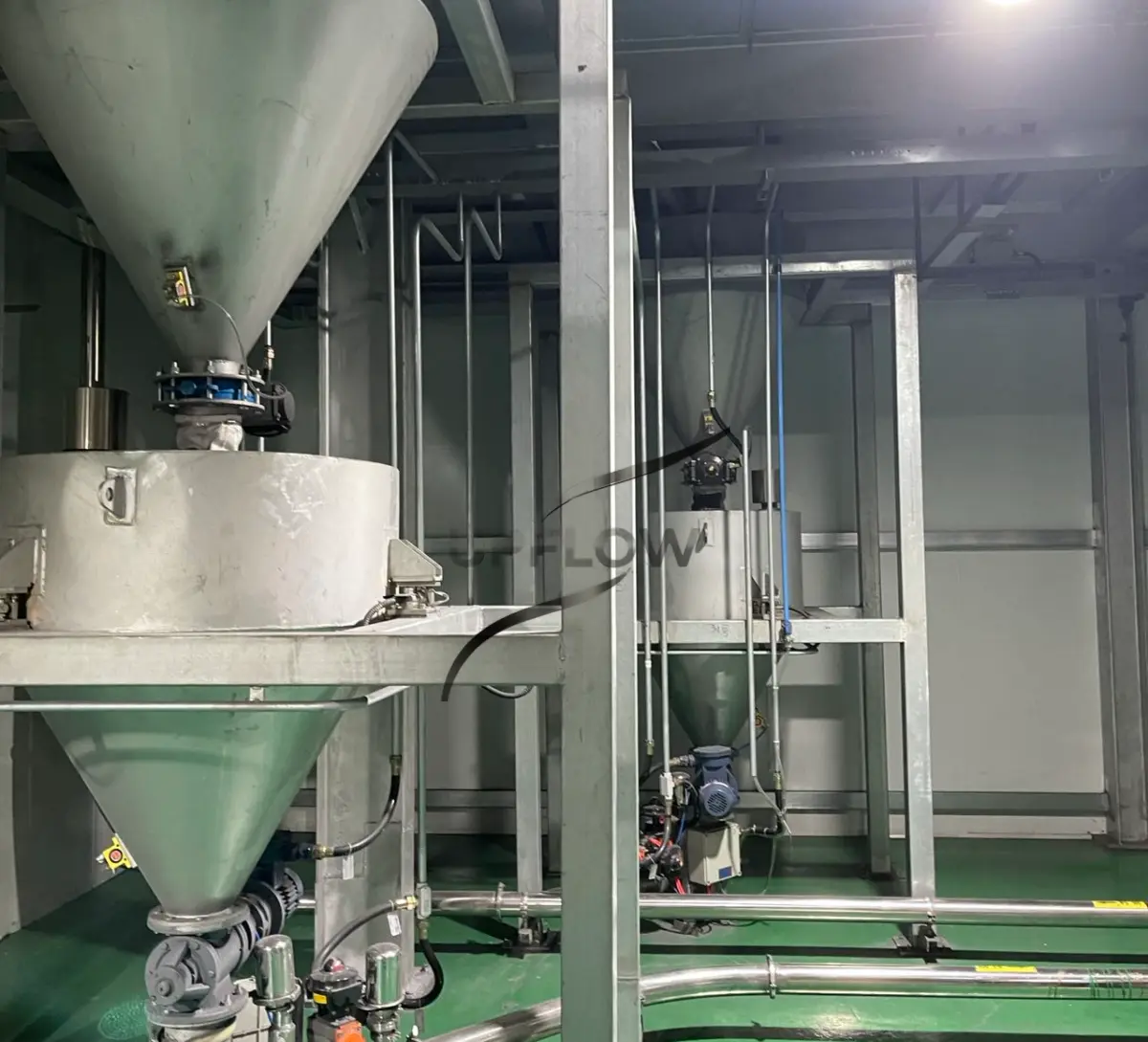
A complete dispersant powder pneumatic conveying system consists of several key components that work together to ensure stable and efficient material transport.
The conveying pipeline is typically made of wear-resistant, corrosion-resistant, and anti-static materials, designed to handle fine chemical powders such as naphthalene sulfonate powder or polycarboxylate dispersant powder. The pipeline layout is optimized to reduce resistance loss, minimize sharp bends, and ensure smooth material flow in long-distance transport systems.
The air supply unit provides the driving force for conveying, using compressed air or blower-generated airflow to create either positive pressure or vacuum conditions. Based on different process requirements, the system can be designed as a positive pressure airflow conveying system for dispersant powder materials, a negative pressure pneumatic conveying system for fine chemical powders, or a general airflow conveying system for powder materials in industrial production lines.
A feeding and dispersing unit is installed at the inlet section to ensure uniform material feeding and prevent bridging or clogging, while downstream separation and filtration equipment ensures efficient separation of air and solid particles to achieve clean discharge.
Working Principle of Dispersant Powder Airflow Conveying System
The working principle of the dispersant powder pneumatic conveying system is based on using controlled airflow to suspend and transport fine powder materials such as sodium lignosulfonate powder, PCE dispersants, and NSF additives inside a fully enclosed pipeline.
In a positive pressure pneumatic conveying system for dispersant powder materials, compressed air pushes the powder through the pipeline toward the destination, making it suitable for continuous and long-distance transport. In contrast, a negative pressure (vacuum) conveying system for dispersant powder uses suction force to draw materials into the pipeline, ensuring a fully enclosed and dust-free transport process.
During operation, airflow velocity and pressure are carefully controlled to maintain stable suspension of fine particles, preventing agglomeration, pipeline blockage, or uneven material distribution during transport.
Industrial Applications of Dispersant Powder Conveying System
The dispersant powder pneumatic conveying system is widely used in industries such as construction materials, mining, metallurgy, power generation, and environmental engineering, where fine chemical additives and mineral powders need to be transported safely and efficiently.
In coal-fired power plants, it is used for fly ash conveying systems and dispersant powder airflow transport systems, where fly ash is moved from boiler discharge units to storage silos for reuse. In mining and metallurgy industries, it is used for ore powder pneumatic conveying systems with dispersant additives, improving ore separation and processing efficiency.
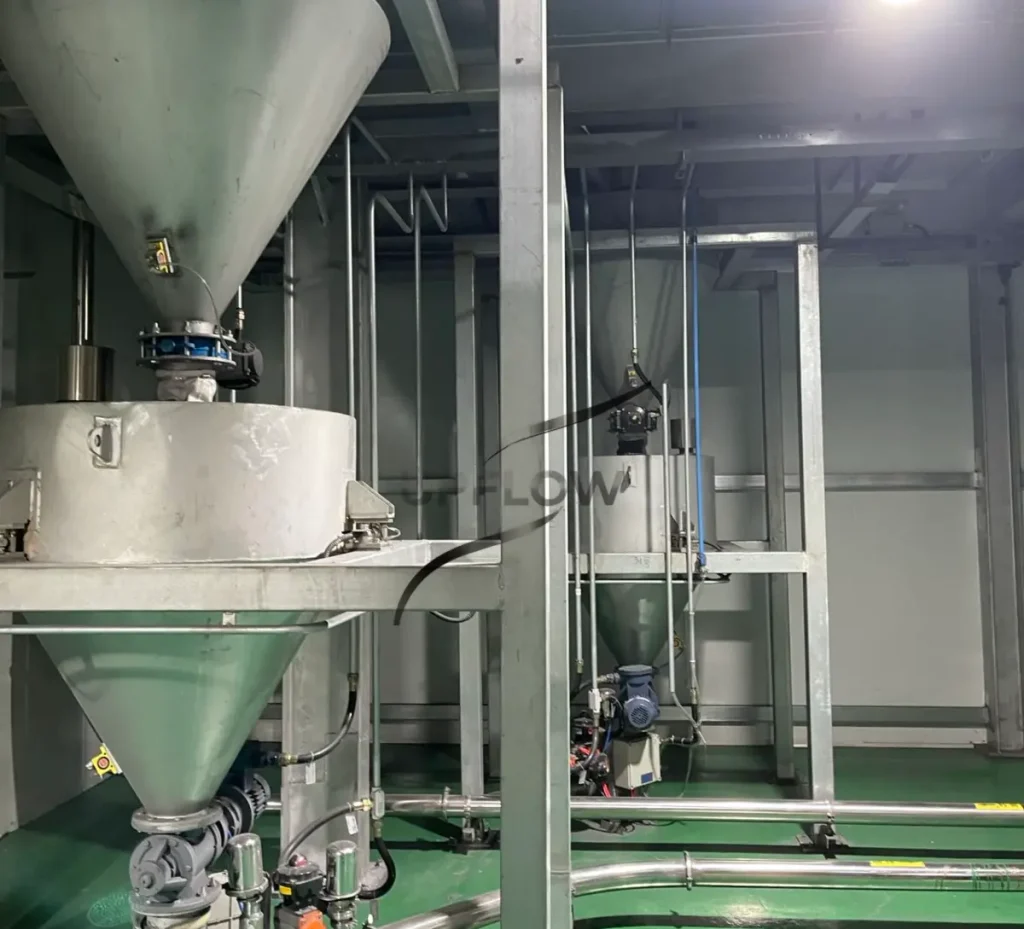
In chemical production, the system supports powder mixing and conveying systems for sodium lignosulfonate and polycarboxylate dispersant powders, ensuring accurate dosing into reactors or blending units. In environmental applications, it is used for transporting industrial waste powders into treatment systems such as incineration or drying units, reducing environmental impact and improving handling safety.
Advantages of Dispersant Powder Pneumatic Conveying System
The system offers significant advantages over traditional mechanical conveying methods, especially when handling ultra-fine and easily dispersible powders.
Because it operates as a fully enclosed pneumatic conveying system for dispersant powder materials, it effectively eliminates dust leakage, improves working environment safety, and reduces material loss during transport. It also provides strong flexibility for complex plant layouts, supporting multi-point feeding, long-distance conveying, and continuous production requirements.
Whether configured as a positive pressure conveying system for sodium lignosulfonate powder, a vacuum conveying system for polycarboxylate dispersant powder, or a general airflow powder conveying system for industrial dispersant materials, the system can be adapted to different production capacities and process conditions.
Conclusion
The dispersant powder pneumatic conveying system is a highly efficient and reliable solution for transporting fine chemical powders such as sodium lignosulfonate, PCE dispersants, and fly ash additives. With advantages such as long-distance transport capability, enclosed operation, and stable performance, it is widely used in modern industrial production systems where safety, efficiency, and environmental protection are critical.