
Introduction to Curing Agent Powder Materials
Curing agents are essential chemical additives widely used in epoxy resins, coatings, adhesives, and composite materials, where they play a key role in initiating cross-linking reactions and improving final product strength, durability, and chemical resistance. Common materials include amine-based curing agents, anhydride curing agents, polyamide curing agents, and modified epoxy hardener powders, many of which are processed into fine powder or granular forms for easier storage and automated feeding.
From a physical perspective, curing agent powders typically have a bulk density ranging from 0.5 to 1.1 g/cm³, depending on formulation and particle structure, while particle sizes often fall within fine powder or micro-granular ranges. These materials are often slightly hygroscopic, sensitive to temperature, and prone to dust formation, and in some cases may exhibit mild reactivity, which requires stable, enclosed, and controlled conveying systems to ensure safe and consistent transport.
What Is a Curing Agent Powder Pneumatic Conveying System?
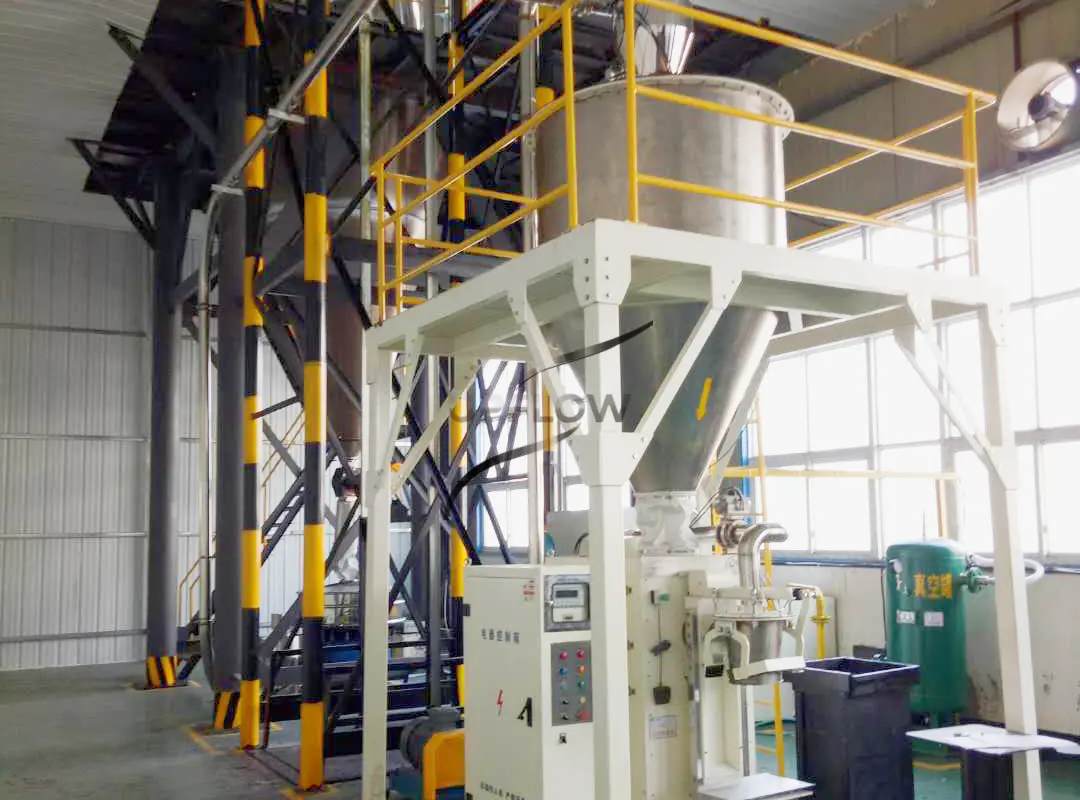
A curing agent powder pneumatic conveying system is a specialized material handling solution that uses airflow to transport curing agent powders such as amine-based or anhydride curing agents through pipelines in a controlled and enclosed environment.
This system is also commonly known as an airflow conveying system for curing agent powder materials, a powder conveying system for epoxy curing agents, or a vacuum conveying system for chemical curing agent powders, depending on system configuration and process requirements.
By forming a stable gas-solid flow inside sealed pipelines, the system enables continuous, dust-free, and efficient transport, making it ideal for modern automated chemical production lines.
Working Principle of Curing Agent Powder Pneumatic Conveying
The working principle of the curing agent powder pneumatic conveying system is based on using high-speed airflow to carry and suspend solid particles inside a pipeline.
In operation, curing agent powder is fed into the conveying pipeline, where it is transported by compressed air or inert gases such as nitrogen, forming a stable air-solid mixture. By adjusting airflow velocity, pressure, and pipeline design, the system ensures that particles remain suspended and move smoothly toward the discharge point.
In addition, a vacuum conveying system for curing agent powder can be used in applications requiring higher cleanliness, where material is drawn into the pipeline by negative pressure, ensuring minimal dust leakage and contamination.
Key Advantages of Curing Agent Powder Pneumatic Conveying System
One of the main advantages of a curing agent powder pneumatic conveying system is its high conveying efficiency, which is achieved through optimized airflow dynamics and system design.
First, high airflow velocity allows curing agent particles to remain suspended in the pipeline, ensuring continuous and stable movement, which makes the system particularly effective for fine powders used in epoxy and coating industries.
Second, the system supports long-distance transport, as properly designed pipelines and airflow pressure can overcome resistance and gravity, enabling long-distance powder conveying systems for curing agent materials in large industrial plants.
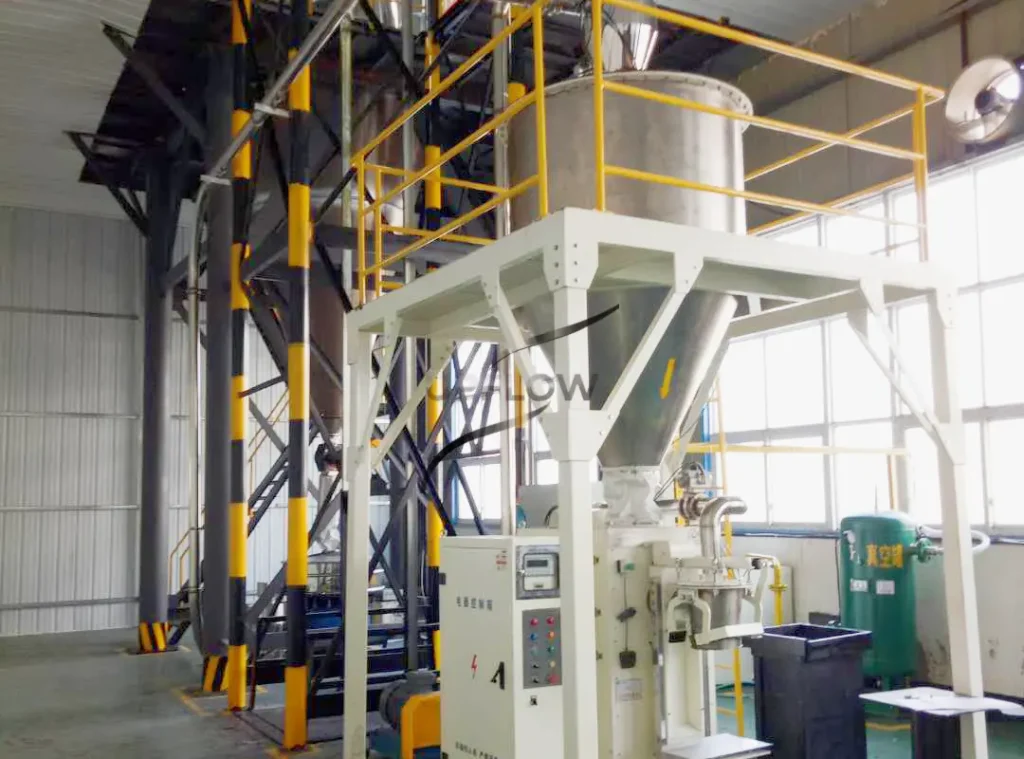
Third, compared with traditional mechanical conveying methods, pneumatic systems typically have lower energy consumption, as compressed air or gas provides efficient transport power without complex mechanical components.
System Flexibility and Industrial Applications
The curing agent powder pneumatic conveying system offers high flexibility and can be adapted to different industrial environments, including chemical processing plants, resin production facilities, and coating manufacturing lines.
In epoxy resin production, it is commonly used for powder conveying systems for amine curing agents and epoxy hardener materials, ensuring accurate dosing into reactors or mixing units. In coating and adhesive industries, it supports clean and enclosed transport of sensitive curing agents, reducing contamination risks and improving product consistency.
Conclusion
The curing agent powder pneumatic conveying system provides a reliable, efficient, and clean solution for transporting fine chemical materials in modern industrial applications. By combining airflow conveying systems, powder conveying systems, and vacuum conveying systems for curing agent powders, manufacturers can achieve higher efficiency, better process control, and safer material handling, meeting the increasing demands of automated and environmentally friendly production environments.