Introduction to Leveling Agent Powder Materials
Leveling agents are essential additives widely used in coatings, inks, plastics, and surface treatment industries, where they improve surface smoothness, reduce defects such as orange peel, and enhance overall film appearance. Common materials include silicone-based leveling agents, acrylic leveling agents, fluorocarbon leveling additives, and polymer-modified surfactant powders, which are often processed into fine powder or carrier-based forms for easier handling and dosing.
From a physical standpoint, leveling agent powders typically have a bulk density ranging from 0.35 to 0.85 g/cm³, depending on formulation and carrier materials, and particle sizes usually fall within micron-level ranges. These materials are often lightweight, easily airborne, slightly adhesive, and sensitive to moisture and static electricity, which makes them prone to agglomeration and dust pollution if handled improperly, requiring a stable and enclosed conveying solution.
What Is a Leveling Agent Powder Pneumatic Conveying System?
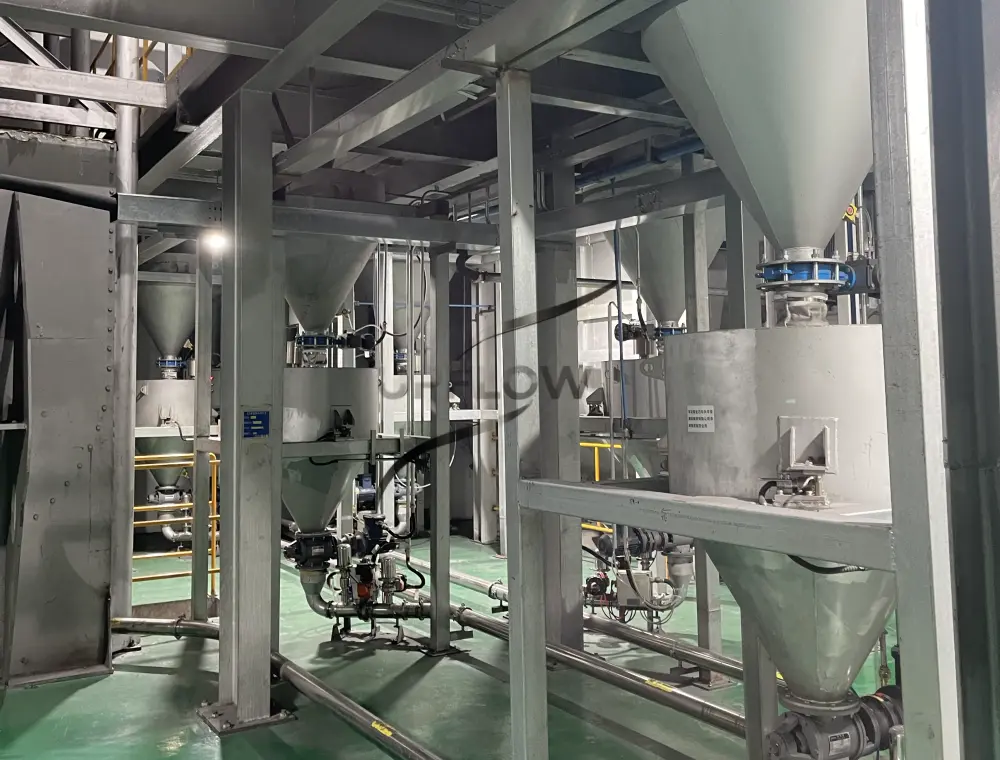
A leveling agent pneumatic conveying system is an advanced material handling solution that uses airflow to transport fine leveling agent powders through pipelines in a controlled and enclosed environment.
In industrial applications, this system is also referred to as a positive pressure conveying system for leveling agent powder, a negative pressure conveying system for silicone leveling agent materials, or a fully enclosed pneumatic conveying system for coating additive powders, depending on process requirements and plant layout.
By forming a gas-solid flow inside pipelines, the system ensures continuous, clean, and efficient transport, preventing dust leakage and maintaining the stability of sensitive chemical additives.
Working Principle and Conveying Methods
The leveling agent powder pneumatic conveying system operates by using airflow generated by blowers or vacuum pumps to move powder materials through sealed pipelines.
In a positive pressure conveying system for acrylic leveling agent powder, compressed air pushes the material forward, making it suitable for long-distance and high-capacity conveying. In contrast, a negative pressure conveying system for silicone-based leveling agent powder uses suction to draw material into the pipeline, which is ideal for dust-sensitive environments and multi-point feeding systems.
Both methods belong to enclosed pneumatic conveying systems for leveling agent powders, ensuring that the material is transported without exposure to external air, which is critical for maintaining product quality and preventing contamination.
System Design Features and Key Considerations
Designing a leveling agent powder pneumatic conveying system requires careful consideration of material characteristics and process requirements to ensure stable operation.
Pipeline materials should be anti-static, smooth, and wear-resistant, reducing adhesion and buildup when handling fine and slightly sticky powders such as fluorocarbon leveling agents. The pipeline layout should avoid excessive bends and long routes, as these increase resistance and may lead to material accumulation.
Airflow velocity and pressure must be precisely controlled to keep particles suspended without causing degradation or separation, which is particularly important in pneumatic conveying systems for polymer-based leveling agent powders.
Advantages of Enclosed Pneumatic Conveying for Leveling Agents
Compared with traditional mechanical conveying systems, the leveling agent powder pneumatic conveying system offers several clear advantages.
First, the fully enclosed conveying process effectively eliminates dust emission, protecting both the working environment and product purity. Second, the system provides flexible installation and can adapt to complex plant layouts, making it suitable for modern automated production lines.
Additionally, whether using a positive pressure conveying system, negative pressure conveying system, or general airflow conveying system for leveling agent materials, the system ensures stable feeding, reduced material loss, and improved overall efficiency.
Industrial Applications of Leveling Agent Conveying Systems
The leveling agent pneumatic conveying system is widely used in coatings manufacturing, ink production, plastic modification, and chemical processing industries.
In coating production lines, it is used to transport fine leveling agent powders into mixing tanks, ensuring uniform dispersion and consistent product quality. In plastic and polymer industries, it supports accurate dosing of additives during compounding processes, improving surface performance of final products.
Conclusion
The leveling agent powder pneumatic conveying system provides a reliable, clean, and efficient solution for handling fine chemical additives in modern industrial environments. By combining positive pressure conveying, negative pressure conveying, and fully enclosed pneumatic conveying systems for leveling agent powders, manufacturers can achieve better process control, improved product quality, and higher production efficiency.