
Material Overview: Ternary Cathode Materials and Their Properties
Ternary materials, widely used in lithium-ion battery production, refer to nickel-cobalt-manganese (NCM) and nickel-cobalt-aluminum (NCA) cathode materials, which are also commonly known as lithium ternary cathode powders or NCM/NCA battery materials, depending on composition and application. These materials are critical in determining battery performance, including energy density, cycle life, and safety.
In industrial processing, ternary materials are typically handled as fine powders or micro-particles, with bulk densities generally ranging from 1.5 to 2.8 g/cm³, depending on composition ratios and particle morphology. They are characterized by high density, strong abrasiveness, brittleness, and strict purity requirements, especially in battery-grade production environments, where even minor contamination can affect electrochemical performance.
Ternary materials can be further classified into NCM (LiNiMnCoO₂) materials with different ratios such as NCM111, NCM523, NCM811, and NCA materials, each requiring precise and controlled conveying systems to ensure consistent quality and stable processing.
What Is a Ternary Material Pneumatic Conveying System?
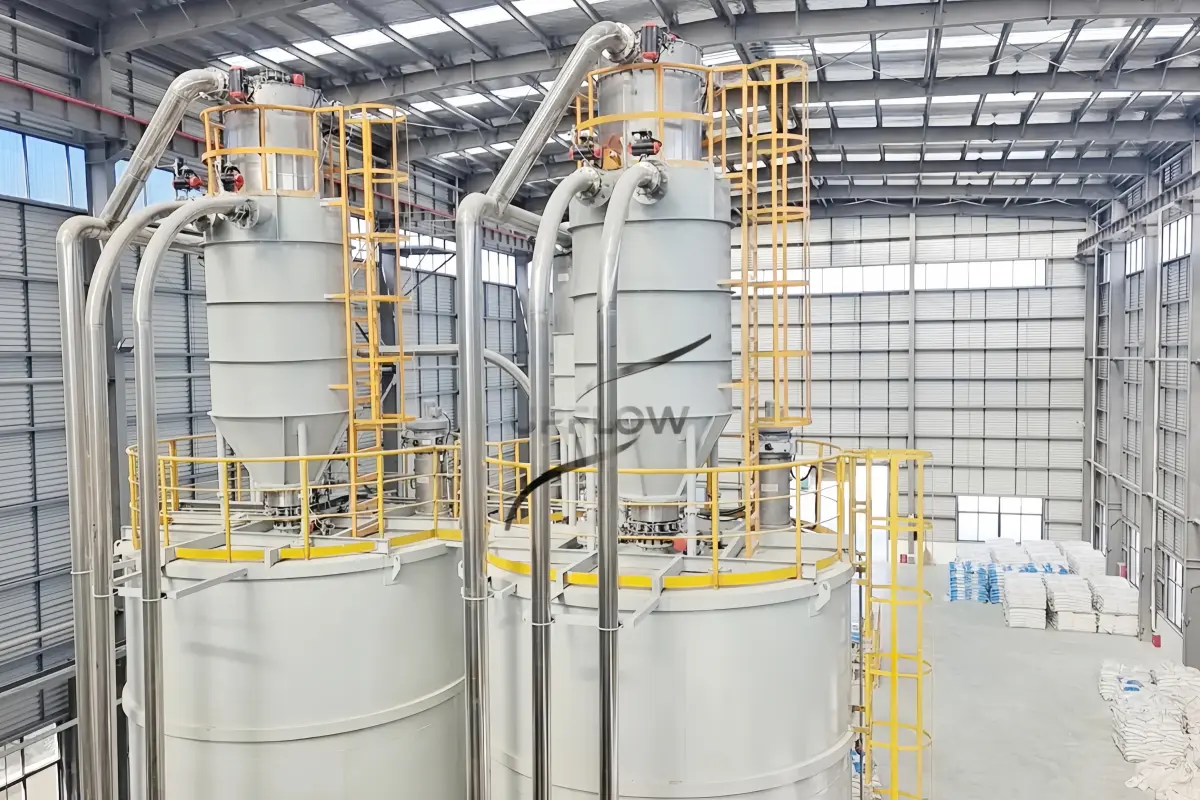
A ternary material pneumatic conveying system is an advanced material handling solution that uses airflow energy to transport lithium battery cathode powders such as NCM and NCA through enclosed pipelines.
In industrial applications, it is also referred to as a material automation system for ternary cathode powder, a high-speed airflow conveying system for NCM materials, a powder conveying system for lithium battery cathode materials, or a positive pressure conveying system for ternary material powders, depending on system configuration and process requirements.
By forming a stable gas-solid two-phase flow inside pipelines, this powder conveying system for ternary battery materials enables continuous, dust-free, and efficient transport throughout battery production lines.
Conveying Principle and Operation Mechanism
The ternary material pneumatic conveying system operates based on aerodynamic principles, where compressed air or gas flow generates a controlled airflow inside pipelines to transport powder materials.
In a positive pressure conveying system for NCM cathode powder, compressed air pushes the material along the pipeline, making it suitable for long-distance and large-capacity conveying. During operation, the powder particles are either suspended in the airflow (dilute phase conveying) or transported in clusters, forming a stable flow state that ensures continuous movement.
As a high-speed airflow conveying system for ternary materials, it relies on precise control of airflow velocity, pressure, and feeding rate to prevent material segregation, blockage, or excessive wear.
Structural Design and Key Components
A complete ternary material pneumatic conveying system consists of several integrated subsystems designed for reliability and performance.
The control system serves as the central unit, enabling real-time monitoring and adjustment of parameters such as airflow speed, feeding rate, and system pressure. The dust collection system plays a critical role in ensuring environmental compliance by capturing fine particles generated during conveying.
The conveying pipeline system is made of wear-resistant and anti-contamination materials, such as ceramic-lined pipes or tungsten carbide-coated components, to withstand the high abrasiveness of ternary powders. The feeding system, including rotary valves, screw feeders, or pressure vessels, ensures uniform and stable material input into the pipeline.
Key Advantages of Ternary Material Pneumatic Conveying Systems
The ternary material pneumatic conveying system offers several advantages that make it essential in lithium battery manufacturing.
First, as a fully enclosed powder conveying system for ternary cathode materials, it ensures dust-free operation and prevents contamination, which is critical for maintaining battery-grade material purity. Second, it provides high flexibility in pipeline layout, allowing horizontal, vertical, or inclined conveying to adapt to complex plant designs.
In addition, this material automation system for NCM and NCA powders supports continuous or intermittent operation, enabling efficient integration with production processes. Compared with traditional conveying methods, it requires less space and offers lower maintenance due to fewer moving mechanical parts.
Multifunctional Process Integration
One of the unique advantages of a ternary material pneumatic conveying system is its ability to integrate multiple process operations during material transport.
As a powder conveying system for lithium battery materials, it can simultaneously support processes such as mixing, classification, cooling, drying, and even particle size adjustment, improving overall production efficiency and reducing the need for additional equipment.
Industrial Applications and Future Trends
The ternary material pneumatic conveying system is widely used in lithium battery cathode material production lines, where it ensures stable and efficient transfer of NCM and NCA powders between reactors, storage silos, and mixing units.
With the rapid growth of electric vehicles and energy storage systems, the demand for high-performance ternary materials continues to rise. As a result, conveying systems are evolving toward fully automated, intelligent material handling solutions, integrating advanced control systems for real-time monitoring, fault diagnosis, and unmanned operation.
Conclusion
The ternary material pneumatic conveying system provides a high-efficiency, clean, and flexible solution for handling lithium battery cathode powders. By integrating material automation systems, high-speed airflow conveying systems, powder conveying systems, and positive pressure conveying systems for ternary materials, manufacturers can achieve improved productivity, enhanced material quality, and optimized production performance in modern lithium battery manufacturing.