
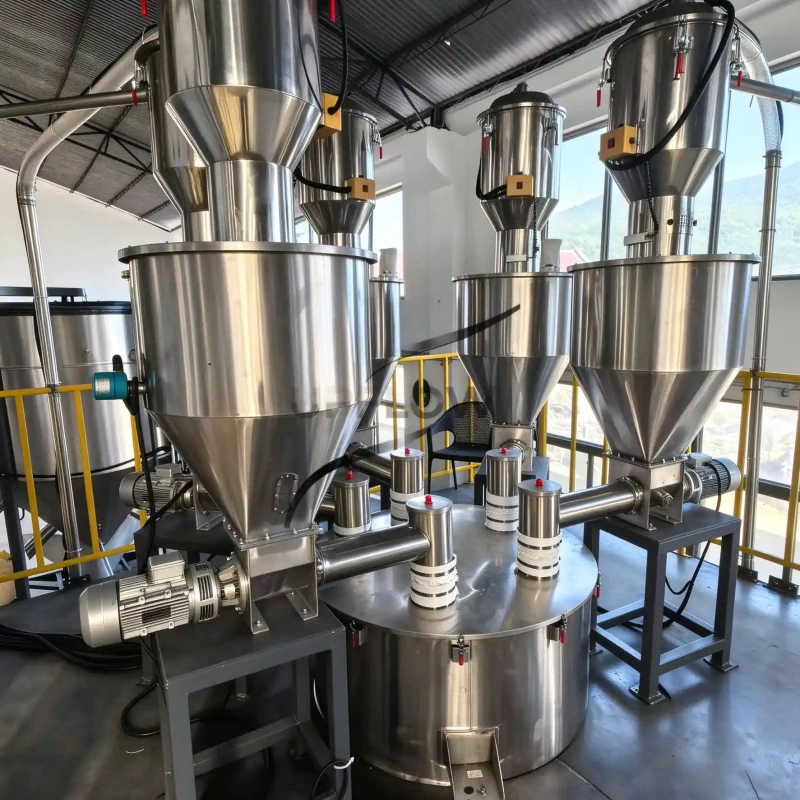
Milk Powder Vacuum Conveying: Batch Transfer and Cleaning Boundaries
Milk powder vacuum conveying for batch production needs a defined handover from the identified source lot to the intended receiving batch, together with clear rules for residual powder, cleaning status and restart. Successful suction alone does not confirm that the right quantity and material have been released to the right process.
Identify the milk powder grade and the production duty before selecting the vacuum conveying system. This guide focuses on batch identity and product-contact boundaries. It does not treat whole milk powder, skim milk powder, whey powder and every dairy blend as interchangeable.
Define the milk powder grade and the receiving operation
Record the supplier’s grade, lot identification, composition information and packaging. Where relevant, distinguish agglomerated or instant grades from other powders. Obtain the actual particle-size, bulk-density and handling information instead of applying a generic milk-powder value to every purchase.
State whether the receiver feeds a dry mixer, a weigh hopper or another process inlet. Define the batch quantity, available transfer time and product requirements. If the route is shared, identify which recipes and ingredients use it and how the plant distinguishes their production records.
Milk powder handling behaviour depends on more than its name. Record the condition after storage and bag opening and select representative material for any trial. Where product functionality matters, agree the checks to compare source material with delivered material rather than assuming that transfer automatically preserves every characteristic.
Start batch identity checks at the source station
For bag-fed powder, the receiving batch record should be linked to the source lot before material is tipped or picked up. Confirm the destination, connected route and available receiving capacity. Decide who can authorize the transfer and how a wrong or incomplete connection is handled.
UPFLOW’s Southeast Asia manual bag dump station project documents supplied feeding stations and downstream connection interfaces. It is a relevant source-feeding reference, but the public case does not identify a milk powder process or demonstrate dairy cleaning validation.
Use the physical feeding interface as the starting point for your own batch controls. A hopper or receiver photograph does not establish the required lot tracking, recipe permissions or release checks for a proposed milk powder line.
Use a batch handover record instead of a transfer-only checklist
This original record structure separates material identity, transfer state and production release. Assign the responsible role and acceptance evidence for each handover.
| Handover | Record before the next step | Question to resolve |
|---|---|---|
| Source lot to transfer route | Material grade, source lot, intended receiving batch and selected connection | How are substitutions, mixed source lots or an interrupted bag handled? |
| Route to receiver | Receiver identity, ready status, usable capacity and transfer authorization | Who prevents charging an unavailable or incorrectly selected receiver? |
| Transfer complete to batch complete | Delivered amount and measurement method, unresolved residue and interruptions | Does the record describe material actually delivered, rather than only a command or elapsed run time? |
| One batch to the next | Retained powder disposition, product-contact inspection and cleaning status | Can residual material be assigned to the next batch, or must it be removed under the plant procedure? |
| Cleaning to production restart | Reassembly, required inspection or sampling results and release authorization | What evidence permits the next identified grade or recipe to run? |
If weighing is part of the scope, coordinate the automated batching system with the receiver and downstream process. Keep the batch identity record separate from the instrument’s measurement logic. Our vacuum refill and weighing guide explains why measurement validity needs its own defined operating state.
Map residual powder at the actual product-contact boundaries
Review the source connection, conveying route, bends, receiver, filter interfaces and discharge valve. Ask which sections can be inspected and where retained powder is assessed at a batch or grade change. An empty source bag does not prove that the route and receiver are empty.
Define what happens to retained material and how it is recorded. Do not assume that an air purge is equivalent to cleaning or that all recovered material can return to production. The appropriate disposition belongs to the plant’s product and quality procedure.
For wider configuration choices, review the complete pneumatic conveying system. Product-contact construction, access and route sharing should be considered before ordering, alongside the actual powder and receiving duty.
Video: review the pickup and receiving sequence
This UPFLOW working video shows general vacuum conveying equipment and material-transfer steps. The material is not identified here as milk powder. It is not evidence of a dairy trial, batch-traceability function or validated cleaning result.
Specify the cleaning method and release criteria together
The plant should state the permitted cleaning method, grade or recipe transition, product-contact requirements and evidence needed before restart. Ask the proposed supplier to describe access, removable parts, filter arrangements, seals and reassembly checks for the actual equipment.
If wet cleaning is required, confirm component compatibility and how the equipment is dried and released before powder transfer resumes. If dry cleaning is proposed, agree the method and the areas that must be inspected. Do not infer either capability from a stainless steel surface or a general food-industry description.
Where the production sequence includes other ingredients, assess the applicable carryover requirements for that sequence. Define the inspection or sampling approach with the plant’s responsible quality personnel. A visible-residue check and a specified analytical acceptance test are different requirements.
Agree what a representative transfer trial must demonstrate
Use the actual proposed grade and document the source lot, packaging, storage condition, route and receiver. Observe complete transfer cycles, delivered material and any residual powder or interruptions. Record differences between the trial and the planned installation rather than treating a short equipment demonstration as a complete production qualification.
Include a batch-change exercise: identify the stopping point, inspect the agreed product-contact sections, document residue disposition and confirm the next batch authorization. Define which observations support the quotation and which still require site confirmation.
Frequently asked questions
Can one vacuum conveying line handle several milk powder grades?
Potentially, but confirm the grade range, product requirements, cleaning approach and batch-change controls. A successful trial with one grade does not qualify every dairy powder or blend.
Does stopping the vacuum mean that the receiving batch is complete?
No. Transfer completion, delivered quantity, remaining powder and production release are separate checks. Specify how each is confirmed for the installed arrangement.
What information should accompany an enquiry?
Send the grade and packaging information, layout, batch duty, receiving equipment details and cleaning/changeover requirements. Use our RFQ datasheet to assemble the inputs, then ask UPFLOW to review the milk powder transfer and batch interfaces.