
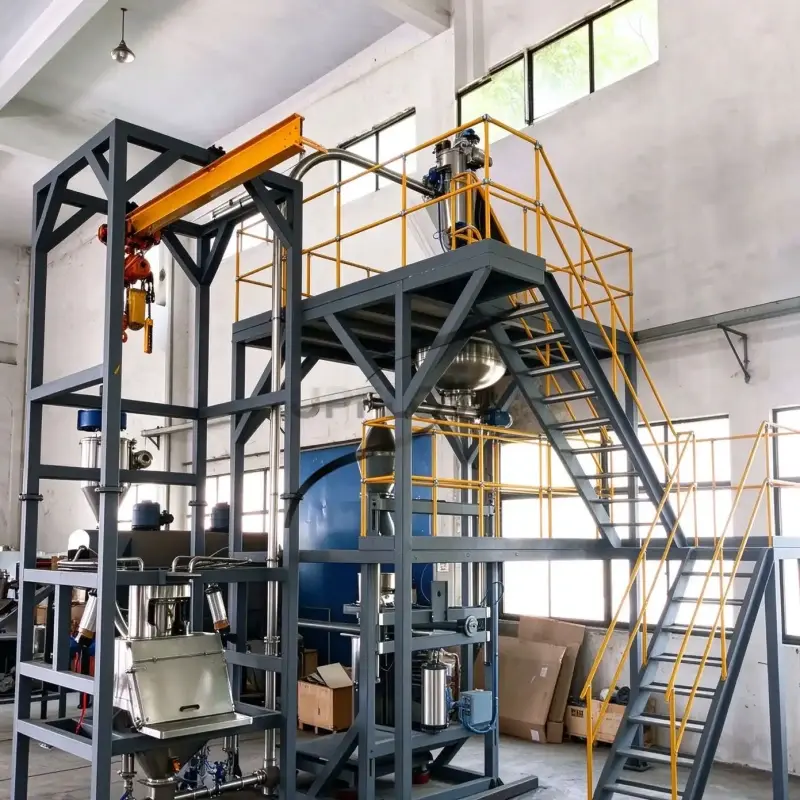
A manual bag dump station is commonly used to introduce powders and granular materials from small bags into industrial production systems, but in some applications, simply emptying the material into a receiving hopper is not sufficient to meet the required product quality and process consistency. Raw materials may contain oversized particles, agglomerates, packaging residues or foreign objects, and these unwanted materials can affect downstream equipment, product quality and production stability if they are not identified and removed before further processing.
For this reason, some manufacturers choose to integrate a vibrating sifter into the manual bag dumping station, creating a combined feeding and screening arrangement that allows operators to open bags, discharge materials and perform preliminary particle separation within one enclosed equipment structure.
However, adding a screen is not necessary for every powder handling application, because screening introduces additional considerations involving mesh size, throughput, material flowability, cleaning requirements, screen maintenance and dust collection. The appropriate configuration should therefore be determined by the purpose of screening and the actual characteristics of the material rather than simply adding a vibrating sieve to every bag dump station.
1. What Is a Bag Dump Station with an Integrated Sifter?
A bag dump station with an integrated sifter combines a manual bag tipping station with a screening device, allowing bagged powders or granules to be discharged directly onto a vibrating screen before entering the receiving hopper or downstream conveying equipment.
During normal operation, the operator opens the feeding door, places the bag in the designated working area and pours the material onto the screen. The vibrating mechanism then moves the material across the screening surface, allowing particles that meet the specified size requirements to pass through while retaining oversized particles and other materials that cannot pass through the selected mesh.
A typical configuration may include:
Manual bag dumping enclosure and operator platform.
Receiving hopper and supporting structure.
Vibrating sieve or screening assembly.
Replaceable screen mesh.
Dust collection unit and extraction connection.
Oversize material collection outlet.
Downstream screw feeder or vacuum conveying interface.
Electrical control system and safety interlocks where required.
The equipment can be configured according to the packaging size, material characteristics, required screening capacity and downstream production process.
UPFLOW’s Manual Bag Dump Station supports an optional vibrating screen, allowing the manual feeding and screening functions to be integrated into one equipment arrangement rather than requiring a separate screening machine after the feeding station.
2. When Should Screening Be Added to a Manual Bag Dump Station?
Screening should be considered when the incoming material requires preliminary particle separation or when the production process needs an additional physical barrier against unwanted oversized materials.
The following situations are common reasons for adding a vibrating sifter.
2.1 Removing Oversized Particles and Agglomerates
Powders may develop lumps or agglomerates during storage, transportation or handling, particularly when moisture absorption, compression or changes in storage conditions affect the material’s physical condition.
A vibrating screen can separate particles that are larger than the selected aperture size, helping prevent unsuitable oversized material from entering downstream equipment.
For example, chemical additives, mineral powders, starch and other industrial materials may require screening before being transferred into a mixer, storage hopper or production line, although the actual screening requirement should be established through material evaluation.
It is important to understand that a vibrating screen separates material according to particle size and screen passage characteristics; it does not automatically break every agglomerate into smaller particles.
2.2 Removing Packaging Residues and Foreign Materials
During manual bag opening, small pieces of packaging material, threads or other unwanted objects may accidentally enter the feeding hopper.
An appropriately selected screen can provide a physical separation step before the material reaches downstream equipment, reducing the possibility of larger unwanted objects entering the production process.
However, a screen should not be treated as a complete foreign-material control system, because thin films, flexible packaging fragments or objects with dimensions smaller than the screen opening may still pass through.
Where the material requires stricter contamination control, additional measures such as magnetic separation, inspection procedures or other suitable detection technologies may be necessary.
2.3 Protecting Downstream Equipment
Oversized particles and unwanted objects can cause operational problems when they enter equipment with relatively small material passages or precise feeding requirements.
For example, a screen installed before a screw feeder, rotary valve or pneumatic conveying system may help reduce the risk of unsuitable oversized material entering the next process stage, provided that the screen aperture and separation efficiency match the downstream equipment requirements.
Screening should therefore be considered as part of the complete material handling process rather than as an independent quality control step.
2.4 Meeting Particle Size Requirements
Some production processes require raw materials to remain within a specified particle size range before further mixing, conveying or processing.
In these applications, a vibrating sifter can provide preliminary size separation according to the selected mesh aperture, allowing material that passes through the screen to enter the next production stage.
However, screening at the bag dumping station does not necessarily replace laboratory particle size analysis or other formal product quality inspection, particularly when the final product requires a defined particle size distribution rather than simply the removal of oversized material.
3. What Are the Main Benefits of an Integrated Bag Dump and Screening System?
Integrating screening directly into a manual bag dump station can simplify the material feeding arrangement, particularly when the production process requires every incoming bag to pass through a preliminary screening step.
3.1 Combine Feeding and Screening in One Equipment Unit
A combined arrangement allows material to be discharged from bags and screened within the same equipment structure, reducing the need for a separate feeding hopper and an independently installed screening machine.
This can simplify the material transfer route and reduce the number of open handling points between bag dumping and downstream processing.
3.2 Reduce Unnecessary Material Handling
When the screen is installed directly above the receiving hopper, material can pass through the screening surface without requiring operators to transfer it manually into another machine.
This arrangement can reduce intermediate handling steps and create a more organized production workflow.
3.3 Improve Preliminary Material Inspection
The screen provides an opportunity to identify oversized particles, agglomerates and certain foreign materials before the powder enters the downstream process.
The effectiveness of this separation depends on the material, mesh size, screen condition and operating parameters, so the screen should be selected according to the actual quality control objective.
3.4 Simplify Equipment Layout
Compared with installing a separate bag dumping station and screening machine, an integrated arrangement may reduce the number of individual equipment units and associated connecting structures.
Nevertheless, the final footprint must include space for screen removal, mesh replacement, cleaning and maintenance, because a compact external structure should not compromise routine servicing.
4. How to Select the Right Screen Mesh Size
Screen mesh selection is one of the most important decisions when configuring an integrated bag dump and screening station, because the aperture size determines which particles can pass through the screening surface under the actual operating conditions.
A screen that is too coarse may allow unwanted oversized material to pass, while a screen that is too fine may reduce throughput, increase material retention and create more frequent cleaning requirements.
4.1 Define the Screening Objective First
Before selecting the mesh, buyers should clarify what they expect the screen to remove.
For example, removing occasional packaging fragments requires a different screening approach from separating oversized powder agglomerates or controlling a specified particle size range.
The screening objective should identify:
The approximate size of unwanted particles.
The acceptable particle size range of the material passing through.
Whether the screen is used for preliminary protection or product classification.
The acceptable quantity of retained material.
Whether the retained material can be inspected, reprocessed or must be discarded.
4.2 Understand Mesh Size and Aperture
The actual screen aperture should be confirmed in millimeters or micrometers rather than relying only on a mesh number, because different mesh standards and wire diameters can result in different effective openings.
For example, a screen specified with a particular mesh count should be accompanied by its actual aperture dimension and screen construction details when preparing the equipment specification.
| Screening requirement | Design consideration |
| Remove large packaging fragments | Aperture should retain the specified fragments |
| Remove coarse agglomerates | Select an aperture according to the unwanted lump size |
| Protect downstream equipment | Match the aperture to the equipment’s allowable particle size |
| Preliminary particle classification | Confirm the required size separation range |
| Fine powder screening | Evaluate mesh blockage, throughput and cleaning requirements |
4.3 Evaluate Screen Material and Construction
The screen material should be compatible with the powder, cleaning process and required hygiene conditions.
Stainless steel screening surfaces are commonly considered for industrial powder handling, while the appropriate grade, wire construction and surface finish should be selected according to the material and application.
For food, pharmaceutical and sensitive chemical applications, the equipment design should additionally consider cleanability, contact material requirements and contamination control.
5. How Does Material Flowability Affect Screening Capacity?
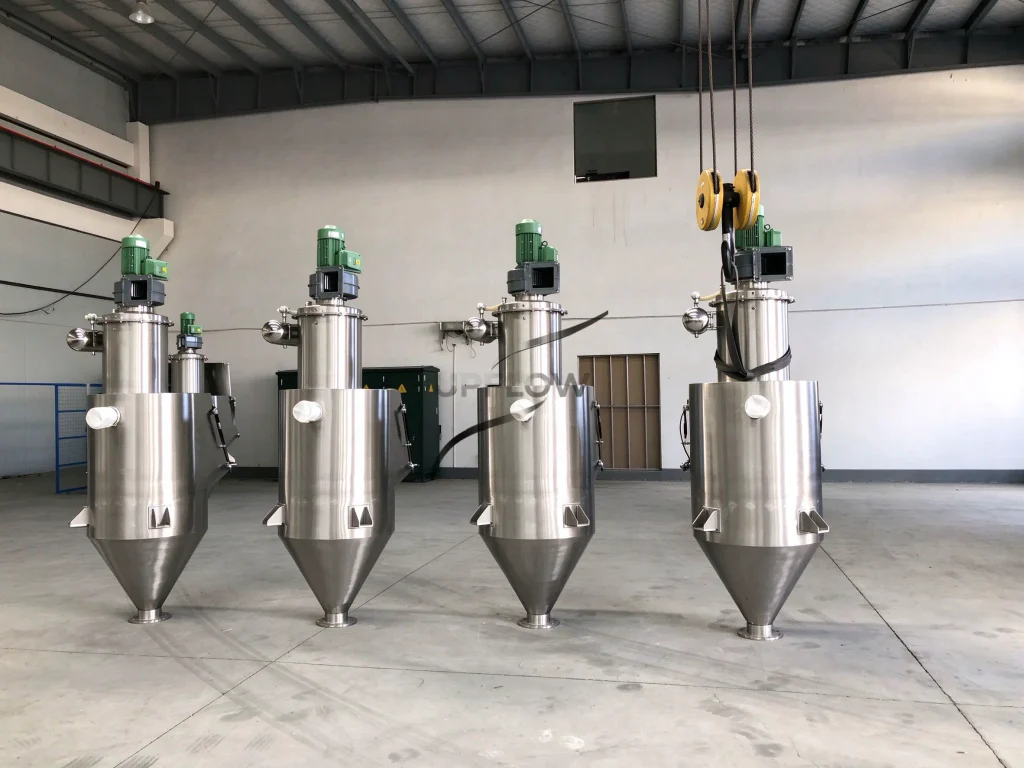
The rated capacity of a vibrating screen cannot be determined from its mesh size alone, because powder behavior, moisture content, bulk density, particle shape and feeding conditions all influence how effectively material moves across the screening surface.
Fine powders may adhere to the mesh or form agglomerates, while cohesive materials may accumulate near the feed inlet and reduce the effective screening area.
The following factors should be considered:
| Material factor | Potential effect on screening | Engineering consideration |
| Fine particle size | May increase mesh blockage | Evaluate screen design and cleaning method |
| High moisture content | May promote agglomeration and adhesion | Assess material conditioning and screen suitability |
| Poor flowability | May reduce material distribution | Evaluate hopper and screen feeding arrangement |
| High bulk density | Increases material loading | Check screen capacity and structural requirements |
| Irregular particle shape | May affect passage through apertures | Conduct representative screening trials |
| Hygroscopic properties | May change material condition during operation | Consider storage and environmental conditions |
A vibrating screen should receive material at a suitable and reasonably uniform rate, because feeding too much powder into one area can reduce screening efficiency even when the motor and screen dimensions appear adequate.
For difficult powders, representative material testing is useful for determining the practical throughput, retained material quantity and potential screen cleaning requirements before finalizing the equipment configuration.
6. How Should the Vibrating Screen Be Integrated with Dust Collection?
Dust collection remains an important part of an integrated bag dumping and screening station, because powder can become airborne during bag opening, tipping and movement across the vibrating screen.
The dust collection arrangement should capture airborne particles around the feeding opening while maintaining suitable enclosure conditions during normal operation.
Important design considerations include:
The position and size of the operator access opening.
The location of the extraction connection.
The screen enclosure and receiving hopper arrangement.
The expected dust generation during bag tipping.
The airflow required under actual operating conditions.
Filter maintenance and dust discharge access.
An extraction system should not be selected using a fixed airflow value based only on the screen diameter or bag weight, because the effective opening, material dustiness, duct resistance and operating sequence also influence the required airflow.
For more information about manual feeding station design, see UPFLOW’s 25 kg Bag Dump Station Design: Hopper Size, Work Height and Dust Capture.
The relationship between extraction airflow, filtration area and dust collector selection is also important when designing the complete feeding station. The screen enclosure and dust collection unit should therefore be evaluated as one integrated arrangement.
7. When Is a Separate Vibrating Screen Better Than an Integrated Sifter?
Although an integrated bag dump and screening station can simplify the feeding process, a separate vibrating screen may be more appropriate when the required screening capacity, classification accuracy or maintenance arrangement exceeds what can practically be accommodated inside the manual feeding station.
| Comparison factor | Integrated bag dump and sifter | Separate vibrating screen |
| Equipment arrangement | Combined feeding and screening unit | Independent screening equipment |
| Installation layout | May reduce separate equipment interfaces | Requires additional installation space |
| Material handling | Direct screening during bag dumping | Requires a defined transfer connection |
| Screening capacity | Depends on the integrated screen size and feeding rate | Can be selected independently |
| Maintenance access | Must be designed around the bag dumping station | Can provide dedicated service access |
| Process flexibility | Suitable for combined manual feeding and preliminary screening | May support independent screening processes |
| Typical application | Small-bag feeding with preliminary screening | Larger or dedicated screening operations |
A separate vibrating screen may be worth considering when the process requires higher screening throughput, multiple screening stages or independent control of the screening operation.
By contrast, an integrated system may be more practical when the primary objective is to screen incoming bags before material enters a receiving hopper or conveying system.
8. Integration with Downstream Powder Handling Equipment
A bag dump station with an integrated sifter is often only the first stage of a complete powder handling process, and the downstream equipment should be selected according to the screened material’s required destination, feeding rate and production sequence.
A typical process may follow:
Manual Bag Dumping → Vibrating Screening → Receiving Hopper → Screw Feeder or Vacuum Conveyor → Storage, Mixing or Production Equipment
For applications where material needs to be transferred to a remote silo, mixer or production machine, the screened powder can be connected to a suitable Pneumatic Conveying System.
If the process requires accurate ingredient weighing and controlled feeding, an Automated Batching System can also be evaluated as part of the complete system configuration.
The integration should define the equipment interface, receiving capacity, feeding sequence and cleaning requirements, particularly when different materials are handled through the same production line.
9. Real Project References: Bag Feeding and Integrated Powder Handling
9.1 Magnesium Silicate Pneumatic Conveying and Batching Project
UPFLOW supplied a customized magnesium silicate conveying and batching system for an overseas industrial customer, integrating a manual bag dumping station with vacuum conveying, weighing hoppers, screw conveying equipment, filtration, controls and storage equipment.
The project demonstrates how a manual feeding station can function as the upstream material introduction point of a larger powder handling system, with dust collection, material transfer and automated batching coordinated according to the customer’s production requirements.
Read more about the Magnesium Silicate Pneumatic Conveying and Batching Project.
9.2 PVC Powder Feeding and Vacuum Conveying Project
For a new materials manufacturer, UPFLOW supplied a customized PVC powder feeding and vacuum conveying system that included bag unloading equipment, dust collection and filtration arrangements, stainless steel conveying pipelines, receiving hopper modifications and centralized control.
This project provides an example of how bag dumping equipment can be integrated with enclosed powder conveying to reduce repeated open material transfer between different production stages.
Read more about the PVC Powder Feeding and Vacuum Conveying System Project.
These cases demonstrate UPFLOW’s experience in bag feeding, dust-controlled powder handling and downstream system integration; they are not presented as projects that necessarily used the same integrated vibrating screen configuration described in this article.
10. Frequently Asked Questions
Q1. Does every manual bag dump station need an integrated vibrating screen?
No. Screening should be added when the material requires preliminary separation of oversized particles, agglomerates or certain foreign materials before entering downstream equipment. If the incoming material already meets the required specifications and there is no process requirement for screening, an additional sieve may introduce unnecessary maintenance and material retention.
Q2. What is the difference between a bag dump station and a bag dump station with an integrated sifter?
A standard bag dump station provides a controlled location for manually emptying bagged materials, while an integrated sifting station adds a vibrating screen that separates particles according to the selected aperture before the material enters the receiving hopper.
Q3. How do I select the screen mesh size?
The mesh should be selected according to the size of the particles or foreign materials that need to be retained, the required product specification and the acceptable throughput. The actual aperture dimension should be confirmed in millimeters or micrometers rather than relying only on the mesh number.
Q4. Can an integrated vibrating screen handle fine powders?
Yes, it can be considered for suitable fine powder applications, but screen blockage, material adhesion, moisture content and dust generation should be evaluated before equipment selection. Representative material screening tests may be necessary for difficult powders.
Q5. Can a magnetic separator be added to a bag dump station?
Yes. A magnetic separator can be considered when the process requires additional separation of suitable ferrous contaminants, although its installation position and magnetic performance must be selected according to the material and contamination control requirements. It performs a different function from a vibrating screen.
Q6. Can the integrated sifter connect directly to a pneumatic conveying system?
Yes. The screened material can enter a receiving hopper and then be transferred through a suitable vacuum or positive-pressure conveying arrangement, provided that the feeding rate, material characteristics and equipment interfaces are properly coordinated.
Q7. What information should buyers provide when requesting a bag dump station with an integrated sifter?
Buyers should provide the material name, particle size distribution, bulk density, moisture content, bag dimensions, required feeding capacity, screening objective, target screen aperture, downstream equipment and cleaning requirements. These details help the supplier evaluate whether an integrated screen or a separate vibrating sieve is more suitable.
Conclusion: Add Screening Only When the Process Requires It
A bag dump station with an integrated sifter can provide a practical solution when industrial powders require preliminary screening during manual feeding, particularly when oversized particles, agglomerates or packaging residues need to be separated before the material enters downstream production equipment.
However, the decision to add screening should be based on the actual material quality requirements, particle characteristics, required throughput, screen mesh, cleaning procedure and downstream equipment compatibility rather than assuming that every manual feeding station needs an additional vibrating sieve.
UPFLOW provides customized manual bag dump stations with optional vibrating screens, dust collection arrangements and connections to screw or pneumatic conveying equipment according to the material and production requirements.
Planning a manual bag dumping and screening system? Send UPFLOW your material specifications, bag dimensions, target screening aperture, required feeding capacity and downstream process information so that our engineering team can evaluate a suitable integrated configuration.
Explore the UPFLOW Manual Bag Dump Station or contact our engineering team to discuss your project requirements.