
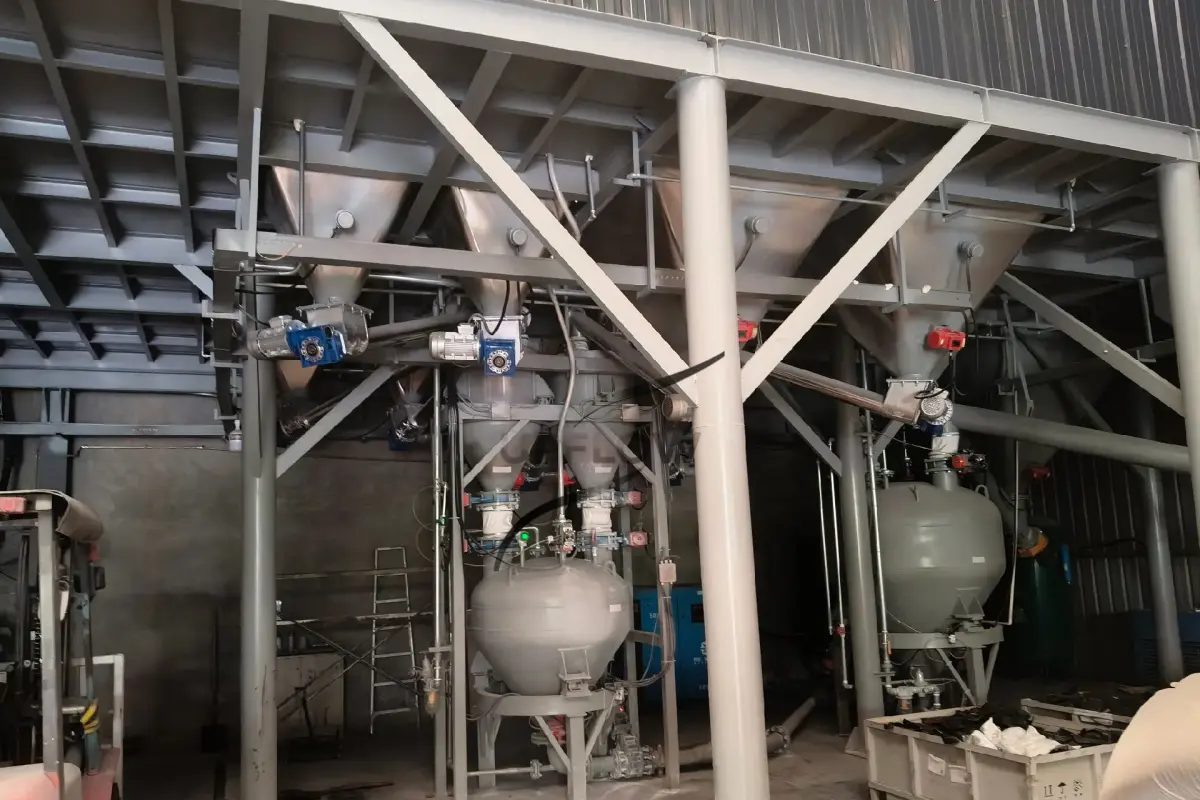
Material Overview: Properties of Acrylic Resin Powder
Acrylic resin, especially in powder or granulated form, is widely used in coatings, adhesives, elastomers, and specialty rubber applications such as acrylic rubber (ACM), where it provides excellent weather resistance, oil resistance, and thermal stability. In industrial handling, acrylic resin powder is typically processed as fine particles or micro-granules, often blended with additives for enhanced performance.
From a physical standpoint, acrylic resin powder generally has a bulk density ranging from 0.6 to 1.1 g/cm³, depending on formulation and particle size distribution, and it is characterized by good flowability under controlled conditions, slight electrostatic tendency, and sensitivity to temperature and dust dispersion, which makes enclosed and stable conveying systems essential to maintain product quality and reduce material loss.
What Is an Acrylic Resin Pneumatic Conveying System?
An acrylic resin pneumatic conveying system is a modern material handling solution that uses airflow or gas as the conveying medium to transport acrylic resin powder or acrylic rubber particles through sealed pipelines.
In industrial practice, it is also known as a central conveying system for acrylic resin powder materials, a long-distance conveying system for acrylic rubber powder handling, a powder transfer system for acrylic resin additives, or a pneumatic powder conveying system for acrylic resin production lines, depending on system configuration and plant layout.
By forming a stable gas-solid two-phase flow, this powder conveying system for acrylic resin materials enables continuous, dust-free, and efficient transport in automated industrial environments.
System Features and Performance Advantages
The acrylic resin pneumatic conveying system is widely recognized for its energy efficiency, environmental friendliness, and flexible system design, making it highly suitable for modern chemical and polymer processing plants.
As a central conveying system for acrylic resin powder, it supports multi-point feeding and centralized discharge, allowing multiple material sources to be transported to a single mixing or processing unit. At the same time, it can also function as a powder transfer system for acrylic resin materials, distributing material from one source to multiple destinations, which is ideal for complex production workflows.
The system operates in a fully enclosed pipeline, ensuring zero dust leakage and preventing external contamination, which significantly improves product purity and workplace cleanliness.
Working Principle of Acrylic Resin Pneumatic Conveying
The working principle of an acrylic resin pneumatic conveying system is based on aerodynamic transport, where compressed air or other gases generate a controlled airflow inside pipelines.
In operation, acrylic resin powder is introduced into the pipeline through a feeding device, and under the influence of airflow energy, the particles are either suspended in the air stream (dilute phase conveying) or moved in clusters (dense phase conveying) along the pipeline.
As a long-distance conveying system for acrylic resin powder, it relies on airflow velocity and pressure to overcome resistance and transport materials efficiently, while maintaining stable flow conditions and minimizing material degradation.
Functional Capabilities and System Components
A complete acrylic resin pneumatic conveying system consists of several integrated components, including feeding equipment, air supply units, conveying pipelines, control systems, and storage silos.
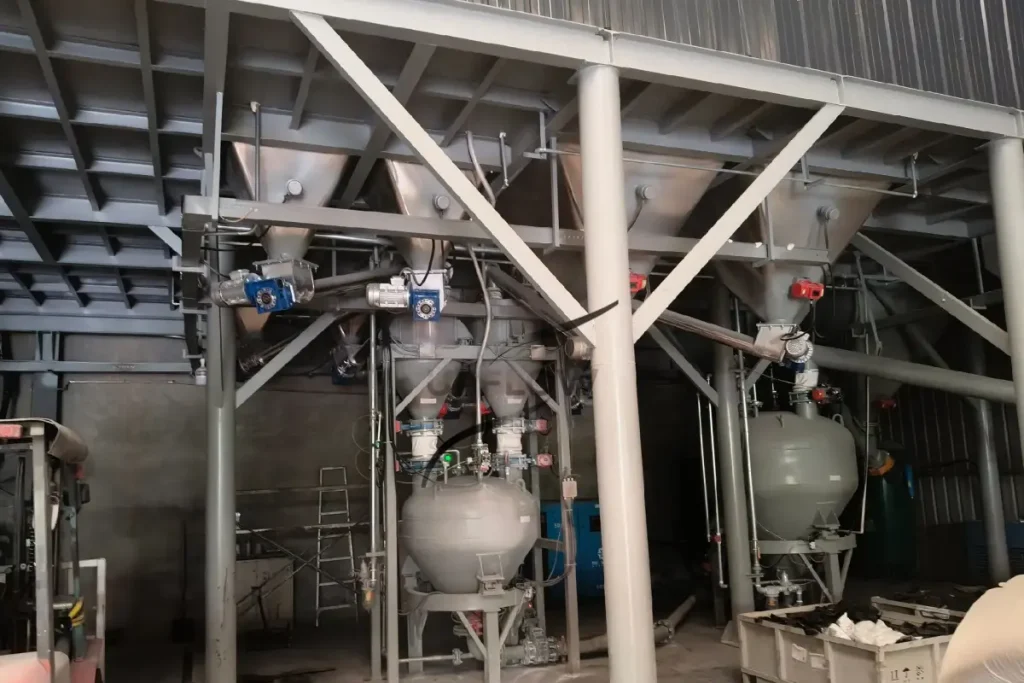
This powder conveying system for acrylic resin materials offers multiple functions such as automated material transfer, dust-free operation, precise dosing, and compatibility with downstream mixing or processing systems. In addition, the modular design allows easy installation, expansion, and maintenance, making it suitable for both new production lines and system upgrades.
Industrial Applications of Acrylic Resin Conveying Systems
The acrylic resin pneumatic conveying system is widely applied in industries such as coatings production, rubber manufacturing, casting, shipbuilding, environmental processing, metallurgy, and pharmaceutical production, where reliable and clean powder handling is essential.
As a powder transfer system for acrylic rubber materials, it ensures stable feeding into mixers and reactors, while a central conveying system for acrylic resin powder in coating plants improves production efficiency and reduces manual handling requirements.
Conclusion
The acrylic resin pneumatic conveying system provides an efficient, flexible, and environmentally friendly solution for transporting fine polymer materials. By integrating central conveying systems, long-distance conveying systems, powder transfer systems, and pneumatic powder conveying systems for acrylic resin materials, manufacturers can achieve improved automation, reduced material loss, and stable production performance in modern industrial applications.