
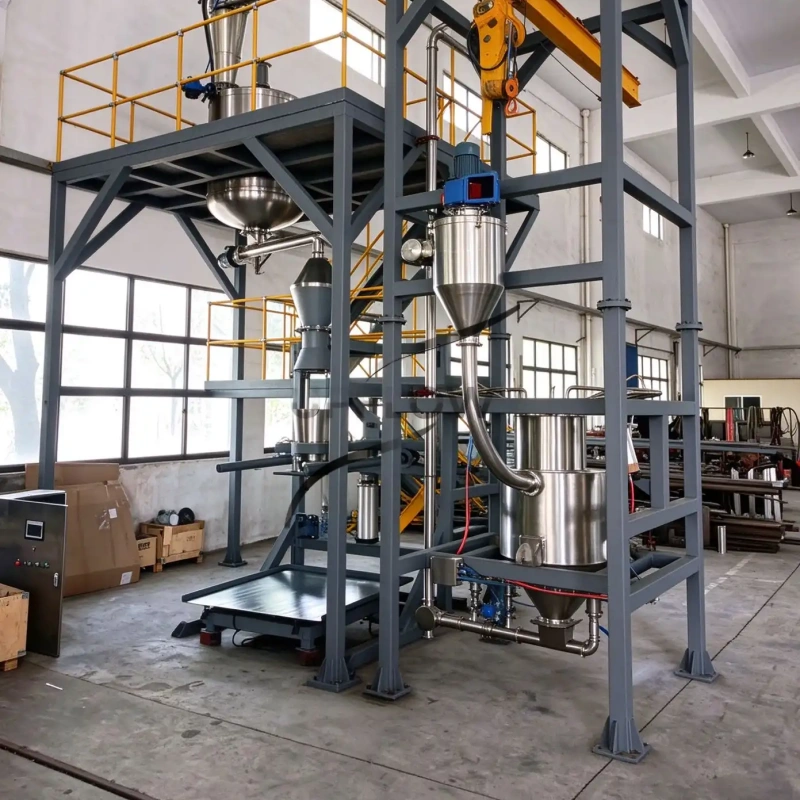
Anode Powder Bulk Bag Conveying System Supplier: What Should the Supply Scope Include?
An anode powder bulk bag conveying system supplier should define the complete path from the FIBC discharge point to the receiving process, including the mechanical interfaces, conveying duty, control ownership and acceptance checks. A quotation for a bag support frame alone does not establish the scope of a working unloading-and-conveying line.
Start with the actual anode powder grade, bag construction, transfer route and downstream demand. Then compare offers against the same boundary. UPFLOW’s pneumatic conveying systems provide the system-level starting point; this guide focuses on the procurement interfaces around bulk bag feeding.
Define the material and delivery duty before comparing suppliers
“Anode powder” is a process description, not a complete material specification. Record the commercial grade, composition supplied by the material manufacturer, particle-size information, bulk density and the relevant handling requirements. Do not treat graphite-based, hard-carbon and silicon-containing materials as interchangeable.
Describe the powder as received, including storage history, bag liner and any observed agglomeration. State where the material must arrive: a storage hopper, mixer, weigh hopper or another process inlet. The receiving equipment’s operating state and refill demand belong in the specification alongside the required transfer quantity and available time.
For quality requirements, use the battery powder contamination acceptance guide to define sampling points and evidence. “Battery grade” on a quotation is not a substitute for agreed product-contact materials, cleaning requirements and an acceptance method.
Use one interface matrix for unloading and pneumatic conveying
The following is an original procurement checklist. Complete it with the purchaser and proposed supplier; it does not describe a standard package that automatically includes every item.
| Boundary | What the quotation should identify | Evidence or responsibility to agree |
|---|---|---|
| FIBC and lifting interface | Bag dimensions, loops, discharge spout or liner, access and handling arrangement | Approved bag drawing; responsibility for lifting equipment and site support |
| Bag outlet to feed device | Connection method, isolation, discharge assistance if required and inspection access | How connection, interruption and bag change are demonstrated using the proposed bag |
| Feed device to conveying line | Feeder duty, pickup arrangement, pressure boundary and connection geometry | Who selects and supplies each mating part; permitted operating conditions |
| Conveying line to receiver | Route, bends, separation, filtration, discharge and vent interfaces | Named owner for pipework, receiver and associated services; test conditions |
| Receiver to downstream process | Usable buffer, inlet geometry, equipment-ready signal and demand sequence | Who permits transfer, confirms completion and manages a full or unavailable receiver |
| Controls and acceptance | Signal list, utilities, alarms, restart sequence and supplied documentation | Responsibilities for panel, site wiring, commissioning and agreed checks |
A ton bag unloading system addresses the source end. If a vacuum arrangement is proposed, define the vacuum conveying system and its receiving boundary explicitly. A shared flange or hose does not by itself establish which supplier owns pressure isolation, discharge control or restart logic.
Separate continuous process demand from intermittent bag discharge
A bag can be connected while the downstream process is stopped, and a receiver may request refill while the bag is nearly empty. Ask the supplier to explain those states, including how the line responds when powder discharge slows or a receiving point becomes unavailable.
Where the process needs buffer storage, specify usable inventory and replenishment response rather than nominal hopper volume alone. Where weighing is included, distinguish material transfer from the point at which a weight is accepted. The quotation should name the device that owns each command and confirmation.
Use a sequence review covering bag connected, transfer requested, receiver ready, material arrival, transfer complete and abnormal interruption. Define what the operator checks before restarting. The specific protection measures and operating limits must follow the actual powder assessment and installation requirements; enclosure alone is not a universal safety claim.
What the UPFLOW anode-material project actually supports
The published anode material big bag unloading project describes multiple customized FIBC unloading systems supplied for a European battery material manufacturer. Its documented scope includes bag support and unloading, controlled discharge, a dust-collection interface, a transfer connection and automated operating control.
This is a relevant reference for connecting bulk bag feeding with a production process. The public case does not provide a tested conveying capacity, a detailed powder grade or a contamination test result. Those items should therefore be confirmed for the proposed application rather than inferred from the project title.
Working video and animation: inspect the source-side interfaces
UPFLOW’s bulk bag discharger video combines working footage and animation. Use it to review the unloading arrangement and connection sequence. It is a general equipment reference, not proof that the footage is the European anode-material project or a test of a particular anode powder.
Request acceptance evidence that matches the purchased boundary
Ask each supplier to mark whether a proposed trial covers only unloading, only conveying or the integrated sequence. Record the powder sample, bag, route, receiver condition and measuring method. If the trial uses a substitute material or shortened route, record the difference and the remaining confirmation work.
A useful acceptance schedule separates discharge consistency, delivery to the intended point, control behaviour and product-quality requirements. Agree how residual material, interruptions and cleaning access are assessed. Do not compare an observed suction rate with another supplier’s complete-cycle delivery figure without reconciling their measurement boundaries.
Frequently asked procurement questions
Should one supplier provide both unloading and conveying?
One integrated scope can simplify interface ownership, but the decision depends on the project. With multiple suppliers, use a signed interface schedule naming who provides the mating parts, utilities, control signals and integrated acceptance checks.
Can a bulk bag unloader feed a pneumatic conveying system directly?
That depends on the discharge arrangement, powder behaviour, required feed control and pressure boundary. Confirm the connection and operating sequence for the proposed equipment rather than assuming any unloader can connect directly to any line.
What should accompany an enquiry?
Send the material specification, bag drawing, layout and elevation changes, required delivery duty, receiving equipment details and quality criteria. Identify existing equipment and exclusions. Prepare those inputs with the pneumatic conveying RFQ datasheet, then contact UPFLOW to review the integrated scope.