
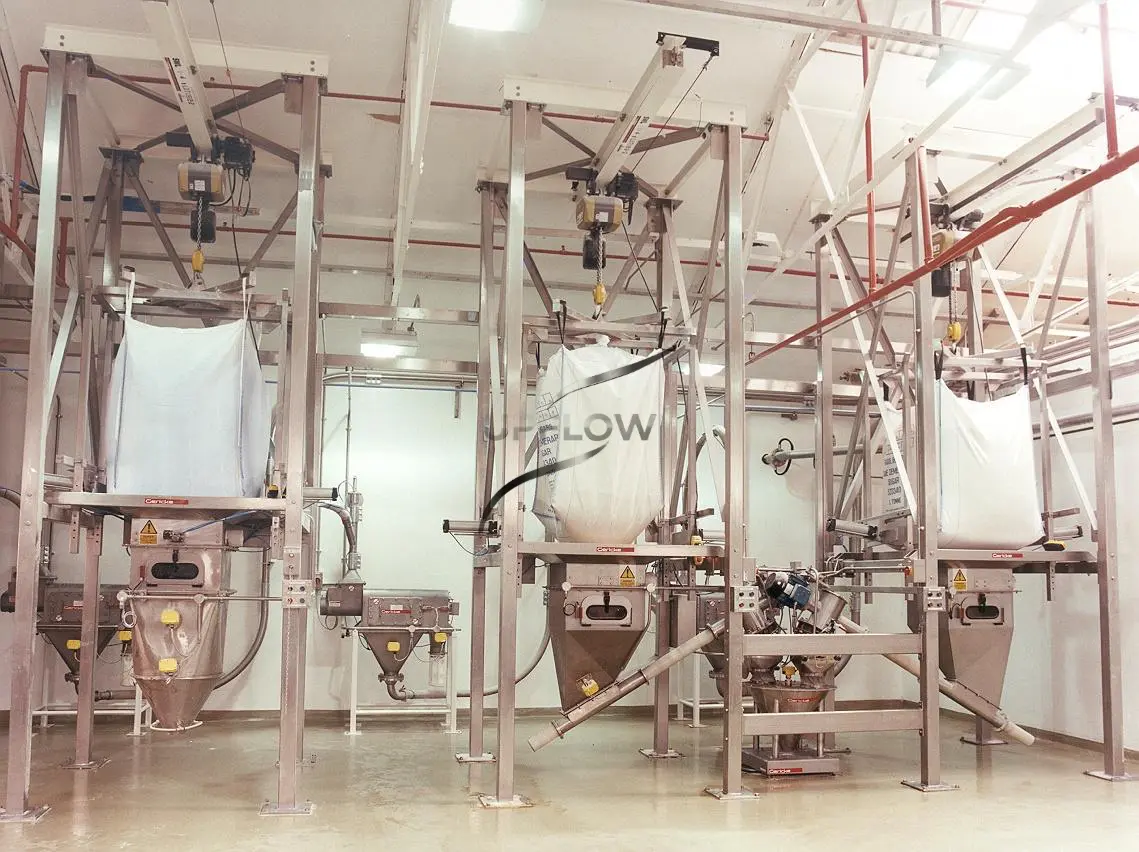
Bulk bags, also known as FIBCs or big bags, are widely used to transport and store industrial powders and granular materials. However, some materials do not discharge smoothly under gravity because they develop lumps during storage, absorb moisture or form cohesive structures inside the bag.
When these materials are unloaded, operators may experience slow discharge, unstable feeding, material bridging or residual powder remaining inside the bag. In more difficult applications, a standard bulk bag unloading station may not provide sufficient material flow, making additional discharge assistance or lump-breaking equipment necessary.
A bulk bag unloader with a lump breaker can be considered when material agglomerates need to be reduced before entering downstream conveying, storage or processing equipment. However, not every poorly flowing powder requires a lump breaker. Engineers should first identify whether the problem is caused by bag bridging, material cohesion or actual hard agglomerates.
This article explains when lump-breaking equipment is necessary and how to select a suitable bulk bag unloading configuration.
1. Why Do Powders Form Lumps Inside Bulk Bags?
Powder agglomeration can occur during storage, transportation or handling, depending on the material properties and environmental conditions.
Common contributing factors include:
Moisture absorption and exposure to humid environments.
Long storage periods under compression.
Temperature changes during transportation and storage.
Fine particle size and strong interparticle cohesion.
Material characteristics that encourage caking or consolidation.
Materials such as calcium carbonate, silica, chemical additives, mineral powders and certain battery materials may require specific discharge evaluations depending on their actual properties and storage conditions.
It is important to distinguish between soft agglomerates that can be broken by moderate mechanical action and hard lumps that require more substantial crushing or size reduction.
The material name alone is not sufficient to determine whether a lump breaker is necessary.
2. Lump Breaker vs Bag Massage Pads vs Vibrators
Different powder discharge problems require different solutions, and selecting the wrong flow-assistance device may increase equipment cost without resolving the actual problem.
Bag Massage Pads
Pneumatic massage pads apply controlled pressure to the sides of a bulk bag to help move cohesive material toward the discharge spout.
They are useful when powder remains trapped along the lower sides of the bag or when the material does not flow consistently toward the outlet.
Vibrators
Mechanical or pneumatic vibrators generate vibration to encourage material movement and reduce certain flow restrictions.
Their effectiveness depends on the equipment structure, vibration transmission and material behavior.
Lump Breakers
A lump breaker mechanically breaks down oversized agglomerates before the material enters downstream equipment.
It is more appropriate when the powder contains solid lumps that cannot be adequately handled by ordinary gravity discharge or bag flow assistance.
For a detailed comparison of the first two solutions, read our article on Bulk Bag Discharger: Massage Pads vs Vibrators.
The key principle is to identify where the material flow problem occurs before choosing the equipment.
3. When Is a Lump Breaker Necessary?
A lump breaker should be considered when the material contains agglomerates that need to be reduced to a suitable size before entering the next processing stage.
Typical situations include:
Hard Powder Agglomerates: Materials that form consolidated lumps during prolonged storage may require mechanical size reduction before they can be conveyed or processed.
Oversized Particles Before Pneumatic Conveying: If the downstream conveying system or receiving equipment has limitations on the size of incoming material, a suitable lump-breaking stage may be required.
Inconsistent Material Feeding: Large agglomerates can interrupt screw feeder operation, block narrow discharge passages or create inconsistent material flow.
Downstream Screening or Mixing Requirements: Some production processes require material to enter the next stage within a specified size range, making controlled lump breaking necessary.
However, a lump breaker should not automatically be installed whenever a powder has poor flowability. If the problem is simply bridging inside the bulk bag, massage pads, vibration or improved hopper geometry may be more appropriate.
4. How to Select the Right Lump Breaking Equipment
The selection of a lump breaker should be based on the physical characteristics of the material and the requirements of the downstream process.
Important parameters include:
Material name and chemical properties.
Initial lump size and maximum particle size.
Bulk density and moisture content.
Material hardness and crushing characteristics.
Required processing capacity.
Target particle size after lump breaking.
Material temperature and abrasiveness.
Cleaning and contamination prevention requirements.
The required lump-breaking capacity should be coordinated with the actual bulk bag unloading rate.
For example, if the unloading station supplies powder at 2 tonnes per hour, the downstream lump-breaking equipment should be evaluated against the actual operating flow, including possible variations in discharge rate.
Engineers should also consider whether the lump breaker will operate continuously or intermittently and whether a buffer hopper is required between the unloading and conveying stages.
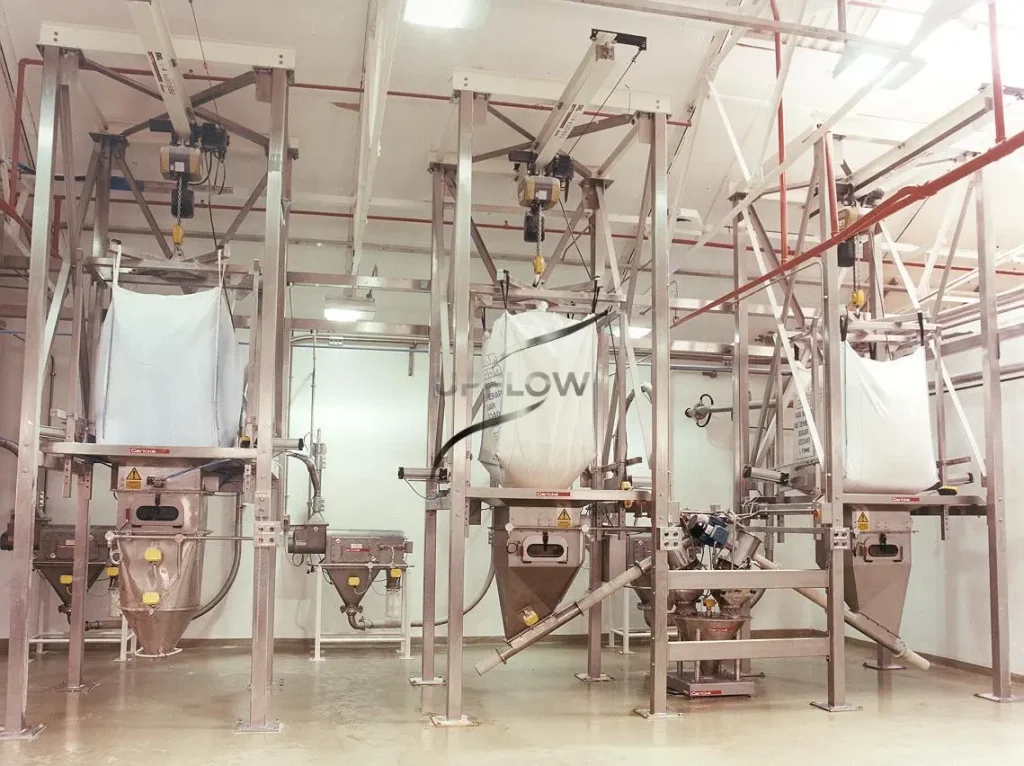
5. Where Should the Lump Breaker Be Installed?
The installation position affects material flow, equipment accessibility and maintenance.
Three common arrangements can be considered.
Option A – Directly Below the Bulk Bag Unloading Station
The lump breaker is installed beneath the receiving hopper, allowing discharged powder to pass through the breaking unit before entering downstream equipment.
This arrangement can provide a compact equipment layout when sufficient installation height is available.
Option B – Between the Receiving Hopper and Conveying System
An intermediate hopper feeds the lump breaker, which then supplies the pneumatic conveying or mechanical transfer equipment.
This arrangement can provide greater flexibility when the unloading process and downstream conveying cycle operate at different rates.
Option C – Before a Storage or Mixing Equipment Inlet
The lump breaker is installed upstream of a storage hopper, mixer or other process equipment where a controlled material size is required.
The final configuration should consider available space, maintenance access, cleaning requirements and the possibility of material accumulation.
6. Integrate Lump Breaking with Dust Collection and Conveying
Breaking powder agglomerates can generate additional fine particles and airborne dust, particularly when handling brittle or dry materials.
Therefore, dust collection and equipment sealing should be considered when designing the complete unloading arrangement.
A typical process flow may include:
FIBC Bulk Bag → Bulk Bag Unloading Station → Receiving Hopper → Lump Breaker → Feeding Device → Pneumatic Conveying System → Downstream Equipment
The exact arrangement depends on the material and production process.
For fine or sensitive powders, engineers should also evaluate material retention, equipment cleaning and possible cross-contamination.
Where combustible dust or hazardous materials are involved, the complete installation must be assessed according to the material hazard characteristics and applicable site safety requirements.
Explore UPFLOW’s Ton Bag Unloading System and Ton Bag Unpacking Machine for bulk bag discharge equipment configurations.
7. UPFLOW Bulk Bag Unloading Project References
UPFLOW provides customized bulk bag unloading and powder feeding equipment for chemical, battery material, food, pharmaceutical and other industrial applications.
European Anode Material Big Bag Unloading System Project
UPFLOW supplied multiple FIBC unloading systems for a European battery material manufacturer.
The project required controlled discharge of large-volume anode material bags, with attention to powder containment, stable feeding, equipment integration and downstream material transfer.
This application demonstrates the importance of considering material characteristics and the complete discharge process when selecting bulk bag unloading equipment for battery materials.
Read more about the European Anode Material Big Bag Unloading System Project.
European Paraformaldehyde and Glycine Big Bag Unloading Project
UPFLOW provided a customized bulk bag unloading and conveying solution for paraformaldehyde and glycine used in a European chemical manufacturing project associated with an annual production capacity of 30,000 tonnes of glyphosate technical material.
The project involved two different chemical raw materials and required an equipment configuration that considered their respective material characteristics, unloading interfaces and downstream transfer requirements.
Read more about the Paraformaldehyde and Glycine Big Bag Unloading Project.
These projects illustrate UPFLOW’s experience with industrial bulk bag unloading and powder handling applications. They should not be interpreted as evidence that a lump breaker was included in either project.
8. Frequently Asked Questions
Q1. Does every bulk bag unloader need a lump breaker?
No. Free-flowing powders and materials with manageable discharge characteristics may not require additional lump-breaking equipment. The decision depends on actual agglomeration, material hardness and downstream process requirements.
Q2. Can bag massage pads replace a lump breaker?
Not always. Massage pads help move powder inside the bulk bag, while a lump breaker mechanically reduces agglomerates after discharge. They address different material handling problems.
Q3. Can a lump breaker be installed directly below a bulk bag unloading station?
Yes. A lump breaker can be installed beneath a receiving hopper when the equipment dimensions, material flow rate and maintenance access are suitable.
Q4. What information is required to select a lump breaker?
Important information includes material characteristics, initial lump size, hardness, bulk density, moisture content, required throughput and target particle size after processing.
Q5. Can a lump breaker be integrated with a pneumatic conveying system?
Yes. A lump breaker can be installed upstream of a pneumatic conveying system, provided that the resulting particle size, material feeding arrangement and conveying conditions are suitable.
Conclusion
A bulk bag unloader with a lump breaker can be a suitable solution when stored powders contain hard agglomerates that need to be reduced before downstream processing.
However, poor powder discharge does not always indicate a need for mechanical crushing. Engineers should first distinguish between bag bridging, cohesive powder flow problems and actual material agglomeration before selecting massage pads, vibrators, hopper modifications or lump-breaking equipment.
UPFLOW provides customized bulk bag unloading, powder feeding and pneumatic conveying solutions for industrial manufacturers.
Handling powders that form lumps during storage or unloading? Contact UPFLOW with your material specifications, lump size, bulk bag dimensions, required capacity and downstream equipment information to discuss a suitable unloading and feeding configuration.