
Introduction
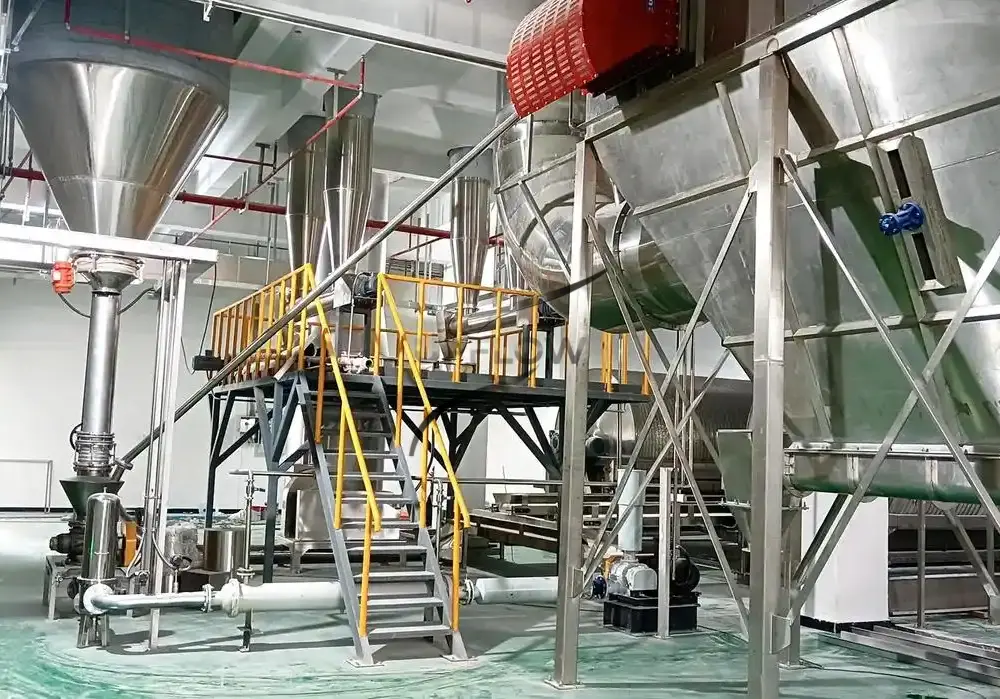
A catalysts pneumatic conveying system is an advanced enclosed material handling solution that uses controlled air flow to transport catalyst powders and granular materials between storage units, feeding stations, and reaction equipment, and it is widely applied in chemical, petrochemical, and plastic manufacturing industries where stable, clean, and continuous powder conveying system, particle conveying system, air conveying system, and feeding system performance is required to ensure production efficiency and process safety.
Catalyst Materials and Their Industrial Characteristics
Catalyst materials used in industrial processes are generally fine powders or small granules with a typical bulk density ranging from 0.4 to 1.2 g/cm³, while particle sizes often fall within the micron range of approximately 5–100 microns, and these materials are usually high-value chemical substances that are sensitive to moisture, oxygen exposure, and contamination, which makes them difficult to handle using open mechanical systems and therefore highly dependent on a sealed and controlled granular conveying system for safe transportation.
In practical applications, these catalyst materials include petrochemical catalysts such as FCC and hydrocracking catalysts used in refining processes, polymerization catalysts such as Ziegler-Natta and metallocene catalysts used in plastic production, environmental catalysts such as deNOx and oxidation catalysts used in emission control systems, as well as various metal oxide and acid-base catalysts used in chemical synthesis processes, all of which require precise handling through a stable powder conveying and air conveying system to maintain performance and avoid product degradation.
Core Functions of Catalysts Pneumatic Conveying System
The catalysts pneumatic conveying system is designed to achieve fully automated material transportation by using controlled airflow to move catalyst powders or granules from storage silos or feeding hoppers directly into reactors, mixers, or dosing equipment without manual intervention, which not only improves production continuity but also significantly reduces the risk of material loss and human error during handling.
At the same time, this system can also support multi-material operation scenarios where different catalyst types or particle grades can be mixed or separated through pipeline control, allowing flexible process adjustment according to production requirements in chemical or plastic manufacturing lines, while maintaining stable flow conditions through a precisely regulated powder conveying system for catalysts and fine particles.
In addition, by adjusting air pressure, vacuum level, and pipeline velocity, the system can achieve highly accurate control of conveying speed and feeding dosage, ensuring that catalyst injection into the production process remains consistent and repeatable, which is especially important in continuous reaction systems where small deviations can affect final product quality.
Another important function is its environmental protection capability, since the entire process operates within a sealed pipeline system, which effectively prevents dust leakage, reduces workplace contamination, and improves operational safety in industries where fine powder handling is a critical concern.
Technical Features and System Advantages
The catalysts pneumatic conveying system is widely adopted in modern industrial production due to its high energy efficiency and flexible design, as it relies on compressed air or vacuum flow instead of mechanical conveyors, which reduces equipment wear and lowers long-term operating costs while maintaining stable performance in continuous production environments.
Its system configuration is highly flexible, allowing customization of pipeline layout, feeding units, and control modules according to different plant capacities and process requirements, which makes it suitable for both small-scale batch production and large-scale continuous chemical manufacturing systems that require reliable air conveying systems for powder and granular materials.
In addition, the system integrates advanced automatic control technology that enables real-time monitoring and adjustment of key operating parameters such as airflow rate, pipeline pressure, and material feeding speed, ensuring stable operation and improved process accuracy without frequent manual intervention.
Because the system operates in a fully enclosed structure, it also significantly reduces the need for manual handling, which not only improves workplace safety but also minimizes human exposure to fine catalyst powders, thereby reducing operational risks and improving overall production efficiency.
Furthermore, with the use of abrasion-resistant pipelines and corrosion-resistant components, the system ensures long-term stable operation even when handling chemically active or abrasive catalyst materials, making it a reliable solution for demanding industrial environments.
Industrial Applications
In industrial practice, the catalysts pneumatic conveying system for petrochemical powder handling, the chemical catalyst particle conveying system, and the industrial air conveying feeding system for fine powders are widely used in petroleum refining plants, polymer production facilities, and chemical processing industries, where continuous and precise material feeding is required to maintain reaction stability and product consistency.
It is especially suitable for applications such as catalyst feeding in petrochemical cracking units, powder dosing in plastic polymerization processes, and fine material transport in chemical reactors, where the system ensures safe, efficient, and stable conveying of high-value materials under fully automated production conditions.
Conclusion
Overall, the catalysts pneumatic conveying system provides a highly efficient and reliable solution for the transportation and dosing of fine catalyst powders and granular materials in modern industrial environments, and by integrating automation control, enclosed conveying technology, and precise feeding regulation, it significantly improves production safety, reduces material loss, and enhances process stability, making it an essential powder conveying and air conveying system for chemical, petrochemical, and plastic manufacturing industries.