
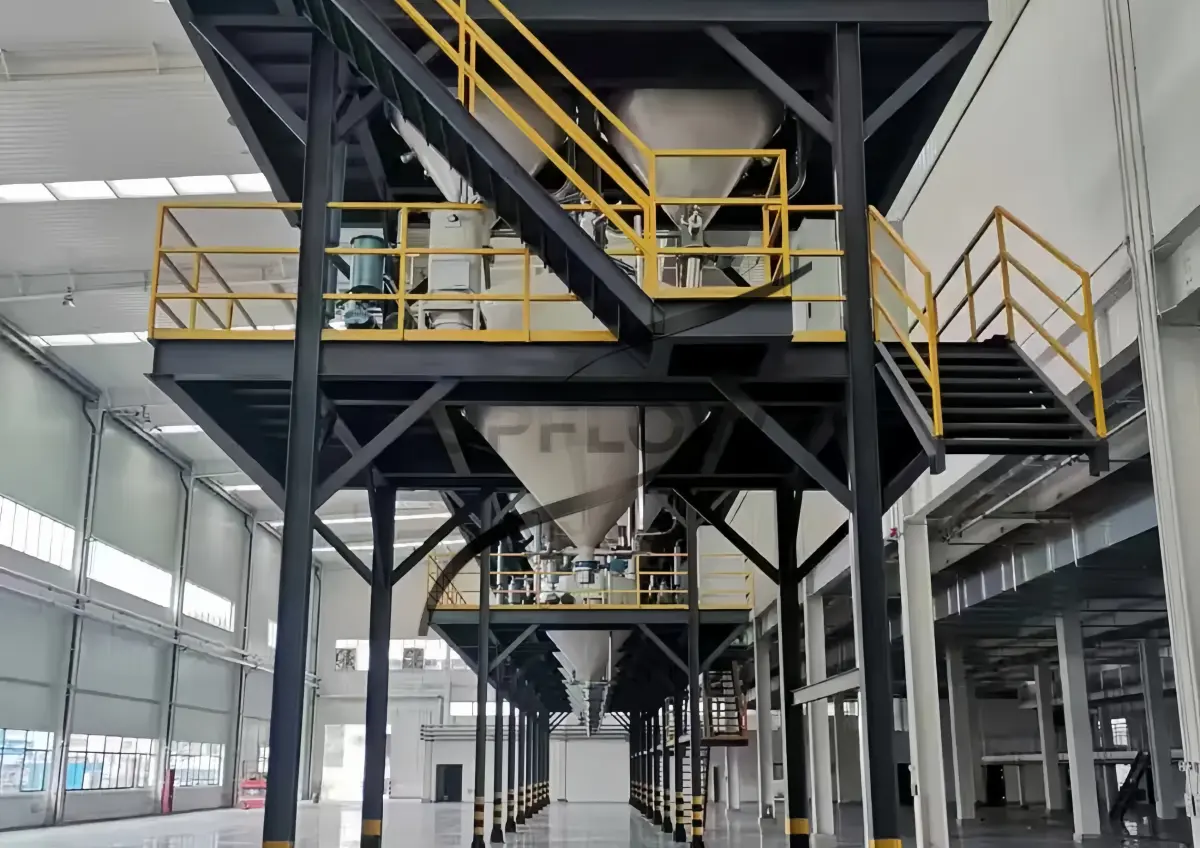
Introduction: Efficient Powder Handling for Complex Formulations
A pneumatic conveying system for pigments and additive powders plays a vital role in industries such as coatings, plastics, inks, and specialty chemicals, where multiple fine powders must be conveyed accurately, cleanly, and consistently across different production stages. As modern production increasingly depends on automated formulation and precise dosing, manufacturers are adopting enclosed powder transfer systems that ensure dust-free operation while improving process stability and product uniformity.
Unlike single-material conveying, pigment and additive handling typically involves multi-component systems, where different powders are transported, stored, and mixed, requiring a highly flexible mixing conveying system capable of handling diverse material properties within one integrated solution.
Typical Pigments and Additive Powders and Their Characteristics
A pneumatic conveying system for pigments and additive powders must be designed to handle a wide variety of materials, each with distinct physical and chemical properties that affect conveying performance and system design. Common pigments include titanium dioxide (TiO₂), iron oxide pigments, carbon black, organic pigments, and ultramarine powders, all of which are fine, lightweight, and prone to dust generation.
In addition to pigments, industrial processes use various additive powders such as calcium carbonate, talc, barium sulfate, silica, stabilizers, flame retardants, and processing aids, many of which exhibit challenges such as poor flowability, high abrasiveness, or moisture sensitivity. For example, carbon black has extremely low bulk density and high dusting tendency, while calcium carbonate is abrasive and requires wear-resistant design in a particle conveying system to ensure long equipment life.
System Design for Multi-Material and Long-Distance Conveying
A well-designed pneumatic conveying system for pigments and additive powders must support not only efficient transport but also flexible routing across complex plant layouts, especially in large-scale production facilities where materials need to be delivered to multiple processing points. In such cases, a long-distance conveying system is often implemented to move powders from centralized storage areas to different production units, reducing handling steps and improving plant efficiency.
Depending on material characteristics and process requirements, both dilute phase and dense phase conveying modes can be applied, where dilute phase is suitable for light, free-flowing powders, while dense phase conveying provides low-velocity transport for abrasive or fragile materials, minimizing wear and preserving material integrity. This flexibility allows the system to adapt to a wide range of pigment and additive applications.
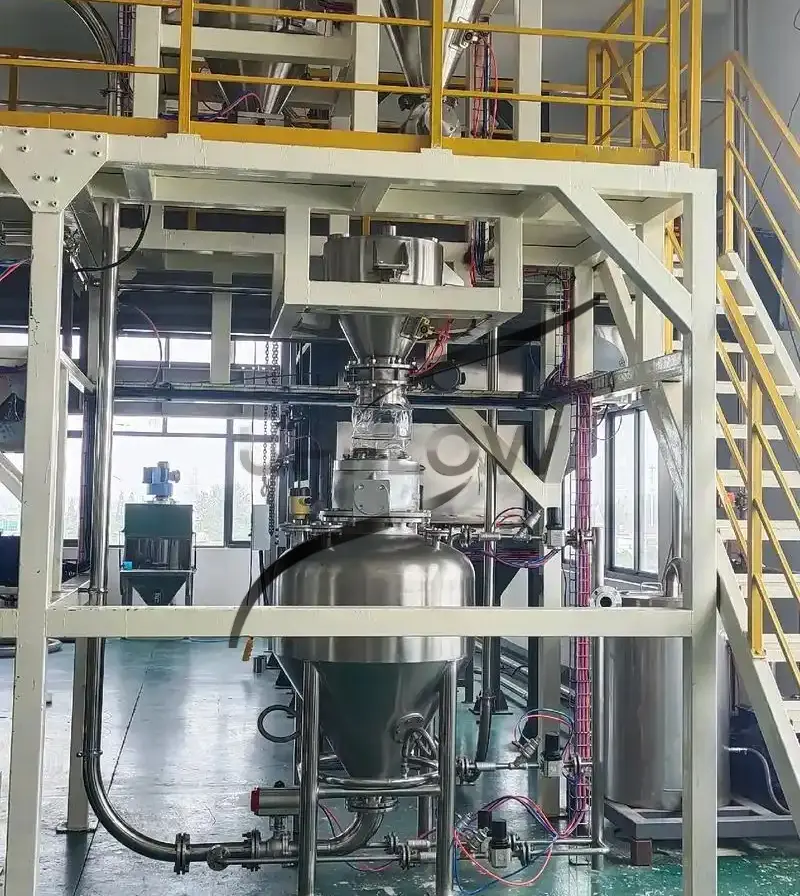
Feeding, Storage and Mixing Integration
In modern production lines, the pneumatic conveying system for pigments and additive powders is closely integrated with feeding, storage, and mixing processes to form a complete material handling solution, where raw materials are introduced through sealed feeding stations and then transferred to silos or hoppers for temporary storage. This integrated approach ensures continuous and stable material supply while minimizing dust emissions and manual intervention.
The system can also be combined with precise batching and dosing equipment, enabling accurate proportioning of multiple components before mixing, which is essential for maintaining product quality in applications such as coatings and plastics. A well-designed mixing conveying system ensures that materials are delivered in the correct sequence and quantity, supporting consistent formulation and production efficiency.
Operational Stability and Anti-Blocking Design
One of the key challenges in a pneumatic conveying system for pigments and additive powders is maintaining stable operation when handling powders with poor flowability or strong cohesion, as these materials can easily cause blockages or inconsistent feeding. To address this, systems are designed with optimized pipeline layouts, controlled airflow, and advanced feeding mechanisms that ensure smooth and continuous material transport.
In addition, monitoring systems are used to track pressure and flow conditions in real time, allowing operators to detect and resolve potential issues before they affect production, while specialized components such as flow aids and variable-speed feeders further enhance system reliability and performance.
Advantages of Pneumatic Conveying for Pigment and Additive Handling
A modern pneumatic conveying system for pigments and additive powders offers several advantages over traditional conveying methods, including fully enclosed and dust-free operation, reduced labor requirements, and improved production efficiency. The system also supports flexible plant layouts, enabling materials to be transported over long distances and distributed to multiple points within the production line.
By integrating conveying, storage, and mixing processes into a unified system, manufacturers can achieve better process control, reduce material waste, and improve product consistency, which is particularly important in industries that require precise formulation and high-quality standards.
Conclusion: A Reliable Solution for Modern Powder Processing
A well-engineered pneumatic conveying system for pigments and additive powders provides an efficient, flexible, and dust-free solution for handling complex powder materials in modern industrial production, enabling manufacturers to overcome challenges related to dust, flowability, and multi-material processing. By adopting advanced conveying technologies and integrated system design, companies can improve efficiency, enhance product quality, and achieve more stable and scalable production processes.