
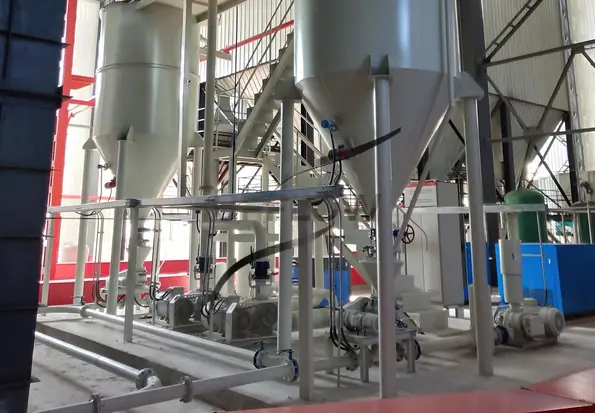
Positive pressure pneumatic conveying systems are widely used in industries that need efficient, high-capacity material transport over long distances. By using compressed air to push materials through pipelines, these systems offer reliable and continuous operation for powders, granules, and bulk solids.
In this article, we will explore how positive pressure pneumatic conveying systems work, their advantages, limitations, and typical applications for long-distance transport.
What is a Positive Pressure Pneumatic Conveying System?
A positive pressure system by generating compressed air that pushes materials from the feeding point to the receiving point. Unlike vacuum systems, which rely on suction, positive pressure systems are ideal for transporting large volumes of dense materials over long distances.
Key components:
Air compressor or blower
Feeding device (e.g., rotary valve, screw feeder)
Conveying pipeline
Receiving hopper or silo
Learn more about our Pneumatic Conveying System Solutions for industrial material handling.
Advantages of Positive Pressure Systems for Long-Distance Transport
High Capacity and Efficiency
Positive pressure systems can move large volumes of powders, granules, and bulk materials continuously, making them suitable for long-distance material transport.
Versatility
These systems handle a wide range of materials, including abrasive, dense, or irregularly shaped particles.
Reduced Risk of Blockage
Compressed air ensures smooth material flow, reducing the risk of pipeline clogging during long-distance transport.
Customizable Layout
Pipelines can be configured vertically, horizontally, or with multiple branches, allowing flexibility for complex production lines.
Limitations of Positive Pressure Systems
Energy Consumption
High-capacity systems may require more energy compared to vacuum systems, especially for lighter materials.
Potential Dust Leakage
Proper sealing and filtration are necessary to avoid dust emissions during operation.
Maintenance
Regular inspection of compressors, valves, and pipelines is required to maintain efficiency.
Typical Applications
Positive pressure pneumatic conveying systems are widely applied across industries such as:
Cement and Construction Materials – Transport cement, sand, and powders over long distances.
Food Industry – Move sugar, flour, and grains efficiently.
Chemical Industry – Convey plastic pellets, resins, or fine powders.
Pharmaceuticals – For high-capacity transport of bulk powders with proper dust control.
For comparison, see our article on Negative Pressure Pneumatic Conveying Systems to understand which system fits your application best.
Choosing the Right System
When designing a long-distance transport solution, consider:
Material properties: density, particle size, abrasiveness
Required transport distance and elevation
Dust control and hygienic requirements
Energy consumption and maintenance preferences
You can also explore our Industrial Pneumatic Conveying Solutions for a complete range of conveying systems tailored to different industries.
Conclusion
A positive pressure pneumatic conveying system is the ideal choice for transporting large volumes of material over long distances. Its efficiency, versatility, and high-capacity operation make it suitable for a wide range of industrial applications. By understanding its advantages, limitations, and applications, you can select the right system to optimize your production line.