
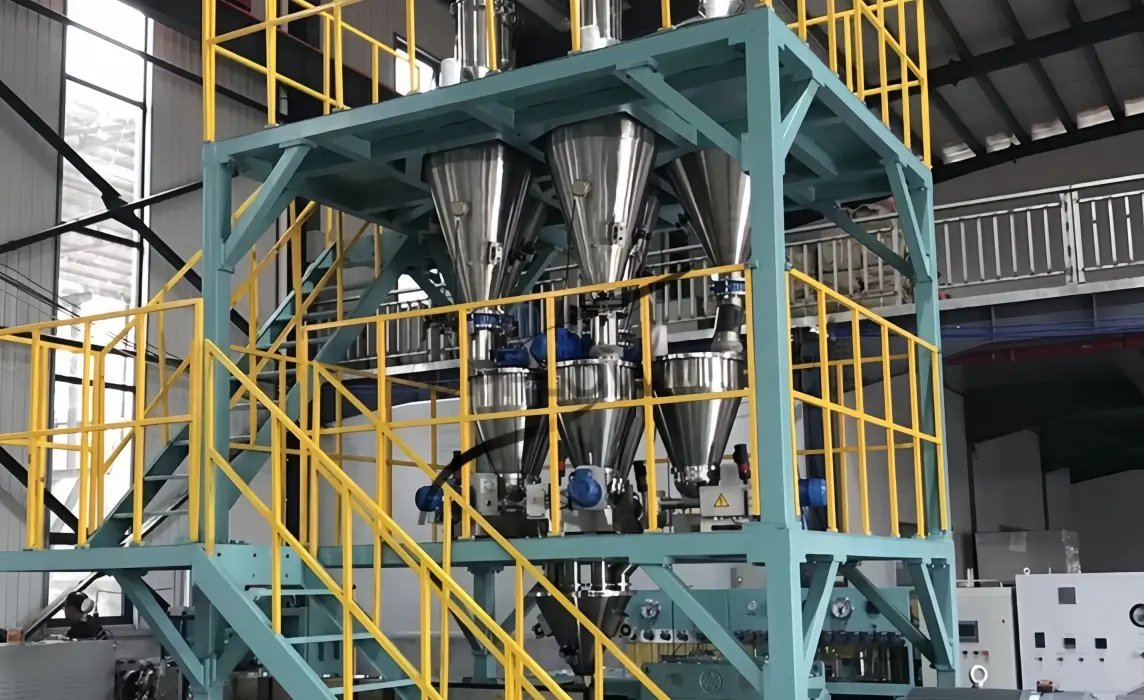
Many industrial manufacturers still receive raw materials in 25 kg bags, but their production processes require accurate weighing, controlled feeding and automatic batching of multiple powder ingredients. Connecting manual bag emptying with an automated powder handling system can help reduce manual material transfer, improve production consistency and create a more organized feeding process.
A complete powder handling line may include a manual bag dump station, dust collection equipment, vacuum or positive-pressure conveying, intermediate storage hoppers, weighing equipment, dosing feeders and a PLC-controlled batching system.
For chemical, food, pharmaceutical, plastic and battery material manufacturers, the system should be designed according to material characteristics, production capacity, batching accuracy and the layout of the existing production line.
This article explains how to design a powder handling system from 25 kg bag unloading to automatic weighing and batching.
1. Understand the Complete Powder Handling Process
A typical production line handling 25 kg bags can be divided into several connected stages:
Manual bag opening and powder unloading.
Dust collection during bag emptying.
Screening or lump removal when required.
Powder conveying to intermediate storage hoppers.
Weighing and dosing of individual ingredients.
Automatic batching according to the production recipe.
Discharge into a mixer, reactor or downstream processing equipment.
The exact arrangement depends on whether the customer uses one powder ingredient or multiple materials, and whether the system operates in batch or continuous production mode.
For example, a chemical manufacturer may require five different raw materials to be weighed according to a specified recipe before entering a mixer, while a food processing plant may need several powder ingredients supplied to a centralized batching station.
The system design should therefore begin with the complete process flow rather than selecting individual machines separately.
2. Select the Right 25 kg Bag Dumping Station
The manual bag dump station is the starting point of the powder handling line.
Operators open the 25 kg bags and discharge the materials into a receiving hopper, while an integrated dust collection system captures airborne powder generated during bag emptying.
Important selection factors include:
Bag dimensions and packaging materials.
Powder flowability and tendency to generate dust.
Required unloading capacity.
Hopper volume and outlet configuration.
Dust collector airflow and filter selection.
Whether screening or lump breaking is required.
For fine powders, a suitable dust extraction arrangement is particularly important because bag opening and manual pouring can generate significant airborne dust.
If the raw materials contain agglomerates or foreign particles, a vibrating sifter or screening unit may be integrated between the bag dump station and the downstream conveying equipment.
Explore UPFLOW’s Manual Bag Dump Station for industrial powder feeding applications.
3. Choose a Suitable Powder Conveying Method
After unloading, the powder needs to be transferred from the bag dumping area to storage hoppers or batching equipment.
Depending on conveying distance, material properties and production capacity, the system may use vacuum conveying or positive-pressure pneumatic conveying.
Vacuum conveying is commonly considered when powder needs to be transferred from several feeding points to a receiving hopper, particularly when enclosed material handling and flexible pickup arrangements are required.
Positive-pressure conveying may be suitable for transferring materials from a centralized feeding or storage point to more distant receiving locations, depending on the pipeline arrangement and conveying requirements.
The selection should consider:
Bulk density and particle size distribution.
Material moisture and flowability.
Horizontal conveying distance and vertical lifting height.
Required conveying capacity.
Number of pickup and discharge points.
Material degradation and contamination requirements.
For multiple powder ingredients, the conveying arrangement should also prevent unintended material mixing and allow suitable cleaning or material changeover procedures.
Explore UPFLOW’s Pneumatic Conveying System and Vacuum Feeding System for different powder transfer configurations.
4. Design Storage Hoppers and Automatic Weighing Equipment
After conveying, each powder ingredient may be stored in an individual hopper or supplied through a shared receiving arrangement, depending on the batching process.
For multi-ingredient production lines, individual storage and weighing arrangements can help control the quantity of each raw material before it enters the mixer or reactor.
A typical automatic batching system may include:
Storage hoppers for different ingredients.
Load cells and weighing hoppers.
Screw feeders or rotary valves.
Pneumatic conveying connections.
Discharge valves.
PLC and HMI control systems.
The weighing method should be selected according to the required batching accuracy, material flowability and production cycle.
For example, screw feeders may provide controlled material feeding for certain fine powders, while rotary valves may be considered for suitable free-flowing materials and conveying arrangements.
The actual feeder configuration must be evaluated against the material characteristics and required dosing range.
5. Coordinate Multi-Ingredient Batching and Recipe Control
When several raw materials are required for one production batch, the PLC system coordinates material selection, weighing, dosing and discharge according to the specified recipe.
A typical sequence may include:
The operator selects the production recipe through the HMI.
The system checks the availability of each required ingredient.
The corresponding feeder starts supplying material to the weighing hopper.
Load cells continuously monitor the accumulated material weight.
The feeder slows down or stops when the target weight is reached.
The system verifies the completed ingredient quantity.
The required materials are discharged into the mixer or designated receiving equipment.
The system records the batch information and prepares for the next cycle.
For higher weighing accuracy, coarse and fine feeding stages may be used where appropriate, with the control system accounting for material falling after the feeder stops.
The batching sequence should also include interlocks for hopper capacity, feeder status, material availability and downstream equipment readiness.
For more information, read our guide to Automatic Powder Batching System for 5–10 Ingredients.
6. Key Parameters Required Before System Design
Before preparing a technical proposal, engineers should collect the information required to determine the equipment configuration and production capacity.
| Parameter | Information Required |
| Raw materials | Material names and number of ingredients |
| Material properties | Bulk density, particle size, moisture and flowability |
| Packaging | 25 kg bags or other packaging formats |
| Production capacity | Required kg/h or tonnes/h |
| Batching quantity | Target weight of each ingredient |
| Batching accuracy | Required weighing tolerance |
| Production cycle | Batches per hour and batch duration |
| Material pickup | Bag dump stations or existing storage hoppers |
| Discharge destination | Mixer, reactor, silo or other equipment |
| Factory layout | Horizontal distance, lifting height and available space |
A process flow diagram and factory layout drawing can also help engineers identify equipment positions, pipeline routes and interface requirements.
The more accurately these parameters are defined, the easier it is to develop a suitable integrated powder handling and automatic batching solution.
7. UPFLOW Powder Handling and Batching Project References
UPFLOW provides customized powder feeding, pneumatic conveying and automatic batching systems for industrial applications.
Kenya Magnesium Silicate Conveying and Batching Project
UPFLOW supplied a customized magnesium silicate pneumatic conveying and batching system for an industrial customer in Kenya.
The system integrated manual bag dumping, pneumatic conveying, weighing hoppers, screw feeding equipment, filtration and centralized control, providing an engineering reference for connecting manual powder unloading with automated batching operations.
Read more about the Kenya Magnesium Silicate Conveying and Batching Project.
Artificial Graphite Airflow Mixing Project
UPFLOW supplied 12 airflow mixing machines to a battery material manufacturer through four separate contracts.
Each machine has a design volume of 60 m³ and a maximum loading weight of 30 tonnes per batch. The project integrated material feeding, weighing equipment, mixing equipment and centralized PLC/HMI control.
This project demonstrates the importance of coordinating material feeding, weighing and downstream mixing equipment in large-scale battery material production.
Read more about the Artificial Graphite Airflow Mixing Project.
8. Frequently Asked Questions
Q1. Can a powder handling system start with 25 kg bags and finish with automatic batching?
Yes. A complete system can connect manual bag unloading, dust collection, powder conveying, storage hoppers, weighing equipment and PLC-controlled batching.
Q2. Can one bag dump station supply multiple storage hoppers?
Yes, depending on the material transfer arrangement, conveying capacity and valve configuration. The pipeline and control system must be designed for the required distribution routes.
Q3. How many raw materials can an automatic powder batching system handle?
The number depends on the required recipe, available space, storage arrangement and production capacity. Systems can be configured for multiple ingredients with individual weighing and feeding equipment.
Q4. What determines the accuracy of powder batching?
Important factors include load cell selection, feeder design, material flowability, weighing hopper structure, control response and the consistency of the feeding process.
Q5. Is a dust collector necessary for 25 kg bag unloading?
For dusty powder applications, local dust extraction is generally an important part of the bag dumping station design. The required airflow and filter arrangement should be determined according to the material and unloading conditions.
Conclusion
Designing a powder handling line from 25 kg bags to automatic batching requires coordinated selection of bag unloading equipment, dust collection, conveying systems, storage hoppers, weighing feeders and PLC control.
By evaluating material properties, production capacity, batching accuracy and factory layout together, manufacturers can develop an integrated system that connects manual raw material handling with automated production processes.
UPFLOW provides customized powder handling, pneumatic conveying and automatic batching solutions for chemical, food, pharmaceutical, plastic, battery material and other industrial applications.
Planning a powder handling line from 25 kg bags to automatic batching? Contact UPFLOW with your material specifications, number of ingredients, required batching capacity and factory layout to discuss a suitable system configuration.