
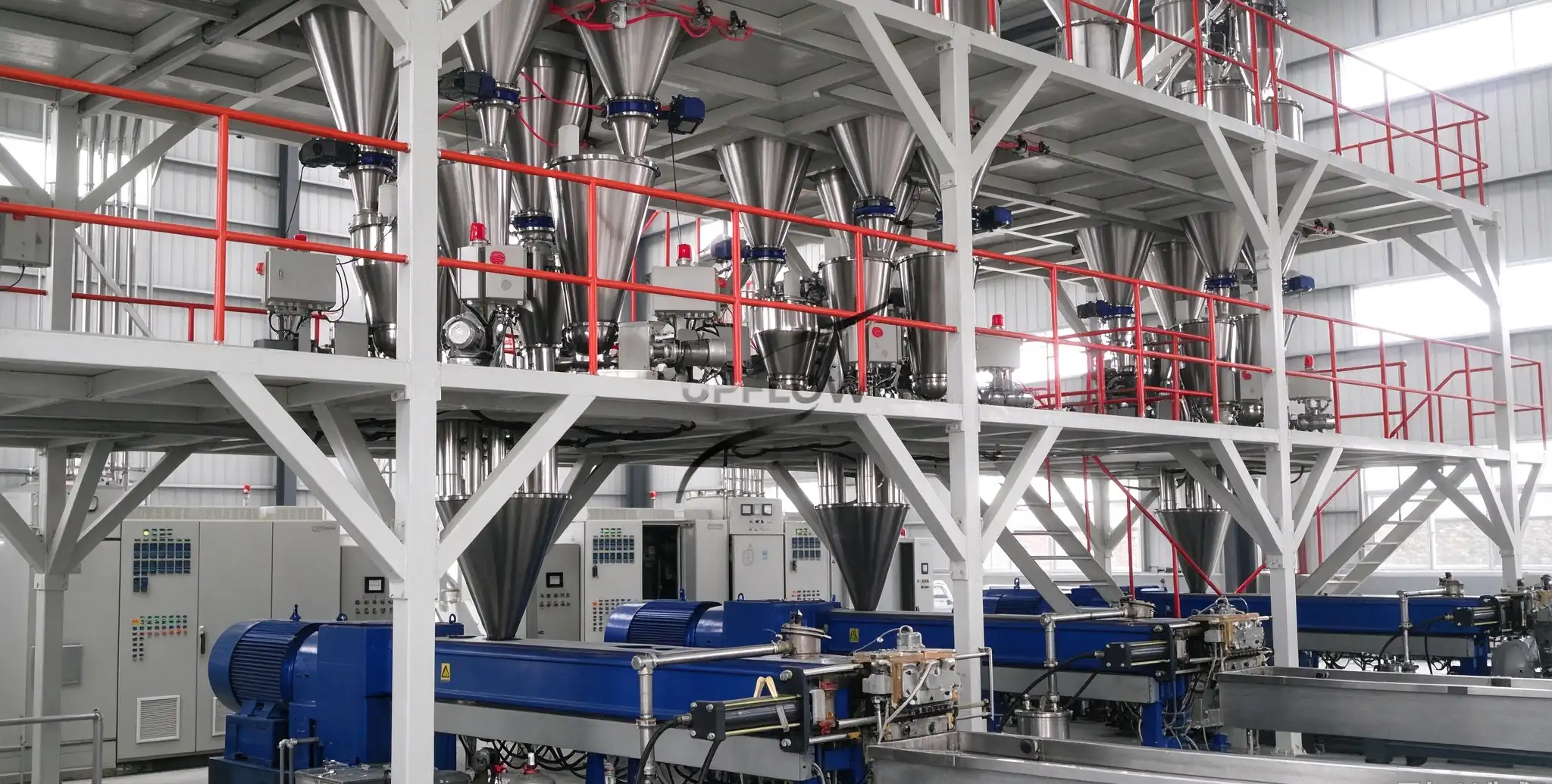
Many industrial production processes require several powder materials to be weighed and dosed according to a predefined recipe. When a production line handles 5–10 different ingredients, manual weighing can become time-consuming and difficult to manage consistently.
An automatic powder batching system integrates storage, feeding, weighing and recipe control to deliver multiple ingredients into a common mixing or processing line.
For food, chemical, pharmaceutical and battery material manufacturers, the system should be designed around the number of ingredients, individual dosing quantities, material characteristics and required batch cycle time.
This article explains the main design considerations for an automatic batching system handling 5–10 powder ingredients.
1. How Does a 5–10 Ingredient Powder Batching System Work?
A typical multi-ingredient batching system consists of several material storage units, individual feeding devices, weighing equipment, a control system and a common discharge or mixing unit.
A typical process includes:
Different powder materials are stored in dedicated hoppers or silos.
Each ingredient is discharged through a controlled feeder.
The weighing system measures the required material quantity.
The PLC follows the selected production recipe.
Individual ingredients are discharged into a common collection hopper or mixer.
The completed batch is transferred to the next production process.
The system can be configured for 5, 6, 8 or 10 ingredients, depending on the production requirements and available installation space.
The number of ingredients alone does not determine the equipment configuration. Individual batch weights, feeding rates and material flow characteristics must also be considered.
2. Select the Right Feeding Equipment for Each Ingredient
Different powders may require different feeding arrangements.
For example:
Free-flowing powders: Screw feeders or suitable rotary discharge devices may be considered.
Fine powders: Controlled screw feeding and appropriate hopper geometry can help maintain stable discharge.
Cohesive powders: Agitation or other flow assistance may be necessary.
Abrasive powders: Material contact surfaces and wear-resistant components should be evaluated.
Moisture-sensitive powders: Enclosed material transfer and suitable environmental protection may be required.
Using identical feeders for all ingredients is not always the best solution.
A customized multi-material dosing system can use different feeder sizes and configurations according to the required quantity and material behavior of each ingredient.
3. Choose the Appropriate Weighing Configuration
There are two common approaches to multi-ingredient powder batching.
Sequential weighing
Ingredients are fed into a weighing hopper one after another. This arrangement can reduce the number of weighing units, but the total batch cycle depends on the individual feeding stages.
Parallel weighing
Multiple ingredients are weighed simultaneously using separate weighing units. This can reduce batch preparation time, although it may require more equipment, installation space and investment.
For a 5–10 ingredient system, the appropriate arrangement depends on the required production capacity, batch size, dosing tolerance and equipment budget.
Some production lines may also use a hybrid configuration, combining parallel weighing for major ingredients with sequential dosing for smaller quantities.
For a detailed comparison, read Multi-Ingredient Powder Batching: Sequential vs Parallel Weighing.
4. Configure the PLC Recipe Management System
When multiple ingredients are involved, recipe management becomes an important part of the automatic batching system.
A PLC-based control system can store different recipes, including:
Ingredient identification.
Target weight for each ingredient.
Feeding sequence.
Feeder operating parameters.
Batch identification.
Weighing and dosing records.
Operators can select an approved recipe through the HMI touch screen, allowing the system to execute the corresponding feeding and weighing sequence.
Depending on the project requirements, communication interfaces such as RS485 or Ethernet can be considered for integration with a factory control system or higher-level production management platform.
The actual communication protocol and data exchange scope should be confirmed during engineering design.
5. How to Maintain Dosing Accuracy Across 5–10 Ingredients
Each ingredient may have a different target weight and dosing tolerance.
A major ingredient requiring hundreds of kilograms per batch may use a different feeder capacity from a minor ingredient requiring only a few kilograms.
Important design considerations include:
Suitable load cell capacity.
Stable weighing hopper support.
Appropriate feeder operating range.
Coarse and fine feeding control.
Material-in-flight compensation.
Vibration isolation.
Calibration and repeated batch verification.
For small-quantity ingredients, the weighing range and feeder resolution deserve particular attention.
For more information, see Powder Batching Accuracy: How to Define and Verify ±0.2% Tolerance.
6. Integrate Powder Conveying, Batching and Mixing
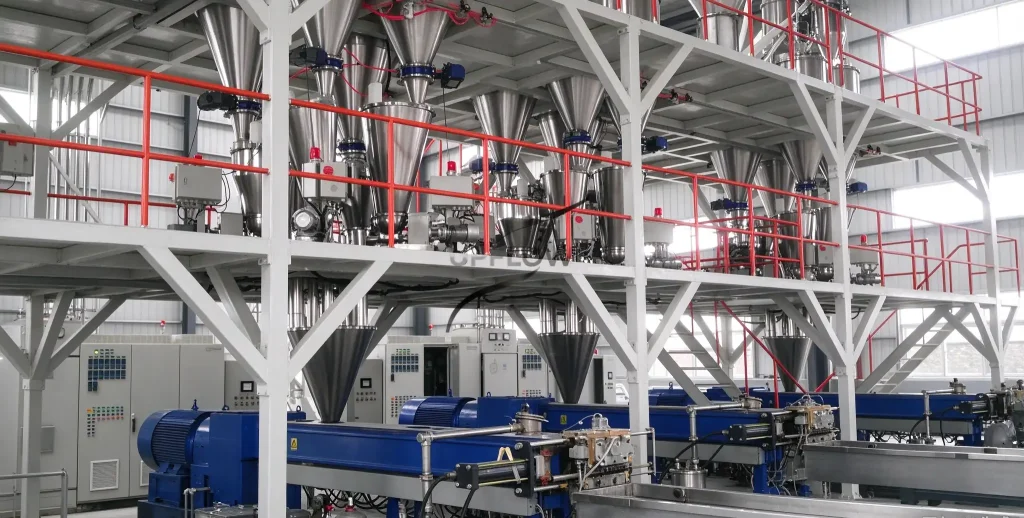
A complete powder batching plant often requires more than weighing equipment.
Depending on the production layout, the system may integrate:
Bulk bag unloading stations.
Manual bag dump stations.
Storage hoppers and silos.
Pneumatic conveying equipment.
Screw feeders.
Weighing hoppers.
Mixing machines.
Dust collection systems.
For example, raw materials can be transferred from storage areas to individual dosing hoppers through enclosed pneumatic conveying lines.
After weighing, the ingredients can be discharged into a mixer or downstream processing equipment.
UPFLOW provides customized Automatic Batching Systems for multi-ingredient weighing and dosing applications.
A Pneumatic Conveying System can be integrated for enclosed powder transfer, while a Big Bag Unloading System can support bulk material receiving and feeding.
7. UPFLOW Project References
Artificial Graphite Airflow Mixing Project
UPFLOW has supplied 12 airflow mixing machines to a battery material manufacturer through four separate contracts.
Each machine has a design volume of 60 m³ and a maximum loading weight of 30 tonnes per batch. The project includes material feeding, weighing equipment, PLC control and coordinated discharge.
This project demonstrates UPFLOW’s experience in integrating large-capacity powder processing equipment and automated material handling.
Read more about the Artificial Graphite Airflow Mixing Project.
Magnesium Silicate Pneumatic Conveying and Batching Project
UPFLOW supplied a customized system integrating manual bag dumping, pneumatic conveying, weighing hoppers, screw feeding equipment and centralized control.
This project provides an engineering reference for combining material feeding, weighing and batching functions.
Read more about the Magnesium Silicate Conveying and Batching Project.
European Anode Material Big Bag Feeding Project
UPFLOW supplied multiple big bag feeding systems for a European anode material manufacturer.
The project involved handling battery-related powder materials and integrating bulk bag unloading equipment into the customer’s material feeding process.
Read more about the European Anode Material Big Bag Feeding Project.
8. Frequently Asked Questions
Q1. Can one automatic batching system handle 5–10 different powders?
Yes. A customized system can use dedicated storage and feeding units for each ingredient, with centralized weighing and recipe control.
Q2. Is sequential or parallel weighing better for 10 ingredients?
It depends on batch cycle time, required capacity, dosing accuracy, installation space and investment. A hybrid arrangement may also be suitable.
Q3. Can different screw feeders be used in the same batching system?
Yes. Feeder diameter, capacity and configuration can be selected individually according to each material and target feeding rate.
Q4. Can the batching system store multiple production recipes?
Yes. A PLC and HMI can manage multiple approved recipes, ingredient quantities and feeding sequences according to the control system configuration.
Q5. What information is needed for a batching system quotation?
Provide the ingredient list, bulk density, particle size, required batch weight, dosing tolerance, production capacity, cycle time and downstream equipment information.
Conclusion
An automatic powder batching system for 5–10 ingredients should be designed around individual material properties, dosing quantities, weighing requirements and production cycle time.
By combining suitable feeding equipment, weighing units, PLC recipe management and material conveying, manufacturers can establish a coordinated multi-ingredient powder processing line.
UPFLOW provides customized automatic batching, powder feeding and pneumatic conveying solutions for industrial production applications.
Planning a multi-ingredient batching project? Contact UPFLOW with your ingredient list, batch capacity, dosing requirements and production layout to discuss a suitable system configuration.