
Introduction
A sodium chloride pneumatic conveying system is a technology that uses airflow to transport solid particles such as sodium chloride to a designated location. Through pipelines, compressed air or nitrogen is used as the driving force to create a gas-solid two-phase flow inside the pipeline, enabling continuous material transfer. This method features enclosed conveying, effectively preventing dust emission, while offering high conveying capacity, low energy consumption, and stable operation, making it widely used in chemical, pharmaceutical, and food industries.
Material Characteristics of Sodium Chloride
Sodium chloride (NaCl), commonly known as salt, is widely used in food processing, chemical production, water treatment, and de-icing applications. It is typically handled in granular or powder form, with a bulk density of approximately 1.2–1.5 t/m³ depending on particle size and moisture content.
Although sodium chloride generally has good flowability, it can absorb moisture under certain environmental conditions, which may lead to caking or reduced conveying performance. Therefore, using a properly designed low pressure conveying system or enclosed pneumatic conveying solution is essential to ensure stable material flow.
Product Overview
Sodium chloride pneumatic conveying is a process that uses airflow to transport solid particles through pipelines. Driven by airflow, sodium chloride particles move along the pipeline, offering advantages such as high efficiency, low energy consumption, simple structure, and easy operation.
The system mainly consists of feeding equipment, conveying pipelines, blowers, and dust collectors. By adjusting airflow rate and pipeline configuration, continuous and stable conveying can be achieved. During operation, sodium chloride particles are fully mixed with the airflow, reducing friction resistance and improving conveying efficiency. Meanwhile, the dust collection system effectively captures airborne particles, ensuring a clean working environment.
Working Principle
The working principle of a sodium chloride pneumatic conveying system is based on mixing particles with conveying gas and using the kinetic energy generated by airflow to transport the mixture to a designated location.
During the conveying process, controlling airflow velocity and pressure is critical to maintaining uniform particle distribution, reducing wear, and minimizing dust generation. This ensures efficient and safe operation of the system, especially in high-capacity applications such as high capacity pneumatic conveying.
Types of Pneumatic Conveying Systems
Pneumatic conveying systems can be classified into several types depending on operating conditions. Positive pressure conveying uses higher internal pressure to push material through the pipeline, while negative pressure conveying draws material into the system using suction.
In addition, pulse conveying systems use periodic airflow pulses to move materials forward. For most sodium chloride applications, a dilute phase conveying system is commonly used, where particles are suspended in a high-velocity airflow, making it suitable for long-distance and large-volume conveying.
A fully automatic conveying system can also be implemented to achieve automated control and continuous operation, improving overall efficiency.
System Structure
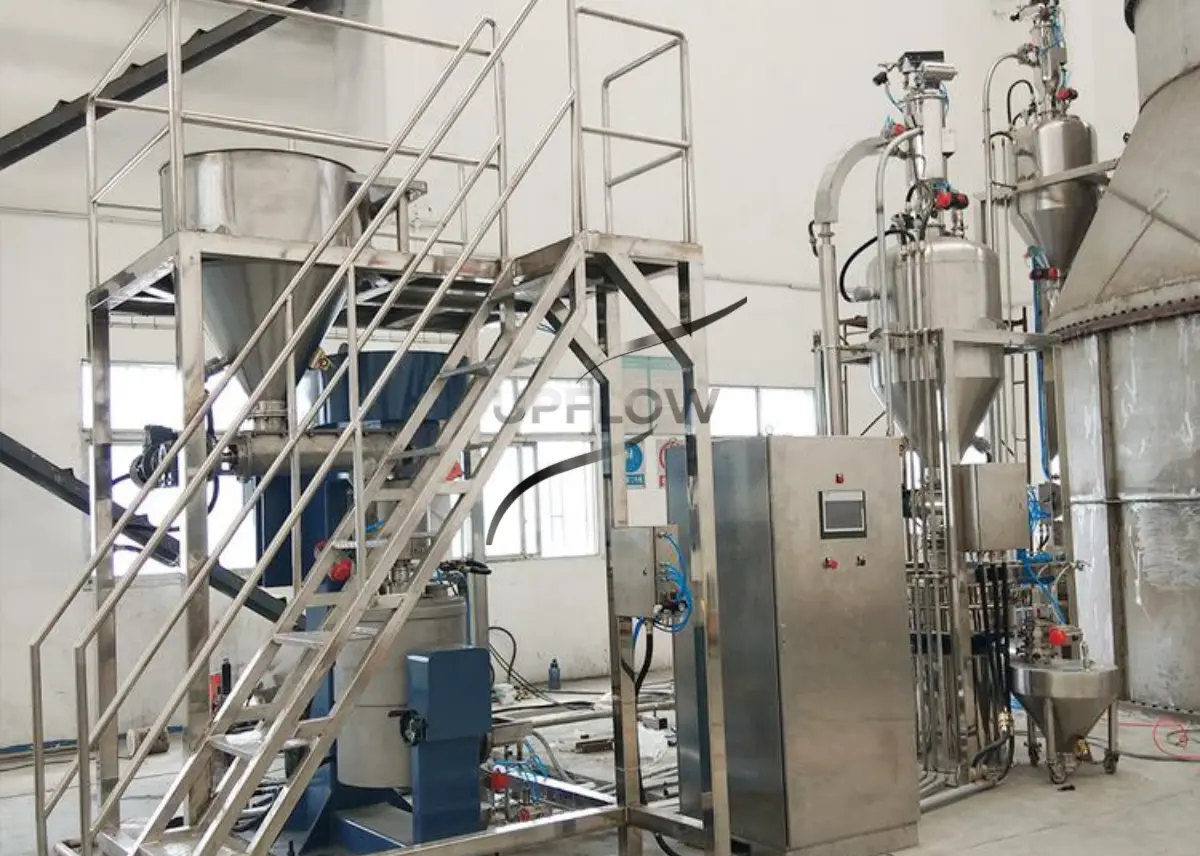
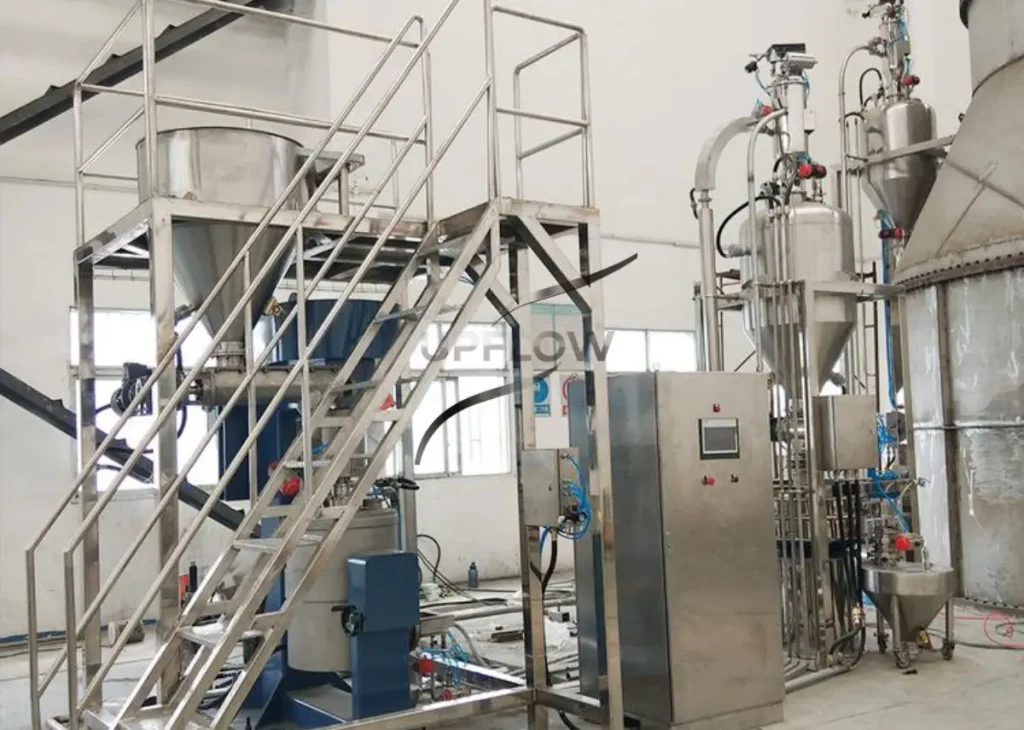
The structure of a sodium chloride pneumatic conveying system includes conveying pipelines, dust collectors, pneumatic conveying equipment, blowers, storage tanks, and control cabinets.
The conveying pipelines are made of corrosion-resistant materials to ensure durability. Dust collectors are used to capture particles and maintain environmental cleanliness. Blowers provide the necessary airflow power, while storage tanks hold sodium chloride before conveying. The control cabinet manages the entire process, ensuring stable and efficient system operation.
Advantages and Features
Sodium chloride pneumatic conveying offers several advantages, including high conveying efficiency, low energy consumption, long conveying distance, simple operation, and reliable safety performance.
The system helps reduce production costs and improve operational efficiency. Compared with traditional conveying methods, it minimizes environmental pollution and ensures consistent material handling performance.
UPFLOW’s sodium chloride pneumatic conveying system demonstrates high efficiency, safety, and environmental performance. By adopting advanced pneumatic conveying technology, the system enables continuous and stable transport of sodium chloride while reducing energy consumption and equipment wear.
Its excellent sealing performance effectively prevents dust leakage and meets environmental standards. In addition, the system is easy to operate and maintain, providing users with a convenient and reliable solution.
Conclusion
Sodium chloride pneumatic conveying is an efficient, energy-saving, and environmentally friendly conveying method that uses airflow to transport particles from one location to another.
With advantages such as fast conveying speed, long-distance capability, high capacity, and reliable operation, it has become an ideal solution for modern industries. UPFLOW is committed to providing high-quality pneumatic conveying solutions to simplify powder handling and improve production efficiency.